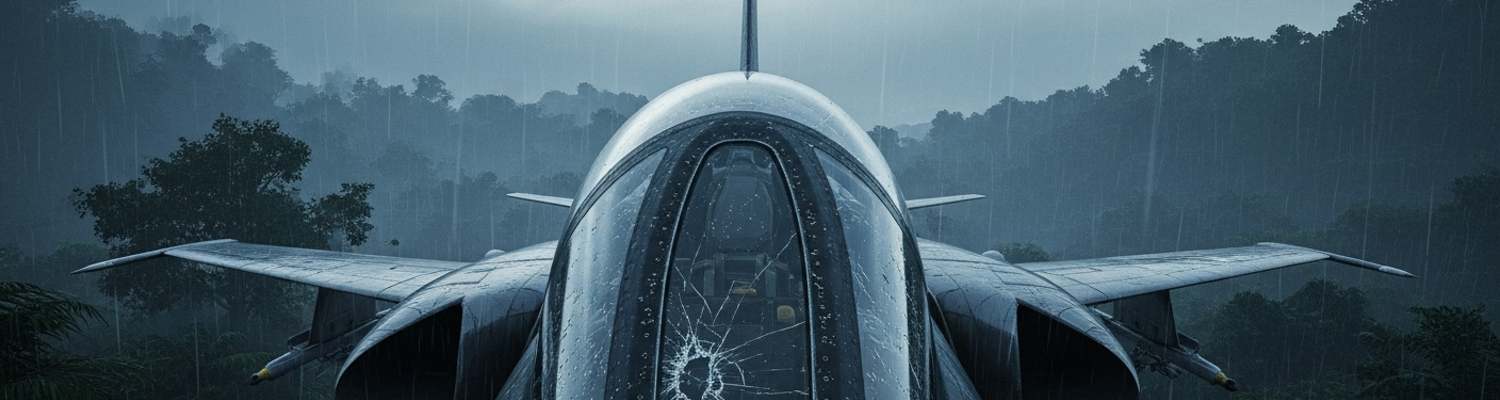

An examination of archival records from Cold War-era planning documents (NARA Record Group 341) reveals a deep, structural conflict between the core doctrines of tactical air power and joint medical support. The United States Air Force’s Wild Weasel squadrons, tasked with Suppression of Enemy Air Defenses (SEAD), operated on a fundamentally predatory logic. Their mission was to bait, hunt, and destroy surface-to-air missile sites. This required patience, aggression, and the use of downed assets as potential traps. For a Wild Weasel F-4G crew, an injured pilot on the ground was not a person to be rescued. He was a piece of bait to draw out enemy radar and launchers. Air Force Combat Search and Rescue (CSAR) doctrine was built around this reality. It prioritized the sanitization of the threat environment before committing a rescue asset like an HH-53 Super Jolly Green Giant. This often meant deliberately waiting, sometimes for hours, for the enemy to expose their positions.
Conversely, U.S. Army MEDEVAC doctrine, centered on helicopter units flying the UH-1 or the later UH-60, was dictated by the critical window to move a trauma patient to a surgical facility. This doctrine prioritized speed above all else. The clash was not one of preference, but of fundamental purpose. An Air Force Rescue Coordination Center viewed a downed pilot as the first step in a complex kill-chain. An Army MEDEVAC operations desk saw the same pilot as a name on a countdown timer.
This doctrinal void was disastrously amplified by the institutional impotence of the Surgeon General's office to enforce standardized medical protocols across service branches in high-threat environments. While the Surgeon General could issue directives, it lacked the direct command authority to compel a Tactical Air Command (TAC) wing commander or an Army Corps-level commander to adopt them. Each service branch developed its own distinct approach to battlefield medicine, optimized for its primary mission set. Air Force Pararescuemen were trained as elite combat rescue specialists first and medical providers second. Their protocols focused on rapid, stabilizing interventions for a potentially violent, high-G extraction. Army flight medics, however, were trained with an emphasis on prolonged field care, anticipating a relatively smoother helicopter flight directly to a Mobile Army Surgical Hospital. A review of after-action reports from joint training exercises (File Ref: J-T-EX-82-4) frequently notes instances where these conflicting medical philosophies caused friction. A PJ team might apply a specific type of tourniquet intended for extreme altitude changes, only to have an arriving Army medical crew, following their own incompatible protocols, attempt to remove it.
This lack of a unified medical authority created scenarios where highly trained medics from different services could, with the best intentions, work at cross-purposes on the same critically injured casualty.
The systemic communication void that resulted was not an accident, but a direct byproduct of the doctrinal schism. The services did not talk to each other effectively because they had fundamentally different objectives. An Air Force CSAR package operated on dedicated, encrypted UHF and VHF frequencies, managed by an Airborne Command and Control Center. These nets were designed for coordinating fighter escorts, SEAD aircraft, and rescue helicopters. An Army MEDEVAC helicopter typically operated on the Army’s own SINCGARS frequency-hopping radio network, coordinating with ground units and its own medical operations cell. The systems were not designed to be interoperable. A close review of operational logs from a 1980s REFORGER exercise highlights this failure point. An F-111 pilot ejected over contested terrain, initiating his rescue beacon. The signal was acquired by the orbiting CSAR command aircraft, which began directing F-4G Wild Weasels to hunt for the SA-6 battery that downed him. A nearby Army aviation brigade, monitoring a different set of frequencies, was alerted by ground troops and dispatched a UH-60 MEDEVAC helicopter. The MEDEVAC crew was unable to communicate with the F-4Gs overhead. The F-4Gs could not see the Army helicopter on their tactical displays. The rescue attempt descended into chaos, with the Army helicopter entering a threat envelope that the Air Force pilots were actively trying to bait. The failure was traced to the simplest of causes. The crypto keys loaded into the Air Force radios could not decrypt the transmissions from the Army radios. No common emergency frequency had been designated in the joint operational plan.
The problem was magnified by the technical chasm between service communication systems. Air Force and Navy aircraft operated on different frequency-hopping radio systems, most notably the Air Force’s HAVE QUICK UHF system and the Navy’s own set of secure voice nets. A pilot from one service often could not directly communicate with a rescue or command element from another. Transmissions were frequently garbled not by enemy jamming, but by the simple fact that the cryptographic keys and frequency-hopping algorithms were different. The services had effectively built digital walls between each other. Intelligence reports would flow up separate chains of command. The Air Force CRC feeding the AOC, the Navy TACC feeding the Carrier Strike Group commander. These reports rarely intersected at a tactical level in a timely manner. An Air Force E-3 Sentry AWACS might identify a pop-up SAM threat and broadcast a warning on an Air Force-specific data link. A nearby Navy F-14 Tomcat, on a different system, would never receive that warning. This digital blindness meant that Air Force and Navy command centers were often issuing conflicting orders based on incomplete and contradictory information. The airspace over a downed pilot became a deathtrap of uncoordinated movements. The disastrous Operation Eagle Claw in 1980 stands as a stark example of these systemic failures, where incompatible communications between Air Force and Marine/Navy elements contributed directly to mission failure and loss of life.
This command and control paralysis made timely MEDEVAC an operational fantasy. Before a helicopter could even be dispatched, a near-impossible series of logistical hurdles had to be cleared. First, the competing command centers of the Air Force and Navy had to de-conflict the airspace, a process that could take hours. Then, the CSAR doctrine of sanitizing the battlefield had to be enacted, requiring fighter escorts and SEAD aircraft to hunt for potential threats. This directly contradicted the MEDEVAC imperative for speed. The rescue asset itself, whether an Air Force HH-53 or a Navy SH-3, would be entering an environment where friendly forces from a different service might be actively trying to bait enemy fire. The lack of a unified command structure meant there was no single authority to prioritize the MEDEVAC, weigh the risks, and issue a clear, joint order. The result was a battlefield where American forces were often as much a danger to each other as the enemy. A downed pilot’s chance of survival depended less on the speed of the medics and more on the bureaucratic luck of which service happened to hear the call.
The mission on April 19, 1967, was representative of the high-stakes SEAD operations that F-105 Wild Weasel crews flew daily over North Vietnam. An F-105F element was tasked with supporting a major strike package targeting the heavily defended Xuan Mai army training compound. Their objective was to hunt and kill the SA-2 surface-to-air missile sites that protected the approaches to the target. A review of the operational timeline reveals the violent efficiency of the engagement. The lead element engaged and destroyed two active SAM sites. Then, the flight’s second element, callsign Kingfish 02, was struck by optically aimed anti-aircraft artillery. The catastrophic damage forced the pilot, Major Thomas Madison, and his Electronic Warfare Officer, Captain Thomas Sterling, to eject. Two good parachutes were spotted, descending into the dense jungle terrain below.
The system immediately began to break down.
Their flight leader, Major Leo Thorsness, established a protective orbit over his downed wingmen, relaying their position to the orbiting EC-121 “Crown” airborne command post. This action initiated the Combat Search and Rescue sequence, but the very existence of the threat that shot down Kingfish 02 paralyzed the response. CSAR doctrine was clear. Slow-moving rescue helicopters like the HH-3 Jolly Green Giant would not be committed to a hot landing zone. The area first had to be sanitized of all known threats. This process stood in direct opposition to the urgent need to recover the two men on the ground. While Thorsness engaged and shot down a MiG-17 that was threatening the parachutes, the larger command and control apparatus was already failing. The request for a rescue package was logged, but the CSAR task force commander, operating from a different headquarters with a different set of intelligence, could not get clearance to enter the hostile airspace. The very assets designed to suppress the enemy, the Wild Weasels, were now forced to choose between protecting the downed crew and their own dwindling fuel state.
A chilling silence fell over the frequency. The crew on the ground, equipped with their AN/PRC-63 survival radios, were broadcasting on the 243 MHz UHF guard frequency. This was the designated international distress channel for military aircraft, a frequency monitored by all assets in the theater. A direct voice link could not be established. The weak, 325-milliwatt signal from the hand-held radios struggled to penetrate the jungle canopy and the rugged terrain. For the orbiting command posts and distant rescue forces, the primary sign of life was the steady, automated beacon. The sound was a monotonous, high-pitched chirp mixed with the constant hiss of atmospheric static. It was a signal of presence, but not of condition. Voice transmissions from the ground were swallowed by the distance and the electronic noise floor. The crew’s voices were unheard, their status unknown. The ignored static and the unanswered beacon became the only tangible evidence of their existence. The rescue was not delayed by an inability to find the crew, but by a systemic inability to act upon the information. The search was officially suspended as darkness fell, the doctrinal requirement for battlefield sanitization having never been met.
The doctrinal gulf between services guaranteed that for a downed aircrew, the physiological realities of trauma were secondary to the operational timeline of threat suppression. A medical review of ejection injuries shows that the event itself is a source of significant trauma. The vertical G-forces involved frequently cause spinal compression fractures. Studies indicate that roughly one-third to one-half of all pilots who eject sustain such spinal injuries. This is often compounded by compound fractures of the extremities from flailing limbs during the high-speed departure from the aircraft or upon landing.
The medical consequences of the ensuing doctrinal delay were predictable. An otherwise manageable injury spirals. A simple long-bone fracture, if left untreated, can lead to fat embolism syndrome, where fat tissue from the bone marrow leaks into the bloodstream and travels to the lungs or brain. Symptoms appear as soon as 12 hours after the initial injury. Internal bleeding, even from a seemingly minor injury, leads to the progressive stages of hypovolemic shock. The body, in an attempt to preserve core function, begins to shut down circulation to the extremities, leading to cool, clammy skin and an increased heart rate. As blood volume loss passes 30%, blood pressure drops precipitously, confusion sets in, and organ failure begins. For a crew member down in a jungle or cold weather environment, hypothermia accelerates this process. The unanswered chirp of a survival radio beacon became the soundtrack to a slow, clinical death delivered by friendly operational procedure.
From a detached analytical viewpoint, the gap between the ejection event and the eventual arrival of a rescue asset represented a severe and predictable operational vulnerability. This multi-hour window, dictated by the Air Force’s CSAR requirement to sanitize the battlespace, was a gift to an intelligent adversary. It provided ample time for enemy ground forces to conduct a methodical search for the downed crew, not for rescue, but for capture or elimination. The crew themselves, carrying sensitive information and representing a high-value intelligence asset, were left exposed. An examination of joint exercise after-action reports from the period consistently flagged this temporal gap as a critical point of failure. The inability to reconcile the Air Force’s deliberate, threat-focused CSAR timeline with the Army’s speed-focused MEDEVAC doctrine created a seam that could be tactically exploited. The life of the pilot was a secondary variable in a much larger equation of asset management. The accepted delay simply became a calculated, and often fatal, risk of SEAD operations.
A review of after-action reports and mishap investigations from the Cold War period reveals a consistent, documented pattern of failure in the medical response chain for downed Wild Weasel crews. The problem was not a lack of data, but a refusal to act on it. Reports from large-scale joint exercises like REFORGER consistently flagged the disconnect between the Air Force’s deliberate Combat Search and Rescue timeline and the urgent medical requirements of an injured aviator. The paperwork trail is a monotonous chronicle of the same fundamental breakdown. An ejection. A successful parachute. Then a multi-hour void where medical intervention was a physical impossibility. The system treated the downed crewman as an asset to be recovered, not a patient to be treated.
The problem was known.
In reaction to this well-documented gap, the Office of the Surgeon General periodically issued recommendations advocating for greater inter-service medical integration. These proposals were a direct reaction to the stovepiped nature of battlefield medicine, where an Air Force Pararescueman and an Army Flight Medic operated under different protocols, used different equipment, and answered to entirely separate command structures. The Surgeon General’s office pushed for the creation of standardized medical doctrines and a unified theater-level medical command that could override service-specific priorities in favor of patient outcomes. The recommendations included commonality in medical kits, joint training for rescue personnel, and the authority for a joint medical commander to dispatch the nearest, most appropriate medical asset, regardless of its branch of service, to a casualty. This was a direct challenge to the existing power structures.
These recommendations were almost universally blocked by entrenched, service-specific bureaucracies. Each branch of the armed forces viewed medical support through the prism of its own core mission, jealously guarding its budget, assets, and operational authority. To the Air Force’s Tactical Air Command, the primary mission was air superiority; CSAR was a supporting function. Resources were allocated to fighters and bombers, not to developing robust, joint-operable medical evacuation systems. The Army, focused on large-scale ground combat, built its medical infrastructure around supporting its own brigades and divisions, with little institutional incentive to dedicate its limited MEDEVAC helicopters to what was seen as an Air Force problem. This institutional resistance manifested in tangible ways. Separate procurement programs led to incompatible radios and medical equipment. Distinct training pipelines reinforced service-specific procedures, making seamless patient handoffs a matter of improvisation rather than doctrine. This bureaucratic inertia perpetuated a state of vulnerability for aircrews, leaving them in a doctrinal void where the responsibility for their immediate medical care was tragically diffuse.