
A New Mission on Foreign Soil
In the decades following the American Civil War, the United States expanded its commercial and political influence across the globe. This projection of power necessitated a physical presence to protect American diplomats, citizens, and interests in distant, often unstable, territories. The United States Marine Corps, traditionally a force for shipboard security and amphibious landings, was adapted for this new mission. While Marines had conducted landings to protect American consulates since the early nineteenth century, the Gilded Age saw the establishment of permanent Marine detachments at key U.S. legations. This shift marked a fundamental evolution in their role, transforming them from transient naval support into resident symbols of American sovereignty. The Corps, facing institutional uncertainty in an era of naval transformation, found a renewed purpose in this diplomatic support role. These detachments were small, frequently numbering fewer than fifty men, and stationed in politically sensitive capitals like Seoul, Bangkok, and Peking. Their presence was a clear statement. In an era before rapid military deployment was possible, the legation guard was the immediate on-the-ground manifestation of American commitment and resolve. They were tasked not just with guarding government property but with embodying the authority of the United States. This duty required a unique combination of military discipline and diplomatic tact, as these isolated units operated under the direct purview of the State Department in complex cultural and political landscapes. The legal framework also favored the Corps for this mission. The Posse Comitatus Act of 1878 restricted the use of the U.S. Army for domestic law enforcement, and a strong tradition existed against deploying Army troops on foreign soil without a declaration of war. The Marine Corps, as a naval service, operated under a different legal and operational mandate, making them the default instrument for the executive branch in foreign contingencies.
Early Tests in Panama and Korea
Stationed in volatile regions, Marine legation guards frequently found themselves in the midst of civil unrest and anti-foreign violence. These small detachments were often the first and only line of defense for American diplomatic compounds. In March 1885, during a civil war in Colombia, the United States invoked its treaty obligations to maintain neutrality and ensure free transit across the Isthmus of Panama. As rebels threatened American lives and property, the North Atlantic Squadron was dispatched. A provisional battalion of Marines under the command of Lieutenant Colonel Charles Heywood landed to secure the vital Panama Railroad. This force reinforced the small contingent already present and worked alongside arriving Colombian federal troops to restore order. These interventions, while small in scale, provided direct experience in independent operations and solidified the Corps' function as a protector of American interests abroad. The deployments were not without risk. During the 1882 Anglo-Egyptian War, Marines from the USS Lancaster landed in Alexandria, Egypt, to protect the American consulate and its citizens from widespread rioting and fires. They were a tangible security presence in a city descending into chaos. These experiences underscored the necessity for disciplined, reliable forces that could operate with minimal support in unpredictable environments. Another test came in Seoul, Korea, in June 1888. Following rumors of a plot against the Korean king and threats against foreigners, the American minister requested protection. A detachment of Marines from the USS Essex landed and marched to the capital, establishing a guard at the American legation. They remained for several weeks until the political situation stabilized. Each incident, from Panama to Korea, reinforced the operational template. A small, disciplined force could be landed from a nearby warship to provide immediate security, acting as a visible deterrent and a last line of defense for American diplomats.
The Tartar Wall Barricades
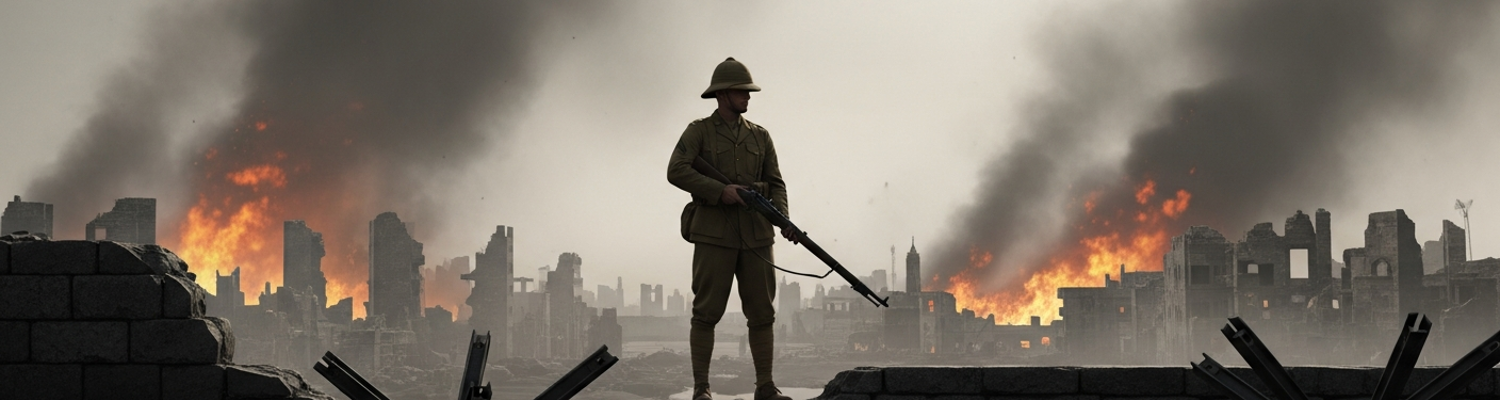
The ultimate test for the legation guard concept came in the summer of 1900 during the Boxer Rebellion in China. An anti-foreign, anti-Christian movement known as the Righteous and Harmonious Fists, or Boxers, swept across northern China, targeting Westerners and Chinese Christians. As the situation in Peking deteriorated, the foreign legations requested military assistance. On May 31, 1900, a detachment under the command of Captain John T. Myers arrived in the capital. This force, composed of men from the USS Oregon and USS Newark, numbered just over fifty Marines and sailors. They joined a multinational force of approximately 450 troops from seven other nations tasked with defending the city’s Legation Quarter. The siege began in earnest on June 20, 1900, when Boxer and Imperial Chinese troops encircled the compound. The American legation was situated near the Tartar Wall, a massive defensive structure sixty feet high and forty feet wide. Captain Myers and his Marines were assigned the critical task of defending this section of the wall, a position the British Minister, Sir Claude MacDonald, later called the peg that held the whole thing together. For fifty-five days, the small international force held out against overwhelming numbers. The Marines on the wall faced constant sniper fire and artillery bombardment, constructing and defending makeshift barricades from rubble and sandbags. On July 3, Chinese forces advanced their barricades dangerously close to the American position on the wall. In a pre-dawn attack during a rainstorm, Captain Myers led a charge with U.S. Marines, British, and Russian troops, successfully dislodging the Chinese and pushing them back. Myers was wounded in the leg by a spear during the assault, and command passed to Captain Newt H. Hall. The fighting was relentless. Another Marine, Private Dan Daly, earned his first Medal of Honor for his actions on the night of July 15, when he single-handedly defended his position on the wall against numerous enemy attacks. His sustained rifle fire reportedly repelled waves of attackers, preventing a breach in the defenses. The siege was finally lifted on August 14, 1900, with the arrival of the international China Relief Expedition, which included a regiment of U.S. Marines under Major Littleton W. T. Waller. The defense of the Peking legations, which cost the Marine detachment seven killed and nine wounded, was a brutal, hard-fought validation of the legation guard’s purpose and capability.
Doctrine Forged in Distant Outposts
The operational realities faced by detachments in places like Panama and Peking drove a significant evolution in Marine Corps training and doctrine. The post-Civil War era had been a period of introspection for the Corps, but the demands of the Gilded Age forced practical reform. Under the leadership of Commandant Charles Heywood, who took command in 1891, the Marine Corps began a process of professionalization specifically aimed at preparing Marines for their expanding expeditionary role. Heywood recognized that the Corps, often armed with obsolete black-powder Springfield Trapdoor rifles and focused on parade-ground drill, needed modernization. He instituted a regular program for marksmanship training, a skill vital for small units facing superior numbers. The adoption of modern, bolt-action rifles using smokeless powder, like the M1895 Lee Navy, was prioritized. The Lee Navy's higher rate of fire and the absence of vision-obscuring smoke clouds proved to be a significant advantage for the defenders in Peking. Heywood established a system of examinations for officer promotions and created the first formal officer’s schools, such as the School of Application established in Washington D.C. in 1891. These institutions were designed to move beyond simple drill and instill in officers the principles of tactics, administration, and independent command. This new focus on professional education and individual skill was essential for the legation guard mission. Marines deployed to these isolated posts had to be self-reliant, disciplined, and capable of making sound decisions under pressure, often without immediate oversight from senior commanders. The development of a strong non-commissioned officer corps was implicit in this effort, as sergeants and corporals were the backbone of these small, detached units, expected to lead patrols and manage guard posts independently. The experiences of Captain Myers' men in Peking, who maintained their discipline and effectiveness through weeks of intense combat, demonstrated the success of this doctrinal shift. By the turn of the century, the Marine Corps had successfully cultivated an expeditionary mindset, transforming itself into a force purpose-built for the complexities of safeguarding American diplomacy on foreign shores.