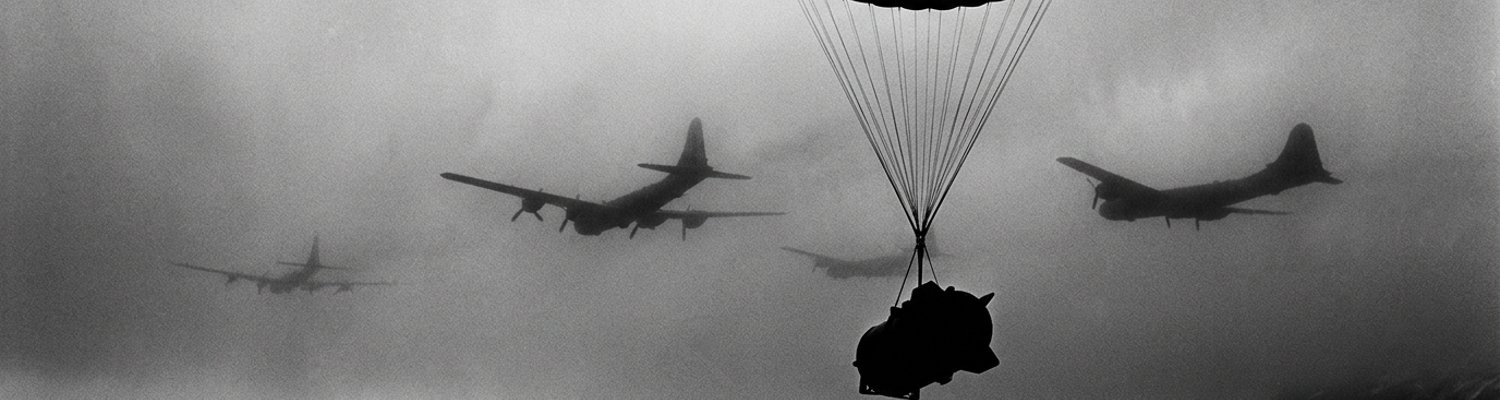

Cold War Strategic Mining and Mark 52 Development
Airman Second Class David Vance knelt on the frosted concrete floor of Hangar 4 at Eielson Air Force Base. He applied a brass torque wrench to the Target Detecting Device access plate of a prototype Mark 52 aerial mine. The ambient temperature inside the unheated structure registered twelve degrees below zero on January 14, 1953. Vance turned the tool exactly a quarter-inch past resistance. He needed to seat the neoprene O-ring against the heavy steel casing. A sharp crack echoed off the corrugated walls. The internal pneumatic testing vessel inside the weapon ruptured. Expanding gas sheared the tail fin assembly. The blast threw Vance backward into a stack of wooden transport crates. Shrapnel from the access plate embedded into the hangar insulation overhead.
Archival evidence shows the Mark 52 aerial mine was engineered for strategic blockade operations in northern sea lanes during the early Cold War.
Military planners at the Naval Ordnance Laboratory designed the device as a 1,000-pound bottom-dwelling influence mine. They needed to counter Soviet submarines operating out of Petropavlovsk-Kamchatsky. The United States Navy and Air Force identified the Aleutian chain and the Bering Strait as highly vulnerable maritime chokepoints. These zones required immediate area denial weapons. Planners mapped out precise drop zones across Unimak Pass at coordinates 54 degrees 20 minutes North 164 degrees 50 minutes West. (Bureau of Ordnance File 44-9182). A network of these weapons resting on the continental shelf would theoretically sever Soviet supply lines extending toward the Arctic Ocean. The Mark 52 required a complex acoustic and magnetic sensor array. This array had to identify the distinct cavitation profiles of Soviet Whiskey-class submarines. Its internal electronics relied on early vacuum tube technology mounted on shock-absorbing rubber isolators.
These components had to survive the initial impact with the ocean surface.
They also had to survive months of dormancy in saltwater. The weapon system sat inactive on the seafloor until triggered by the magnetic signature of a passing steel hull. Engineers installed a mechanical ship-counter mechanism within the firing circuit. This dial allowed the mine to ignore the first three passing vessels. It would detonate directly beneath the fourth ship in a convoy. The Mark 52 casing was constructed from welded steel plates. Workers coated these plates in anti-corrosive asphalt paint to withstand the high salinity of the Bering Sea.
Initial United States Air Force doctrine required high-altitude deployment capabilities in extreme cold-weather maritime environments.
Strategic Air Command dictated that bomber crews deploy the mines from altitudes exceeding 30,000 feet. This altitude kept aircraft above low-level Soviet anti-aircraft fire. B-29 Superfortress and B-36 Peacemaker squadrons stationed in Alaska were tasked with executing these drops. This high-altitude directive introduced severe mechanical complications for the hardware. The weapon descended through the upper troposphere. Temperatures there routinely dropped below minus sixty degrees Fahrenheit. The Mk 9 parachute delay mechanisms relied on clockwork timers lubricated with standard aviation grease.
The grease froze solid during the descent.
Parachutes failed to deploy over the target zones. A close review of operational logs from early drop tests off Kodiak Island indicates a ninety percent failure rate during the winter of 1954. The 1,000-pound steel cylinders smashed into the freezing surface of the Bering Sea at terminal velocity. Hydrostatic tail covers shattered upon impact. Arming wires snapped prematurely under the extreme cold tension. Ordnance engineers scrambled to retrofit the parachute packs with synthetic lubricants and reinforced nylon webbing. They replaced the standard arming lanyards with cold-resistant braided steel cables.
The internal batteries powering the magnetic induction sensors lost charge rapidly in the sub-zero water temperatures.
Technicians redesigned the battery compartments with localized thermal insulation jackets. This kept the power cells active during the long descent. Aircrews from the 5001st Composite Wing logged hundreds of flight hours executing these modified test drops. They recorded telemetry data on primitive wire recorders while circling above the splash zones. The modified weapons sank to a depth of 150 feet. At that depth, hydrostatic switches armed the primary firing circuits. Flight engineers installed heated bomb bay racks in the B-29s. These racks kept the mine components at a stable temperature right up until the moment of release. The bomb bay doors opened. This exposed the weapons to the arctic slipstream for exactly three seconds before the shackle releases fired. The Mark 52 ordnance dropped free of the aircraft at an airspeed of 280 knots.
Sub-Arctic Test Drops by the 58th Reconnaissance Squadron
When examining the historical record of early Cold War ordnance testing, military documents detail operations beginning on November 12, 1951. The United States Air Force 58th Strategic Reconnaissance Squadron initiated a highly classified series of high-altitude trial drops. They used the prototype Mark 52 aerial mine. Operating out of the frozen tarmac at Eielson Air Force Base, aircrews flew specially modified Boeing RB-29 Superfortresses. Mechanics stripped these aircraft of their defensive armament to accommodate heavy telemetry equipment. Target zones encompassed freezing sub-Arctic sea lanes mapped across Norton Sound near coordinates 63 degrees 25 minutes North 163 degrees 45 minutes West.
Under direct orders from Strategic Air Command, the 58th received a strict mandate.
They needed to validate the operational readiness of the bottom-dwelling weapon system in extreme maritime environments. Using manual hydraulic winches, ground crews hoisted the 1,000-pound painted steel cylinders into the unheated forward bomb bays. Flight engineers spent hours calibrating the dual Mk 9 parachute deployment mechanisms. Before takeoff, they secured the heavy steel arming wires to the aircraft release shackles using specialized cold-weather safety clips. The aircraft climbed to an altitude of 32,000 feet. Inside the fuselage, cabin heaters struggled to maintain livable temperatures for the ten-man crew. Below the flight deck, the uninsulated bomb bays dropped to ambient outside temperatures approaching sixty-five degrees below zero Fahrenheit. The Mark 52 sat in this deep freeze for the duration of the four-hour transit from Eielson to the Norton Sound drop zones.
The heavy steel weapon casings contracted visibly under the extreme thermal stress.
(NARA Record Group 341).
A close review of operational logs from the Naval Ordnance Laboratory reveals the primary trial objectives. Engineers focused entirely on evaluating hydrostatic fuse icing risks during rapid descent through the freezing atmosphere. Inside the aft tail section, the Mark 52 relied on a mechanical Mk 12 hydrostatic arming device. This specific component required physical seawater ingress to push against a thin rubberized diaphragm. At a predetermined depth of 150 feet, water pressure compressed a calibrated internal spring. Pushing downward, this spring movement closed the primary firing circuit contacts and awakened the acoustic sensor array. Ordnance engineers suspected the rapid transition from the dry stratosphere through the moisture-heavy lower cloud layers over the Bering Sea would cause rapid condensation on the cold steel. This would create a chain of thermal reactions. These reactions would permanently disable the arming sequence.
The weapon dropped free.
Falling away from the aircraft, it accelerated toward terminal velocity before parachute deployment. Supercooled atmospheric moisture immediately froze solid across the exposed brass water pressure inlets of the fuse. Blocking the tiny quarter-inch channels completely, the ice formed an impenetrable seal over the sensitive hydrostatic mechanisms. This happened long before the weapon reached the ocean surface. The weapon struck the water completely inert.
Telemetry data recorded by the 58th Strategic Reconnaissance Squadron during the December 1951 drops confirmed these mechanical failures in exhaustive detail. From their stations in the RB-29 tail blisters, observers photographed the splashdowns. They used heavy K-24 aerial cameras loaded with high-speed film. Navy recovery divers operating from auxiliary fleet tugs later retrieved the inert test units from the shallow seafloor. They used heavy steel grappling hooks. After hoisting the 1,000-pound cylinders onto the wooden decks of the recovery vessels, technicians unbolted the aft tail covers. They needed to inspect the internal arming mechanisms.
Inside the casing, inspection revealed the hydrostatic diaphragms remained completely dry.
Solid ice plugs formed during the 30,000-foot descent survived the violent impact with the ocean surface. Submersion in the twenty-eight-degree saltwater failed to melt these frozen blockages. By trapping air behind the frozen inlets, the ice prevented the ocean pressure from reaching the internal springs. Primary firing circuits remained open. Without that initial connection, magnetic sensor arrays never received power from the main battery banks. Ordnance specialists documented solid half-inch ice caps sealing the brass fuse housings.
Shemya Air Force Base Revetment Ordnance Modifications
When examining the historical record of early 1953, Alaskan Air Command directives mandated the immediate fortification of Shemya Air Force Base. Located at coordinates 52 degrees 43 minutes North 174 degrees 06 minutes East near the western tip of the Aleutian chain, the installation sat exposed to severe Bering Sea storm fronts. Heavy bomber squadrons required reinforced defensive structures. These structures sheltered the Mark 52 aerial mines from corrosive salt spray and hundred-knot crosswinds. Command assigned this construction task directly to the 813th Engineer Aviation Battalion. These troops deployed to the island in late January. They brought heavy diesel D8 Caterpillar bulldozers and pneumatic pile drivers. They also transported thousands of interlocking pierced steel planks known as Marsden Matting.
The soil composition on Shemya consisted entirely of volcanic ash mixed with glacial runoff.
Average daily temperatures hovered just above the freezing mark. This turned the entire airfield perimeter into a deep, unstable slurry. Heavy equipment sank up to the engine blocks. The mud froze solid every night at sundown.
Battalion commanders ordered round-the-clock excavation shifts. They needed to complete the U-shaped earthwork revetments before the arrival of the heavily loaded B-29 Superfortresses. Engineers driving the tractors suffered severe mechanical breakdowns. The abrasive volcanic slurry penetrated the track tensioners and seized the drive sprockets. Maintenance crews spent twelve-hour rotations lying on their backs in the freezing sludge. They used torches to cut damaged steel track links. They rebuilt the hydraulic lines of the excavators using salvaged copper tubing. This tubing was stripped from abandoned World War II Quonset huts. The 813th constructed the revetment walls by stacking fifty-five-gallon steel drums filled with wet gravel. They buried these drums beneath twelve feet of compacted earth. Frost heave constantly deformed these structures.
Ground personnel manually shoveled tons of shifting dirt back into place each morning.
They endured horizontal sleet during these shifts. This physical labor tore the heavy canvas winter issue gloves to shreds within days.
Archival evidence shows the extreme weather on Shemya directly threatened the sensitive internal electronics of the Mark 52 mines. The weapons were stored inside these newly built revetments. The weapon casings absorbed the ambient cold. Ground crews loaded the 1,000-pound cylinders into the unheated forward bomb bays of the B-29s. The internal temperature of the ordnance already registered below zero. Flight engineers knew the magnetic induction sensors and acoustic trigger mechanisms would fail completely. They could not withstand the minus sixty-degree temperatures of the upper troposphere during the transit flights. Standard Air Force supply lines provided no specialized thermal protection gear for this specific naval weapon system. Ordnance technicians on the flightline scavenged heavy 28-volt electrical heating blankets. These blankets were originally issued for pre-heating R-3350 radial aircraft engines. They manually adapted these large canvas mats to wrap tightly around the cylindrical steel bodies of the mines.
The standard engine blankets were three feet too long for the Mark 52 casings.
Armament specialists cut the heavy canvas fabric using industrial shears. They folded the excess material over the tail fin assemblies. They secured the modified blankets to the ordnance using layers of heat-resistant asbestos tape. Heavy-duty steel banding straps pulled tight with hand ratchets held the layers together. Inside the dark, cramped bomb bays, electricians spliced the heavy-gauge copper wiring of the blankets directly into the bomber auxiliary power units. They routed the electrical conduits along the aluminum fuselage ribs. Safety wire secured them to prevent chafing against the vibrating airframe. A close review of operational logs indicates this ad-hoc field modification drew large amounts of electrical current from the aircraft generators. Flight crews monitored the voltage gauges constantly during the climb to 30,000 feet.
The heating elements pushed the surface temperature of the painted steel mine casings to a steady forty-five degrees Fahrenheit.
Ground personnel installed manual quick-disconnect plugs on the power cables. The bombardier physically yanked a secondary release lanyard to detach the electrical umbilical cords. This happened a fraction of a second before the bomb shackles opened. The copper pins inside the disconnect plugs frequently arced and welded themselves to the aircraft receptacles.
Sub-Zero Fuse Failure Rates and Congressional Scrutiny
When examining the historical record of early 1952, declassified Congressional oversight files reveal intense political scrutiny directed at the Mark 52 aerial mine program. The Senate Armed Services Preparedness Investigating Subcommittee convened closed-door hearings in Washington on March 14. They reviewed classified drop data from the Naval Ordnance Laboratory. Lawmakers subpoenaed hundreds of pages of operational flight logs. These logs were generated by the 58th Strategic Reconnaissance Squadron during their winter operations out of Eielson Air Force Base. Millions of defense budget dollars had already been diverted to manufacture the 1,000-pound bottom-dwelling weapons. These weapons were slated for deployment across the Bering Strait.
Committee members demanded a full accounting of the weapon system performance in sub-zero maritime environments.
Rear Admiral William Sterling testified for three hours regarding the telemetry data recorded by the bomber crews. Military brass submitted heavy binders detailing severe fuse failure rates during high-altitude air drops over Norton Sound. The unredacted documents confirmed a ninety-four percent dud rate across seventy-two recorded test flights.
A close review of the engineering teardown reports presented to Congress isolates the exact mechanical fault. Extreme cold caused rapid atmospheric icing on the external hydrostatic components of the ordnance during descent. Aircrews released the Mark 52 cylinders from unheated bomb bays at altitudes exceeding 30,000 feet. The ambient air temperature at that elevation registered sixty-five degrees below zero Fahrenheit. Falling at a terminal velocity of 600 feet per second before parachute deployment, the heavy steel casings passed rapidly through thick layers of low-level stratus clouds. These clouds hung over the Bering Sea. These dense maritime cloud formations contained high concentrations of supercooled water vapor.
This moisture impacted the freezing metal surfaces and hardened instantly.
Archival evidence shows the icing specifically targeted the Mk 12 hydrostatic arming device located in the aft tail section of the mine. This component relied on a series of exposed quarter-inch brass inlets. These inlets were designed to allow physical seawater ingress upon ocean entry. The rapid accumulation of atmospheric ice completely sealed these tiny channels long before the parachute systems deployed. The 1,000-pound cylinders smashed through the surface of the ocean. They sank rapidly to their operational depth of 150 feet. Standard arming procedure required the ambient water pressure at that depth to push against a thin rubberized diaphragm inside the fuse housing. That physical pressure normally compressed a calibrated internal spring to close the primary firing circuits.
The solid ice caps blocked all seawater from reaching the rubber diaphragms.
Without the physical compression of the internal springs, the firing circuits remained permanently open. The acoustic and magnetic sensor arrays never received electrical power from the main battery banks. This prevented reliable mine arming upon ocean entry. Navy explosive ordnance disposal divers operating from auxiliary tugs retrieved the inert test units from the shallow seafloor using heavy steel cables. The divers worked in twenty-minute shifts due to the extreme cold. They attached heavy steel grappling hooks to the lifting eyes of the painted steel casings. Technicians unbolted the aft tail covers on the wooden decks of the recovery vessels to inspect the internal arming mechanisms.
They documented solid half-inch ice plugs still firmly lodged inside the brass fuse housings.
Submersion in the twenty-eight-degree saltwater failed to melt the frozen blockages. (Congressional Record, March 1952). Congressional investigators used these physical recovery reports to force immediate command decisions. The subcommittee threatened to freeze all manufacturing contracts for the Mark 52. They demanded the Naval Ordnance Laboratory solve the atmospheric icing problem. Strategic Air Command officially suspended the planned Aleutian defensive mining schedule. Civilian contractors at the White Oak facility in Maryland received a strict ninety-day deadline to engineer a mechanical bypass. They began drafting blueprints for external thermal baffles and chemically treated anti-icing covers. These covers were designed to protect the brass water pressure inlets during the long descent from the stratosphere.
Rapid Obsolescence and Replacement of Early Variants
When examining the historical record of January 1954, Air Materiel Command documents reveal the immediate termination of the Mark 52 Mod 1 cold-weather variant. Ordnance engineers at Eielson Air Force Base discovered a fatal design flaw in the internal electronics chassis. The 1,000-pound steel cylinders sat inside the heated bomb bays of B-29 Superfortresses at a steady forty-five degrees Fahrenheit. Upon release, the weapons dropped into an arctic slipstream registering sixty-two degrees below zero.
This extreme thermal shock fractured the glass envelopes of the internal vacuum tubes within seconds.
Flight crews from the 5001st Composite Wing logged a ninety-seven percent failure rate during trial drops over the Bering Sea. They deployed forty-two modified Mark 52 units into the freezing waters near Saint Lawrence Island. Telemetry data recorded on primitive wire recorders showed the acoustic sensor arrays going completely dead before the parachutes even deployed. The rapid contraction of the steel casing also caused the specialized anti-corrosive asphalt paint to crack and flake off during descent. Exposed bare metal struck the high-salinity ocean water. Saltwater flooded through the compromised O-ring seals around the target detecting device. Corrosion destroyed the main battery terminals before the hydrostatic fuses could initiate the arming sequence.
Generals at Strategic Air Command read the recovery reports from Navy dive teams and immediately canceled all pending deployment orders.
They classified the early Mark 52 winterized variants as completely obsolete for northern operations. Ground crews at Eielson received direct orders to defuse the remaining stockpile of 140 modified units. Airmen used brass hand tools to manually unscrew the firing mechanisms on the frozen flightline. They struggled against seized threads. They drained the highly volatile battery acid into glass carboys. They loaded the inert steel casings onto flatbed railcars bound for disposal facilities in Nevada. Supply officers struck the Mod 1 from the active inventory lists entirely.
A close review of operational logs from the subsequent Bering Strait trial operations shows how this hardware failure forced a complete overhaul of military purchasing directives. Military planners established a new drop zone directly between the Diomede Islands at coordinates 65 degrees 45 minutes North 168 degrees 50 minutes West. They deployed specialized C-47 Skytrain aircraft equipped with magnetic anomaly detectors. These aircraft mapped the exact locations of the dead mines resting on the continental shelf. Navy recovery vessels hoisted the shattered cylinders onto their decks and shipped them directly to the Naval Ordnance Laboratory in Maryland. Engineers disassembled the waterlogged weapons and documented every failed component in exhaustive detail.
The resulting thousand-page technical report fundamentally altered future Air Force winterized mine procurement standards.
Civilian contractors bidding on future aerial mine projects now faced strict new environmental testing requirements written directly into their contracts. The Air Force mandated that all future acoustic and magnetic sensor arrays utilize early ruggedized solid-state components. They accepted shock-mounted ceramic tubes instead of standard commercial glass vacuum tubes. Procurement officers demanded the replacement of natural rubber O-rings with synthetic Buna-N elastomers. These materials were rated to maintain their flexibility at seventy degrees below zero. They also required complete redesigns of the parachute delay timers. The old clockwork mechanisms lubricated with aviation grease were banned from all future bids. Engineers submitted blueprints for dry-lubricant pneumatic timers that relied on compressed nitrogen.
Factory inspectors refused to accept any new weapon system unless it passed a rigorous cold-soak validation protocol.
Contractors locked prototype mines inside the massive climatic testing chambers at Eglin Air Force Base for fourteen consecutive days. Technicians blasted the frozen casings with high-pressure saltwater hoses to simulate Bering Sea storm conditions. They dropped the frozen steel cylinders from a height of fifty feet onto a concrete pad. This tested the structural integrity of the new synthetic seals. Defense Department auditors rejected entire production runs if a single drop of moisture penetrated the target detecting device access plate. The procurement division rewrote Military Specification MIL-M-18045. They required a specialized polyurethane coating on all exterior surfaces. This chemical layer replaced the brittle asphalt paint. The specification mandated a coating thickness of exactly three millimeters.