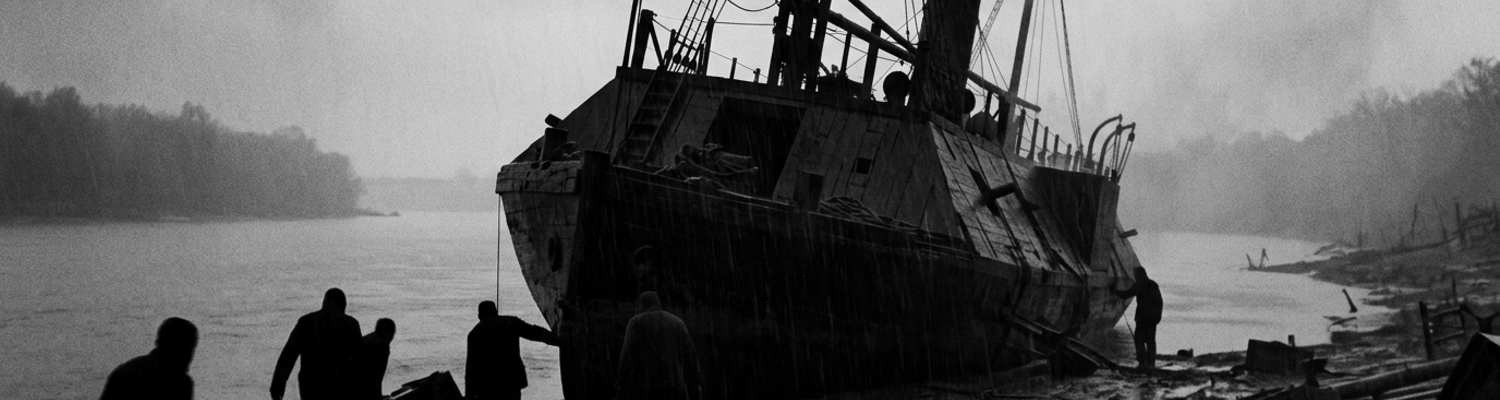

Antebellum Naval Doctrine and Littoral Environments
Archival evidence shows that antebellum United States Naval Academy coursework treated littoral waterways as irrelevant deviations. Instructors trained midshipmen on the mechanical systems of ocean-going wooden frigates. Students spent years reefing topsails in simulated gale-force conditions. They balanced standing rigging to support heavy pine masts. They calculated shell trajectories against rolling oceanic swells.
No classroom modules covered the hydrodynamic drag of shifting river shoals.
Below New Orleans in early 1862, Flag Officer David Glasgow Farragut brought the West Gulf Blockading Squadron into an unyielding river environment. This environment invalidated nearly every page of that curriculum. When Farragut assembled his strike fleet at the Head of Passes, officers found themselves directing deep-draft ocean combatants through narrow channels. River currents ran at four knots against their prows. This reduced rudder control to zero. High square yards turned into hazardous dead weight catching overhanging riverbank timber.
The physical anatomy of the premier warships actively accelerated their vulnerability in dynamic delta channels.
Farragut brought heavy steam sloops-of-war. These included the screw sloops USS Hartford, USS Richmond, and USS Brooklyn. He also brought the massive side-wheel steamer USS Mississippi and the deep-hulled USS Pensacola. These wooden vessels were engineered for deep-water endurance. They possessed displacement drafts ranging between sixteen and twenty-two feet. Southwest Pass and Pass a l Outre were choked by millions of tons of shifting river sediment carried downstream.
They frequently provided less than fifteen feet of clearance over the natural bars.
Crews exhausted their strength attempting to drag grounded hulls through several feet of sticky mud. They used kedge anchors, steam tugs, and hawser lines strained under extreme tension. Inside the machinery spaces, the river hydrology generated mechanical failures. Fine alluvial silt entered the sea injection valves. This filled the intake manifolds. This abrasive grit directly scored cylinder linings. It jammed reciprocating feed pumps. It packed inside the copper tubes of surface condensers. This risked boiler explosions before a single Confederate battery opened fire.
Engineers dumped hundreds of tons of coal and fresh provisions directly into the river.
They needed to gain four inches of clearance.
A close review of operational logs indicates that the operational draft altered completely under the weight of river silt settling against the lower hull. Fleet Captain Henry H. Bell watched deep-draft sloops ground themselves in succession across the bar. Their sterns twisted unpredictably in the downriver current as bottom suction gripped their wooden keels. Ships designed to project global maritime power lay immobilized in Louisiana silt. They waited for seasonal upstream floods to provide sufficient operational depth.
Groundings of USS Hartford and USS Pensacola
By April 7, 1862, Flag Officer David G. Farragut had concentrated the bulk of the West Gulf Blockading Squadron at Head of the Passes.
This isolated convergence point was situated at 29 degrees 8 minutes North latitude and 89 degrees 15 minutes West longitude. Ninety miles downstream from New Orleans, this exposed anchorage formed the tactical staging zone for twenty-four steam combatants and nineteen armed mortar schooners under Commander David Dixon Porter. Farragut stripped his vessels of unnecessary top-hamper. He landed royal yards, topgallant masts, and excess rigging at Ship Island and Pilot Town to reduce topside weight.
Coal schooners and ammunition transports crowded the river fork.
They transferred three hundred rounds per gun tube while armorers bolted chain cables along ship hulls to protect the boilers. Fleet orders directed coal allotments of twenty tons per vessel per day. Before Farragut could deploy against Fort Jackson and Fort St. Philip, his heaviest deep-draft warships had to cross the bars at the river mouths. Weeks of spring runoff had accumulated into broad subterranean ridges of blue clay and silt.
Southwest Pass became an engineering trap during the heavy spring downpours of early April.
Farragut chose to bring his flagship, the screw sloop USS Hartford, across the bar on April 13. Initial attempts through Pass a l Outre had failed. Drawing sixteen feet six inches of water over a bar measuring scarcely fifteen feet, the vessel struck bottom at five knots. She buried her forefoot deep into the alluvial mud bank. Downpours dumped inches of surface water across the sound.
The river current swelled to four knots and swung the flagship broadside across the channel.
When the crew attempted to back down the horizontal steam engine, river sediment choked the bilge pumps. It fouled the salt-water injection valves. Deck officers ran out eight-inch manila hawsers to the relief gunboat Winona and the steam tug Reliance. They attempted to pivot the hull by running engines at maximum boiler pressure. The hawser lines snapped under eighty tons of tension.
Sailors spent eighteen continuous hours shifting four hundred rounds of thirty-two-pound solid shot and twenty tons of pig-iron ballast to the quarterdeck.
Kedging anchors finally hauled the flagship free into the deep pool beyond the bar. Naval records from NARA Record Group 45 reveal that the heavy screw sloop USS Pensacola stayed hard aground in the Southwest Pass channel for twelve days under uninterrupted rain. Commanded by Captain Henry W. Morris, the vessel carried twenty heavy guns. She drew twenty-two feet six inches aft. This exceeded the sounding depth on the bar by more than six feet.
The ship grounded firmly on April 2.
Its wooden keel plowed three feet into dense Louisiana silt. Morris ordered all twenty IX-inch Dahlgren smoothbores dismounted. They were lowered onto flatboats alongside the spare spars, shot racks, sheet anchors, and two hundred tons of anthracite coal. Relieved of over two hundred fifty tons of topside and hold displacement, the hull stayed suctioned to the riverbed. Two gunboats, USS Clifton and USS Westfield, lashed themselves alongside. They ran steam lines and twin eight-inch cables to their deck capstans to dredge the warship through the bottom mud.
The friction ground away copper sheathing from the lower hull.
It stripped two blades from the bronze propeller. On April 14, after five separate towlines parted, the combined pull of three tugs and continuous high-pressure engine strain dragged the stripped hull across the obstruction into eighteen feet of water.
Collier Logistics and Commercial Paper Vulnerabilities
The mechanical stamina of the West Gulf Blockading Squadron rested on a web of private charter agreements, merchant vouchers, and short-term bank drafts.
Navy Department paymasters arrived off Ship Island and the Mississippi passes carrying Treasury warrants and ninety-day bills of exchange drawn on Eastern commercial houses. Civilian collier owners and merchant captains refused to accept federal paper outright. Fuel suppliers in Baltimore and Philadelphia had negotiated charter parties requiring spot settlements in coin or validated local credits before offloading anthracite.
Fleet Paymaster William B. Boggs faced commercial gridlock.
Local factors demanded clear processing through regional institutions like the Bank of New Orleans. These transactions were blocked by the suspension of specie payments and wartime Confederate currency edicts. With five hundred dollars a day accumulating in charter demurrage fees on stranded schooners, supply agents had to re-route drafts through intermediary banking agents in New York and Havana. This delayed fuel dispatch schedules by up to four weeks.
Ordnance vessels carrying powder for the mortar flotilla sat idle at Ship Island anchorage.
Civilian cargo masters waited for notarized sight drafts. Ships burned their reserves just maintaining steam to hold against the current. Contracted civilian transport vessels proved incapable of mooring directly alongside deep-draft warships in swift water. At the Head of Passes, the river current surged downstream at rates between four and six knots. It carried heavy drift logs and masses of uprooted marsh vegetation.
Navy captains required their coal bunkers replenished while anchored in the main stream.
Civilian wooden schooners lacked the structural bracing to survive the lateral hydrodynamics. On April 10, the chartered transport Great Republic attempted to secure along the port quarter of the screw sloop Richmond. The sheer volume of river water trapped between the two hulls generated a hydrodynamic venturi effect. The resulting low-pressure zone dragged the lighter civilian hull sideways into the warship. The force shattered three heavy oak catheads and crushed the collier bulwarks down to the water line.
Ten-inch hemp mooring lines snapped across capstans under sudden shock loads.
Loose hawser ends turned into lethal hazards across the deck. Civilian captains flatly refused further mooring evolutions. They demanded that naval steam tugs run coal bags in open launches. Alternatively, they insisted the warships haul out into shallow eddies where anchors repeatedly dragged across the alluvial silt.
Engineers recorded repeated mechanical disruptions during mid-stream cargo handling in the deck logs of the USS Brooklyn.
Commander Thomas T. Craven attempted to take aboard one hundred tons of black powder and heavy ordnance shells from the contracted supply schooner Sarah Bruen. He was stationed in fifteen fathoms of water above the Southwest Pass bar. The river current threw the smaller vessel broadside across the starboard bow. This drove the warship anchor chain directly into the civilian transport cutwater. Crewmen spent four hours rigging heavy spruce spars and rope mats as deadweights.
They hoped to absorb the surging impacts.
The violent friction tore away the schooner chainplates and cracked two lower hull strakes. Powder barrels had to be hoisted out of open holds during squalls. This exposed paper-wrapped cartridges and friction primers to soaking humidity and falling rain. Gunners discarded forty damaged powder charges after river water swept over the lightering barges. Ordnance transfers halted until steam cutters could drag the damaged civilian supply craft into the dead water off Pilot Town.
Improvised Coaling Under Dangerous River Currents
An unseasonal surge of meltwater transformed the lower Mississippi into a hydraulic conduit of heavy debris by mid-April 1862.
Hydrologic runoff from the upper river basin pushed downriver velocity past six knots. This generated lateral water pressure that destroyed standard naval mooring configurations. Federal gunboats and heavy sloops required up to one hundred tons of anthracite each day to hold their positions against the torrent. Bringing civilian colliers alongside warships generated dynamic load spikes that exceeded the breaking strength of shipboard gear.
Deck officers on the paddle-wheel steam frigate USS Mississippi and the screw sloop USS Richmond ran ten-inch manila hawsers and wire rope springs.
They attempted to hold the supply vessels parallel in the main channel. Surging cross-currents caught the flat hulls of the colliers. This wedged high volumes of water into the gap between vessels and heaved them apart with sudden hydraulic shocks. Iron bitts sheared flush with the oak deck planking. Heavy manila lines stretched past their rated elastic limits of thirty tons of working tension.
They parted with reports that sounded like twelve-pounder field guns.
Whipping line ends cleared quarterdecks. The sudden separation of hulls ripped out gangways and plunged half-emptied coal scuttles into thirty feet of river mud. Farragut deck crews were forced to invent crude lightering arrangements to survive continuous battering from floating driftwood. Upstream floodwaters tore uprooted cypress trees, whole marsh islands, and sixty-foot river snags from the riverbanks. This sent dense rafts of heavy timber downstream at night.
These floating snags slammed into exposed mooring lines.
They lodged across warship anchor chains. They wedged into the paddle-wheel buckets of the USS Mississippi. This threatened to drag anchored warships into one another. Fleet engineers answered by requisitioning shallow-draft, flat-bottomed lighters and civilian cotton barges. They secured them between the warship hulls and the riverbank eddies using heavy timber outriggers and jury-rigged spar booms.
Deck crews drove iron drift bolts through squared pine baulks.
They constructed improvised fenders capable of fending off heavy drift snags before they could crush the lighter hulls. Sailors balanced on rocking deck barges in torrential rain. They manually filled canvas coal sacks and wicker baskets with shovel brigades operating in twelve-hour shifts. Deck crews rigged single whip tackles to yardarms and davits. They hoisted five-hundred-pound sacks of anthracite from the lashed lighters up the sides of the sloops while the hulls rolled in the river swell.
When floating snags jammed between the hulls, crews used iron-shod pike poles to pry the heavy logs free under the constant threat of a crushed hull strake.
On April 16, crews were coaling the gunboat USS Cayuga. A three-ton cypress root cluster collided with the forward lighter. It snapped two forward lashings and spun the flatboat across the gunboat bow. Petty officers secured the remaining lines to an auxiliary deck winch. They held the coal lighter in place while four stokers bailed river water out of the barge hold with buckets. They fought to keep seventy tons of raw anthracite from sinking to the bottom.
Clandestine Boat Reconnaissance Under Captain Bell
Fleet Captain Henry H. Bell directed small launch parties on clandestine nocturnal scouting missions into the delta marshland flanking Fort Jackson and Fort St. Philip.
Stationed below the river bend at 29 degrees 21 minutes North latitude, Bell personally supervised the deployment of shipboard cutters drawn from the sloops USS Hartford and USS Brooklyn. His objective centered on determining the exact composition of the heavy river barrier spanning the eight-hundred-yard channel between the forts. Confederate engineers had anchored eight dismasted schooners across the stream.
They shackled them together with heavy iron chains to block Federal passage.
Bell ordered coxswains to strip each twenty-six-foot wooden launch of all brass fittings, bright metal, and white canvas. Rowing crews wrapped their ash oar looms in greased wool blankets. They smeared salt-pork tallow across the iron rowlocks to prevent metallic squeaks. Drifting out from the fleet anchorage at two in the morning. These small reconnaissance parties slipped along the muddy shoreline eddies.
They were shielded only by low-hanging willow branches and overhanging river debris.
Small-craft river reconnaissance forced blue-water seamen into ground-level combat operations. Bell took his launch crews within three hundred yards of the Confederate water batteries. They dropped tallow-coated lead lines over the side by hand to record channel depths in complete silence. Confederate pickets patrolled the eastern levee. Sentries at Fort Jackson stood behind earthen ramparts mounted with heavy smoothbore guns.
One loose oar blade slapping the water or a dropped lead weight could bring an entire battery broadside down on an unarmored wooden launch.
Seamen maintained headway by digging boat hooks into the soft mud banks. They pulled their hulls forward against the four-knot current hand over hand through dense reed patches. The fleet captain monitored the riverbed contours with a hand lead line. He noted where submerged chain cables pulled taut across the river. He recorded where deep flood eddies had begun dragging the anchor lines of the center hulks.
Marsh infiltration under persistent mosquito swarms exposed the disconnect between textbook fleet formations and irregular swamp reconnaissance.
Standard navy regulations trained crews to fight standing upright at open gunports. They maneuvered in disciplined double-line battle formations under signal flags. In the delta swamps, tactical success depended on crawling through black muck and rotting cane brakes in total darkness. Dense clouds of salt-marsh mosquitoes and biting gnats coated the exposed skin of the rowing parties the instant their boats entered the stagnant backwaters off the Plaquemines Parish shore.
Men were forbidden from slapping their faces or swatting the insects.
The sharp sound of an open palm hitting flesh carried across the water to Confederate rifle pits. Sweat dissolved grease from the rowlocks. It ran into the eyes of sailors who sat frozen over their oars for three hours at a stretch. The exposure caused immediate swelling, eye inflammation, and sudden outbreaks of marsh fever. This stripped warships of fit crewmen days before the fleet attack.
Bell recorded his findings directly into his pocket notebook.
He mapped the exact moorings of the schooner hulks and verified that the heavy chain barrier was intact between the second and third hulks from the western bank. On the night of April 20, acting on the launch reconnaissance data, Bell took the gunboats USS Pinola and USS Itasca directly upstream to sever the obstruction. Lieutenant Charles H. B. Caldwell guided Itasca alongside the second hulk. He boarded the abandoned vessel with a boarding party armed with cold chisels, sledgehammers, and petards.
Petty officers wrapped fifty-pound powder charges around the heavy links.
Bell kept Pinola anchored in thirty feet of water. He held the channel position against the downriver sweep of burning rafts until the explosion split the iron chain.
Confederate Fire Rafts and Timber Barriers
Confederate military engineers under Brigadier General Johnson K. Duncan established a formidable choke point across the lower Mississippi below Fort Jackson and Fort St. Philip.
Centered at 29 degrees 21 minutes North latitude, the channel narrowed to roughly eight hundred yards. The defensive line relied on an obstruction designed to arrest incoming steam vessels under point-blank artillery fire. United States Coast Survey teams led by Ferdinand H. Gerdes worked in coordination with naval reconnaissance crews in armed cutters. They systematically charted the barrier from distances under one mile. Observers identified heavy cypress timbers bound by two-and-a-half-inch iron cables.
These were linked between eight dismasted schooner hulls anchored in line abreast across the current.
Spring floodwaters in March had sheared portions of the original solid timber raft. Confederate work parties had reinforced the surviving section by stringing heavy iron chain cables through the hawseholes and over the decks of the anchored vessels. Each hulk was held by heavy bower anchors dropped into thirty feet of water. Downstream outriggers and floating cypress baulks were angled to foul screw propellers.
The physical structure of the boom created extreme hydrodynamic stresses across the entire river section.
Confederate garrison troops from the Louisiana artillery regiments tightened the main span by securing the western chain terminus directly to a massive timber capstan set behind the levee below Fort Jackson. On the eastern shore, the cable wrapped around living cypress stumps rooted deep into the mud of the Fort St. Philip marshes. River currents running at four knots exerted continuous lateral drag against the hulls of the anchored schooners. This caused the chains to creak audibly across the open water.
Federal reconnaissance parties noted that the anchor chains of the central schooner had begun to sag three feet below the surface under the accumulation of upstream river drift.
When river debris collected against the upriver sides of the hulks, the weight drove several hulls down to their scuppers. Lieutenant Commander George H. Preble reported that water piled two feet higher on the upstream side of the barrier than on the downriver side. This turned the entire timber boom into an active hydraulic dam that churned white water through the narrow gaps between the hulls. General Duncan and river defense commander John K. Mitchell prepared flat-bottomed timber fire rafts to sweep down the main channel against the Federal fleet.
Measuring forty to sixty feet in length and built from thick pine timbers, each craft carried twenty cords of highly combustible split fat pine, resin, asphaltum, and turpentine-soaked scrap cotton piled ten feet high.
Confederate crews ignited these craft above the river bend under the cover of night. They allowed the five-knot flood current to carry the drifting blazing vessels directly down toward the anchored wooden sloops. The intent centered on driving the deep-draft Federal vessels into the shallow mudflats. Alternatively, they hoped to set tarred standing rigging ablaze while crews worked frantically to slip anchor cables.
Radiant heat from these rafts registered at distances exceeding two hundred yards.
It blistered paint on forward hulls before contact occurred. Dense clouds of black resinous smoke rolled downstream ahead of the flames. This blinded Federal watch officers and obscured visual sighting lines for gun crews attempting to lay their broadsides. Federal commanders countered this threat through constant small-boat picketing. Flag Officer Farragut assigned rotating naval boat detachments from the sloops USS Hartford, USS Richmond, and the side-wheeler USS Mississippi to row guard duty every evening above the fleet anchorage.
Twelve-oared cutters and armed steam launches drifted near the riverbanks with greased rowlocks.
They were equipped with grapnel hooks, axes, buckets, and two-inch manila towlines. When lookouts spotted the orange glare of a descending fire raft rounding the river bend at midnight, boat crews pulled directly into the heat and black smoke. They heaved iron grapnels over the burning gunwales. Sailors passed hawser lines around smoking log outriggers. They took the lines to steam tugs like the Reliance or rowed manually to drag the flaming masses into the soft mud along the eastern batture.
On April 21, a cutter detachment commanded by Lieutenant Albert Kautz intercepted a forty-foot raft drifting within one hundred yards of the Hartford.
They secured two lines to its charred stern timbers and guided it into the willows. It burned down to the water edge in eight feet of mud.
Operational Adjustments Before the New Orleans Run
Standard naval tactics prescribed a minimum spacing of two cable lengths between steam combatants proceeding in a single line ahead.
This four-hundred-yard interval was intended to keep ships clear of blinding black-powder smoke and prevent catastrophic collisions if an engine broke down. Farragut calculated that strict adherence to such textbook intervals would string his seventeen wooden warships across nearly four miles of the lower Mississippi. Entering an eight-hundred-yard river channel against a four-knot current at that distance guaranteed that each hull would spend forty minutes absorbing concentrated fire from the one hundred and fifteen heavy cannon mounted across Fort Jackson and Fort St. Philip.
Farragut scrapped conventional spacing entirely in his April 20 fleet orders.
He ordered his captains to form two close-order parallel columns. They closed gaps between hulls down to bare rudder clearance so the ships could execute an aggressive high-speed push past the water batteries. Captain Theodorus Bailey led the first division in the gunboat Cayuga. He steered hard against the eastern bank to smother Fort St. Philip with rapid grape and canister fire. Farragut followed in Hartford.
He led the second division straight into the western channel beneath the brick casemates of Fort Jackson.
Commanders received instructions to run their steam plants at maximum draft. They bypassed disabled friendly hulls rather than dropping anchor to offer assistance. The weeks of gridlock at the river mouth forced an equally fundamental shift in naval administration. Throughout February and March, the West Gulf Blockading Squadron depended on chartered civilian schooners and commercial transports to deliver anthracite, replacement boilers, and ammunition from Northern ports.
These private merchant contracts collapsed when tested against river hazards.
Commercial masters frequently anchored twenty miles downstream off the shallow bar at Southwest Pass. They refused to risk their privately owned hulls in the swift freshwater current where floating snags sheared rudder posts. Civilian captains repeatedly refused to tie up alongside steam sloops. They demanded exorbitant demurrage fees of up to five hundred dollars per day while paymasters argued over unbacked Treasury warrants.
Ship captains had to pull regular gun crews from their battle stations for days at a time to row flat-bottomed lighters back and forth across open waters.
They hand-hauled three-hundred-pound ordnance shells and wet coal bags into fleet bunkers. Navy Department correspondence reveals that these failures proved to flag officers that commercial chartering was incompatible with forward river operations. Operating an expeditionary steam fleet demanded commissioned naval auxiliary vessels. The Navy required dedicated supply ships and colliers manned by enlisted naval personnel under military law.
These vessels needed specialized deck capstans and heavy reinforced timber guards capable of absorbing direct hull collisions in turbulent waters.
Crews spent seventy-two continuous hours modifying their wooden hulls for the close-range assault between April 21 and April 23. Machinists lashed heavy cast-iron anchor chains along both sides of the sloops. They secured the links with iron staples over the machinery compartments to shield engines from horizontal solid shot. Carpenters packed coal bunkers with extra anthracite and bags of sand around cylinder heads.
This created makeshift baffles to contain high-pressure steam ruptures.
Top-hamper was lowered to the deck. Only lower masts remained standing to strip away excess wind resistance. Sailors smeared river mud across the light paintwork of the hulls to blend the ships into the cypress forests. Gunners whitewashed the wooden decks so crews could see dropped friction primers and handspikes in pitch-black night fighting. Farragut mechanics completed these modifications by the afternoon of April 23. Seventeen warships cleared for action and anchored in double columns five miles below the broken river boom.