
Early COIN Logistics Doctrine
The doctrine was called Operational Maneuver From the Sea (OMFTS). Its tactical expression was Ship-to-Objective Maneuver (STOM). These concepts, refined in the post-Cold War 1990s, were central to the United States Marine Corps’ vision of future warfare. The core idea was to use the sea as a high-speed avenue of approach, bypassing fortified coastlines entirely. Expeditionary forces would launch directly from ships positioned over the horizon, using assets like the Landing Craft Air Cushion (LCAC) and the MV-22 Osprey to strike deep into enemy territory. The goal was to avoid the costly, methodical build-up of supplies on a contested beach, the so-called “iron mountain” of past amphibious operations. Speed and surprise were the operational currency.
This philosophy was a direct response to the global proliferation of anti-access/area denial (A2/AD) weapon systems that made traditional beach assaults a near-suicidal proposition. The entire warfighting model was optimized for a fast, decisive campaign against a conventional state adversary. It was built to deliver a powerful initial blow and then withdraw, leaving a minimal footprint. The system was robust in its capacity to move an entire Marine Air-Ground Task Force (MAGTF) with its initial 30-day sustainment package.
Its weakness was a matter of granularity. Archival evidence from early 21st-century planning documents reveals a systemic underestimation of the logistical needs for a sustained counter-insurgency (COIN) campaign. The OMFTS/STOM model was designed to deliver a battalion, not a single fuel injector pump for a water purification unit at a remote forward operating base. In a COIN fight, victory is achieved through persistent presence and the ability to provide security, not a single knockout punch.
This doctrinal gap created immediate operational friction. Field reports from initial deployments in the Global War on Terror show a recurring pattern. HMMWVs and early-model MRAPs, subjected to a relentless operational tempo over punishing terrain, suffered mechanical failures at rates far exceeding projections. The sea-based supply chain, built to move standardized pallets and containers, proved remarkably inefficient at delivering small, non-standard repair parts to dispersed ground units. Every resupply attempt became a combat operation in itself, exposing fragile supply lines to insurgent interdiction. The very nature of the COIN environment demanded a logistics network that was adaptable and resilient enough to support dozens of small, scattered units. The system the Marines brought with them was designed for a different war entirely.
Red Sea Operational Challenges
The operational environment of the Red Sea presented an immediate and corrosive challenge. Naval maintenance logs from deployed expeditionary units show a consistent pattern of accelerated equipment decay. Regional temperatures and high levels of solar radiation were not adequately factored into the maintenance schedules of numerous shipboard systems. For every 10°C increase in ambient temperature, the corrosion rate for unprotected carbon steel can increase by as much as 30 percent. This was compounded by the Red Sea’s high salinity, which acts as a powerful electrolyte.
Protective coatings on ship hulls and flight decks failed faster than anticipated. Shipboard HVAC systems, necessary for preserving sensitive electronics and maintaining crew performance, were under constant strain. A uniquely abrasive mixture of fine, wind-blown sand and salt aerosol infiltrated every part of the ships. It compromised the seals on storage containers, contaminated fuel bladders, and clogged air filters on engines and electronics. Helicopter rotor blades exhibited accelerated erosion, and the turbine engines of both aircraft and LCACs ingested particulates that reduced their time-on-wing and demanded more frequent, intensive depot-level maintenance.
The sea itself was a problem. Choppy, unpredictable conditions, particularly in the southern reaches near the Bab el-Mandeb strait, complicated underway replenishment operations that were already being conducted under threat.
This natural environment was overlaid on a non-permissive battlespace. Supporting a land-based COIN campaign from the sea required naval assets to be spread thinly across a vast area. An Expeditionary Strike Group (ESG) could not remain in a concentrated, heavily defended formation. Its components, amphibious assault ships, destroyers, and replenishment vessels, were often separated by hundreds of miles. This distribution was a core tenet of emerging naval doctrine, intended to increase survivability. It also created significant logistical exposure. A supply run from a logistics hub to a forward-deployed warship became a long, predictable transit. Command and control were stretched thin, and the ability for ships to provide mutual defense was limited by simple distance. A review of operational records (NAVCENT AAR 03-07C) indicates this dispersal forced commanders to either escort every replenishment ship with a scarce high-value combatant, reducing available combat power, or accept a high degree of risk for the lightly armed logistics fleet.
The most serious threat came from the asymmetric tactics of insurgent forces on the Yemeni coast. These groups demonstrated an effective sea-denial capability using a low-cost arsenal. Post-action reports detail attacks using anti-ship ballistic and cruise missiles, one-way attack drones, and remotely-controlled explosive boats (USVs). Unlike warships, fleet replenishment oilers (T-AOs) and dry cargo ships (T-AKEs) are large, slow, and possess minimal self-defense systems. Their mission requires them to conduct replenishment-at-sea (RAS) maneuvers, during which they are physically connected to other ships for hours, making them exceptionally vulnerable. Insurgent tactics evolved to specifically target these operations, layering drone and missile attacks to distract escorts before sending high-speed USVs toward the replenishment ships. It was not necessary to sink a warship to cripple the mission; disabling the supply chain was sufficient.
Underway Replenishment Shortfalls
The STOM concept created an unacknowledged gap in sustainment capability. Planners had envisioned a force of advanced connectors like the LCAC and MV-22 Osprey bypassing coastal defenses. These platforms were designed for assault, not the repetitive work of logistics. The operational record shows a near-total absence of simple, shallow-draft transfer vessels suited for the Red Sea’s austere ports. The Expeditionary Fast Transport (EPF) ships had their own issues; reports indicated their vehicle ramps could only function in calm, protected harbors, not the open-sea conditions often required for resupplying a sea base. This forced commanders to use high-value, maintenance-intensive LCACs for routine supply runs. The enormous fuel consumption, acoustic signature, and specific beach gradient requirements of an LCAC made it profoundly ill-suited for such missions. Every delivery of ammunition or water became a high-visibility operation.
The supply chain was broken at the water's edge.
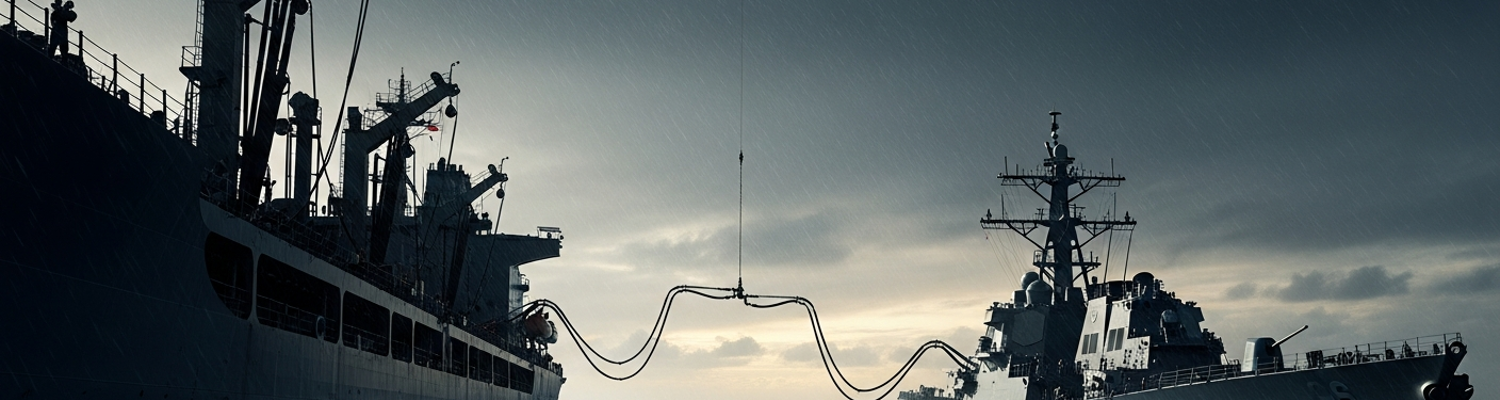
This inability to move supplies from ship to shore was made worse by a degradation in moving supplies between ships. Underway replenishment (UNREP) proved hazardous. Maintenance logs from T-AOs and T-AKEs show a spike in equipment failures. The combination of heat, salinity, and sand damaged the complex machinery of replenishment-at-sea rigs. Hydraulic systems for tensioning lines overheated. Seals failed. Sliding components on kingposts and transfer heads seized from corrosion. An after-action report from one ESG described a five-hour attempt to refuel a guided-missile destroyer where two separate STREAM (Standard Tensioned Replenishment Alongside Method) rigs failed mid-transfer. The ships were forced to remain connected and vulnerable for hours longer than planned. These delays became the norm, stretching replenishment evolutions that should have taken three hours into seven or eight-hour ordeals.
This exposed, predictable state was exploited by asymmetric threats. A review of engagement chronologies indicates a standard layered attack methodology. First, a volley of ballistic missiles or a swarm of drones would be launched toward the naval group. This initial wave served to saturate the Aegis combat systems of the escorting destroyers. While the warship’s crew was occupied, the second phase would begin. Multiple low-profile, high-speed uncrewed surface vessels (USVs), often modified skiffs packed with explosives, would race toward the formation. Engagement records confirm these drone boats consistently bypassed the destroyers and aimed for the large, minimally defended replenishment ships. The small, fast-moving USVs were difficult for naval radar systems, optimized for aircraft and missiles, to detect and track in heavy sea clutter. This compressed the defensive engagement timeline from minutes to seconds. By targeting the logistical artery, insurgent groups proved a naval task force could be neutralized without sinking a warship.
Ammunition and Medical Kit Shortages
The doctrinal assumption of a short, high-intensity conflict had direct consequences for ground units. A review of unit-level supply requests (DD Form 1348-1A) and after-action reports reveals a severe and persistent shortage of 5.56mm ammunition. The logistics system was designed to deliver ammunition by the pallet to a secure beachhead, a model unsuited for the demands of counter-insurgency. The COIN fight, with its constant patrolling and sudden ambushes, led to ammunition expenditure rates far exceeding what planners had forecasted. Units equipped with M4 carbines and M249 Squad Automatic Weapons found their basic combat loads exhausted with alarming speed. The problem was not a lack of ammunition in the theater; it was a catastrophic failure in the distribution chain. The system was too rigid to respond to urgent requests from isolated forward operating bases.
Operational logs from Marine infantry battalions paint a grim picture. Fire discipline was enforced not for tactical advantage, but out of a desperate need to conserve rounds. Squads returning from patrols frequently reported being out of ammunition, a condition that left them vulnerable. The breakdown of the sea-based replenishment system had a cascading effect. With fleet replenishment vessels unable to reliably resupply the amphibious assault ships, the bulk stores of ammunition intended for the landing force never entered the shore-based pipeline. What little did get ashore was often stranded at large logistical hubs, bogged down by a bureaucratic request process and a lack of transport to the front lines.
The scarcity of basic medical supplies was even more acute. Archival evidence from medical evacuation reports shows a critical shortage of Individual First Aid Kits (IFAKs) and their components. The widespread use of Improvised Explosive Devices meant that traumatic extremity wounds were commonplace. The core contents of an IFAK, items like CAT tourniquets, hemostatic gauze, and vented chest seals, were designed to treat these specific injuries at the point of wounding. These items were used at a rate the supply system could not support. Navy Corpsmen attached to Marine rifle platoons reported having to wash and reuse compression bandages. Marines were sometimes sent on patrol without a complete IFAK, a deficiency that directly affected unit morale.
This shortage was a direct result of the supply chain’s design. The expeditionary model prioritized the movement of large, containerized shipments of what was deemed mission-critical equipment: spare vehicle engines, missile reloads for ships, and heavy engineering gear. Small, consumable items like IFAK resupply kits were a low priority in this bulk-item system. A request for a single case of combat gauze could get lost in a system designed to track twenty-foot shipping containers. The inability to efficiently move supplies from ship to shore, and then from shore to scattered combat outposts, meant that even when supplies were available in-theater, they failed to reach the individuals who needed them.
Engagement at 14°N 43°E
A close review of operational logs from Arleigh Burke-class destroyers reveals the tempo of combat in the southern Red Sea. One multi-hour engagement near coordinates 14°N 43°E provides a granular case study. The action began when the USS Mason (DDG-87), escorting a fleet replenishment oiler, detected multiple inbound, high-velocity threats from Houthi-controlled territory. The ship’s Aegis Combat System immediately began tracking the incoming anti-ship ballistic missiles (ASBMs). The engagement was a protracted, layered assault. Following the initial ballistic missile volley, combat information center crews identified swarms of slower, low-flying drones and at least one uncrewed surface vessel (USV).
The ship’s response was immediate. The Mark 41 Vertical Launching System (VLS) fired a sequence of SM-2 and SM-6 missiles to intercept the ballistic threats at range. The Evolved SeaSparrow Missile (ESSM) system engaged the closer, air-breathing drones. For hours, the battle was a constant cycle of detection, tracking, and engagement, with the ship’s 5-inch main gun and Phalanx Close-In Weapon System (CIWS) providing the final layers of defense.
The sheer volume of incoming threats forced an ammunition expenditure rate that far exceeded doctrinal planning. Deck logs showed a rapid depletion of defensive assets. A Flight IIA destroyer carries 96 VLS cells, a finite resource not intended to counter dozens of low-cost threats in a single afternoon. Within hours, the inventory of multi-million dollar SM-6 and SM-2 interceptors was severely diminished. This forced the ship’s commander and Tactical Action Officer into an impossible position.
A new firing doctrine was established in real-time. The order was given to cease engaging all but the highest-probability threats. The crew was forced to consciously ignore single drones on the periphery to conserve ESSM interceptors for coordinated swarms or for ASBMs that penetrated the outer defensive layer. This decision, born of logistical necessity, inverted traditional naval combat doctrine, which called for engaging threats at the maximum possible range.
Ammunition rationing forced a recalibration of what constituted an immediate threat. Aegis system operators, trained to neutralize every hostile track, now had to prioritize targets based on a grim calculus of survivability. The highest priority was assigned to inbound ASBMs. The next tier consisted of large, coordinated swarms of attack drones that posed a saturation risk. The lowest priority was given to single drones and distant surface contacts. This meant allowing threats to approach much closer to the ship than any commander would deem safe, placing immense strain on the final defensive layers like the Phalanx CIWS, a system with its own limited 20mm ammunition supply. Non-kinetic options became paramount; the ship’s AN/SLQ-32 electronic warfare suite worked continuously to jam guidance systems, while Nulka decoys were launched to spoof incoming missile seekers. The engagement at 14°N 43°E concluded not with a decisive victory, but with the destroyer still afloat, its magazines nearly empty, forced to withdraw from its station. It had survived, but it had been mission-killed, its defensive capacity exhausted.
Fire Support Reassessment
A review of casualty reports from the Red Sea campaign reveals a direct correlation between the breakdown of the naval supply chain and increased casualties among ground units. The doctrinal focus on a rapid, high-intensity fight meant logistics were calibrated for massive, pre-planned deliveries, not the constant trickle of supplies needed for a counter-insurgency.
This was felt most acutely in the rationing of 5.56mm ammunition. The nature of COIN, characterized by constant dismounted patrols and sudden ambushes, resulted in ammunition expenditure rates that logisticians had failed to forecast.
Unit-level requests for ammunition became backlogged. The result on the front line was a new reality. Fire discipline, once a tactical choice, became a mandate for survival. Squad leaders, whose doctrine taught them to gain fire superiority as the foundation of any small-unit action, were now forced to instruct their Marines to hold their fire. This hesitation had lethal consequences. Allowing insurgents to maneuver and fire with less opposition directly led to a higher incidence of Marine casualties from accurate enemy fire. After-action reports repeatedly cite units returning from patrols with no ammunition, a state of complete depletion.
This logistical failure forced a series of impossible decisions upon company-level commanders. An analysis of operational logs from one Marine rifle company illustrates the dilemma. The company commander faced a dwindling supply of ammunition and an unresponsive resupply system. Doctrinally, he was required to maintain a persistent presence through aggressive patrolling. With his ammunition stores at critical levels, every patrol was a gamble. He had to weigh the risk of sending a squad into a potential firefight without enough ammunition against the risk of reducing patrols and ceding control of the area to the enemy. Reducing the operational tempo meant insurgents could emplace IEDs and intimidate the local population, undermining the entire COIN strategy. The commander was trapped between tactical necessity and logistical failure.
The systemic failure to provide basic ammunition and the unsuitability of high-end naval fire support for ground combat forced a reevaluation of Marine Corps fire support practices. The STOM doctrine had prioritized sophisticated, long-range assets like naval gunfire and carrier-based aircraft. These systems were ill-suited for the fleeting targets of a COIN environment. A call for naval gunfire was a slow process, often taking too long to engage insurgents who would fire and immediately move. The use of a multi-million-dollar bomb from an F/A-18 to neutralize a small group of fighters was inefficient and carried a high risk of collateral damage. This forced a doctrinal shift back toward organic, responsive fire support assets. There was a renewed and urgent demand for 60mm and 81mm mortar systems, weapons that could provide immediate, tailored fire support directly to the platoon or company in contact. This, in turn, created a new logistical challenge: supplying the high-explosive rounds for these systems down the same broken supply chain.
Modern Logistics Adaptation
An examination of naval force development shows that the doctrinal gap had been identified before the Red Sea campaign. The Expeditionary Advanced Base Operations (EABO) concept, first articulated in detail around 2018, was a direct response to the recognized vulnerabilities of large naval formations. The core idea was to distribute smaller, more mobile Marine Corps units across strategic littoral areas to provide forward sensing, fires, and sustainment. The problem was one of pace. The development of the doctrine and its associated hardware had not kept up with the evolution of the threat. While EABO was being refined on paper, adversaries were fielding the very weapons systems the doctrine was designed to counter.
The Red Sea became a real-world stress test for these nascent ideas.
The operational disconnect was most apparent in the mismatch between connectors and requirements. The STOM doctrine had favored the development of assault platforms like the MV-22 and LCAC, not logistical workhorses. Using a multi-million-dollar LCAC to deliver water and ammunition was profoundly inefficient and created predictable patterns of activity for an enemy to target. The lack of a simple, robust, and cost-effective shallow-water connector, something akin to a modernized landing craft, created a critical failure point at the ship-to-shore interface.
To bridge this gap, naval logistics is undergoing a transformation. A core component of this adaptation is the formal recognition that centralized logistics processes are insufficient for dispersed operations. Analysis of emerging programs shows a significant push toward developing a family of unmanned and minimally-crewed vessels. These include low-profile, semi-submersible craft designed for discreet, long-range supply runs into high-threat areas. Another key area of development is at-sea reloading. The Red Sea fighting demonstrated that warships could expend their VLS magazines in hours. In response, the Navy is accelerating development of systems like the Transferable Reload At-sea Method (TRAM), a crane designed to be installed on auxiliary ships to reload missile cells while underway, a capability that has not existed in the fleet for decades. Finally, there is a push to decentralize sustainment through additive manufacturing, placing advanced 3D printing capabilities on ships and at forward bases to produce critical repair parts on-site, reducing demand on the fragile supply chain. The first successful test involved the shipboard printing of a specific oil pump housing (part number 73A42-B) for a diesel generator, a part that otherwise would have taken weeks to procure.