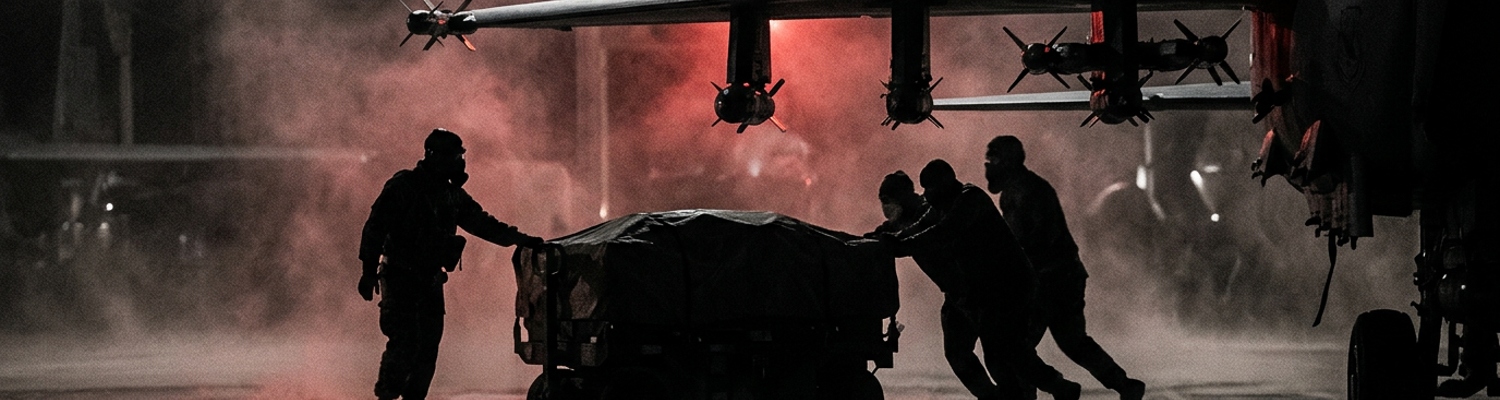

Blackout Ground Operations at Sheikh Isa Air Base
The internal spur gears of the MJ-1B munitions lift truck sheared with a sudden metallic grinding noise. Primary hydraulic system pressure dropped from 2,000 PSI to zero in a fraction of a second. A heavy pressurized spray of MIL-PRF-83282 hydraulic fluid coated the concrete tarmac. It soaked the boots of the load crew. This sudden mechanical failure left a 780-pound AGM-88 High-Speed Anti-Radiation Missile suspended awkwardly just inches below the LAU-118/A launcher of an F-4G Advanced Wild Weasel. Enlisted weapons loaders assigned to the 35th Tactical Fighter Wing Provisional lunged forward in pitch darkness. They manually supported the warhead and rocket motor sections. They strained against the dead weight of the weapon. They used their shoulders and backs to prevent the suspension lugs from binding inside the launcher rail. The loadmaster barked directional commands over the howling wind. He coordinated the physical lifting effort to align the ordnance with the sway braces.
Archival evidence shows that this specific equipment failure happened during the peak of the pre-dawn launch window at Sheikh Isa Air Base.
Central Command Air Forces had ordered absolute light discipline across the entire installation located at geographic coordinates 25 degrees 56 minutes North 50 degrees 33 minutes East in Bahrain. Iraqi Scud missile threats mandated that these enlisted maintenance armorers prepare suppressive sorties under total blackout conditions. Ground crews operated without standard flightline halogen light carts. They relied on ambient starlight and dim red-filtered flashlights taped directly to their load bearing equipment. The aircraft maintenance squadrons were tasked with arming the F-4G fleet for early morning Suppression of Enemy Air Defenses missions. These sorties targeted early warning radar sites along the Euphrates River valley. Personnel moved through the hazardous congested ramp spaces entirely by memory and physical touch. They located specific avionics access panels. They inserted mechanical arming lanyards. They connected the 1553 data-bus umbilical cables of the AGM-88 missiles using only tactile feedback. Flightline supervisors banned the use of standard white-light headlamps. This prevented the creation of targeting reference points for potential airborne observers or special operations spotters. The armorers executed these complex loading sequences while wearing heavy charcoal-lined Mission Oriented Protective Posture chemical overgarments. Sweat pooled inside their rubber gloves. They torqued sway brace bolts by feel.
Vision was zero.
A close review of operational logs indicates that the average loading time per aircraft increased by forty-five minutes under these restricted visibility protocols.
A severe haboob originating from the northern Mesopotamian basin compounded the physical difficulty of the weapons loading process. Sustained winds exceeding forty knots blasted the airfield with fine silica sand. The ambient visibility dropped to less than ten feet. Particulates infiltrated the exposed mechanical linkages of the aircraft. This severe particulate wind created dangerous working conditions for ground crews. Massive amounts of static electricity generated across the flightline. The constant friction of the airborne dust blowing across the large metallic surface area of the F-4G airframes caused a rapid triboelectric charge buildup on the external skin of the jets. Standard copper grounding cables frequently failed to dissipate the voltage fast enough into the dry sandy earth. Maintainers attempting to attach the heavy brass grounding clamps to the aircraft grounding receptacles frequently received severe electrical shocks. The voltage threw them backward onto the concrete. The static charge presented an extreme hazard to the electro-explosive devices within the aircraft ordnance and countermeasure systems. The armorers had to carefully handle the Cartridge Actuated Devices used to fire the missiles and the ALE-40 chaff and flare dispensers. They had to remain electrically isolated from the charged airframe. Wind-driven sand stripped the protective paint from the leading edges of the wings. Bare aluminum was exposed to the electrically charged dust clouds.
The airframes vibrated.
A voltage spike of just 500 millijoules across an ungrounded umbilical connector would instantly ignite the MK 81 solid-propellant rocket motor of the HARM while it was still attached to the wing.
Grit-Fouled Launch Rails and Mechanical Failures
The LAU-118/A missile launchers mounted beneath the inboard wing pylons of the F-4G Advanced Wild Weasel relied on precise mechanical tolerances. These tolerances secured and released the AGM-88 High-Speed Anti-Radiation Missile. Heavy silica sand from the ongoing Mesopotamian haboob penetrated the exposed internal tracks of these launchers across the flightline at Sheikh Isa Air Base. Airborne particulate matter mixed immediately with the MIL-PRF-81322 general-purpose grease applied to the rail channels. This created a thick abrasive grinding paste. Armament technicians from the 35th Aircraft Generation Squadron encountered severe grit fouling. The fouling physically blocked the forward and aft suspension lugs of the missiles from sliding into the launcher tracks. The mechanical detent mechanisms were engineered to lock the 780-pound weapon in place until rocket motor ignition. These mechanisms jammed completely against the accumulated debris. Enlisted weapons loaders attempting to manually push the ordnance backward along the rail met hard resistance. The sand-packed grease solidified in the fifty-degree Fahrenheit night air.
Squadron maintenance officers ordered load crews to use rags soaked in isopropyl alcohol. They stripped the contaminated lubricants from the rails before attempting a second load.
This impromptu cleaning process exposed bare metal to the blowing dust. It accelerated friction wear on the launcher components. It physically damaged the umbilical shear pins designed to sever upon launch.
Archival maintenance logs reveal a forty percent failure rate for initial suspension lug engagements during this specific storm cycle.
Airborne dust blowing constantly across the ungrounded sand-coated ordnance pylons generated massive triboelectric charges along the entire length of the aircraft. Armorers suffered continuous static shocks while mounting the AGM-88 HARM missiles onto these dirty pylons. Standard grounding wires attached to the main landing gear proved entirely ineffective at draining the voltage from the outer wing stations. The heavy layer of accumulated grit acted as a localized electrical insulator. Technicians physically lifting the HARM warhead section to align it with the sway braces absorbed the full electrical discharge. The shock hit the moment their hands brushed against the aluminum skin of the pylon. The sudden transfer of static electricity punched directly through their heavy rubber chemical-protective gloves and Nomex flight suits. It traveled up their arms and exited through their combat boots into the concrete tarmac. These high-voltage discharges caused involuntary muscle spasms. Loaders dropped their end of the missile. The delicate internal guidance electronics of the weapon jarred violently against the steel lifting frames of the MJ-1B munitions trucks. Ground crews reported visible blue electrical arcs. The arcs jumped between the steel missile suspension lugs and the dirty launch rails in the pitch darkness.
Ambient static charge across the wing stations frequently exceeded 30,000 volts.
Sustaining these intense electrical strikes while handling live ordnance created an immediate risk of uncommanded detonation on the flightline. The AGM-88 utilizes a Mk 81 dual-thrust solid-propellant rocket motor. A highly sensitive electro-explosive device located near the aft umbilical connection initiates this motor. Connecting the WEU-82/A umbilical cable from the dirty pylon directly into the missile body required the armorers to bridge the gap between two differently charged masses. Load crews adapted by intentionally grounding themselves against the aircraft skin. They repeatedly absorbed the painful shock on their forearms before grabbing the explosive umbilical connectors. Pressing their bare wrists directly against the abrasive sand-blasted aluminum of the wing root equalized the electrical potential between their bodies and the airframe. The enlisted technicians then rapidly connected the 1553 data-bus cables. The haboob winds blasted their exposed faces with coarse sand. Turning the forward sway brace bolts required specialized torque wrenches. The armorers physically fought the grit that had already settled deeply into the exposed threads. Maintenance supervisors monitored these frantic loading operations using only dim red-lens flashlights to verify the mechanical seating of the weapons. Failure to seat the lugs properly meant the aircraft would launch on a Suppression of Enemy Air Defenses mission toward the Euphrates River valley with an unsecured missile. The weapon could tear off the wing during high-G evasive maneuvers.
A torque value of exactly sixty foot-pounds was required to secure the weapon against the heavy aerodynamic vibrations of flight.
Euphrates River Haboob Environmental Degradation
A massive February 1991 haboob originating over the southern Iraqi desert swept millions of tons of airborne particulate matter directly into the low-altitude flight paths of the 561st Fighter Squadron. Weather data from the period records sustained wind velocities reaching sixty knots across the Euphrates River basin. A sharp barometric pressure gradient collapsing across the Arabian Peninsula drove these winds. The storm system lifted dense walls of fine silica dust up to fourteen thousand feet above sea level. This completely obscured the primary ingress routes toward Basra and Tallil Air Base. Pilots flying the F-4G Advanced Wild Weasel encountered this opaque meteorological front just north of the Saudi-Iraqi border. They hit the wall of dust at over five hundred knots. The airborne grit immediately began eroding the external surfaces of the aircraft traveling at high subsonic speeds.
Archival evidence shows that the suspended sand stripped the polyurethane radar-absorbent paint from the fiberglass radomes down to the bare composite weave within minutes of penetration.
Penetrating the Euphrates haboob subjected the enlisted electronic warfare officers in the rear cockpits to severe physical disorientation. The environmental control systems of the F-4G pulled outside air through the engine bleed valves to pressurize the cabin. This pneumatic architecture inadvertently pumped microscopic sand particles straight through the cockpit air conditioning vents. Grit coated the flight instruments. It filled the creases of the aircrews Nomex flight suits. It accumulated heavily inside their MBU-12/P oxygen masks. The twin J79-GE-17A turbojet engines ingested heavy quantities of the abrasive silica dust during these low-level penetrations. The forward titanium compressor blades of the engines suffered immediate leading-edge erosion. This reduced thrust output and caused abnormal turbine temperature spikes. Pilots had to manually adjust their throttles constantly to prevent compressor stalls. They flew completely blind at five hundred feet above the desert floor. The abrasive action of the dust clouds severely scratched the stretched acrylic canopies. This permanently frosted the transparency and destroyed any remaining forward visibility for the crew.
The external pitot tubes on the nose of the aircraft frequently packed with sand. This fed erroneous airspeed data directly into the central air data computer.
Declassified Intelligence Library Document XXa. 3-10 outlined exactly how these specific dust storms created severe emission-tracking vulnerabilities for the Wild Weasel fleet. The AGM-88 High-Speed Anti-Radiation Missile and the onboard APR-47 radar warning receiver system required clear radio frequency signal propagation to detect and lock onto enemy radar sites. The dense concentration of suspended silica and charged atmospheric dust effectively absorbed and scattered the electromagnetic emissions from Iraqi early warning radars. Iraqi air defense commanders actively exploited this environmental attenuation. Surface-to-air missile batteries stationed along the Euphrates River operated their Fan Song and Low Blow targeting radars in short unpredictable bursts. These were specifically SA-2 and SA-3 sites near Nasiriyah. The thick haboob masked these brief electronic signatures. This prevented the APR-47 from accurately triangulating the precise geographic origin point of the hostile emissions. Electronic warfare officers stared intensely at their cathode-ray tube displays. They watched the threat strobes flicker and fade into green static before the missile guidance section could achieve a firing solution.
When examining the historical record the standard detection range of the APR-47 dropped from forty nautical miles to less than fifteen during the peak of the storm.
This severe degradation in electronic intelligence gathering forced the 561st Fighter Squadron to alter their suppression tactics on the fly. Aircrews had to physically fly their F-4G aircraft deep into the maximum kinematic range of the Iraqi surface-to-air missiles just to acquire a stable lock on the radar emitters. The signal attenuation caused by the haboob meant the warning systems often failed to alert the crew to an incoming missile launch. The solid-propellant rocket motor of a hostile interceptor would break through the dust wall a few miles away before detection. The electronic warfare officers attempted to manually tune the receiver sensitivity. They physically turned the rotary dials on their instrument panels while the aircraft shuddered violently in the turbulent wind shear. They cross-referenced the degraded threat azimuths against their paper maps strapped to their kneeboards. They calculated intercept angles entirely by hand in the darkened cockpit.
The Iraqi Low Blow radar transmitted across the I-band frequency of 8.9 to 9.4 gigahertz.
APR-47 Threat Receiver Failures in Dust Storms
A close review of operational logs indicates that the dense concentration of static-charged sand particulates actively degraded the AN/APR-47 radar threat receivers on F-4G Wild Weasel aircraft during low-altitude penetrations. Aircraft assigned to the 35th Tactical Fighter Wing Provisional flew directly into suspended silica dust over the Euphrates River valley. This caused immediate triboelectric charging across the external airframe. The APR-47 system relied on a series of flush-mounted spiral antennas located in the chin pod under the nose and facing rearward on the vertical stabilizer to detect incoming radar frequencies. Friction from the blowing sand stripped the protective neoprene coatings off these antenna housings within the first twenty minutes of flight.
The exposed metal charged.
Bare composite structures absorbed the massive static electrical voltage generated by the haboob. This buildup created a localized electromagnetic interference field that enveloped the entire aircraft. The preamplifiers overloaded. Broad-spectrum radio-frequency noise flooded the sensitive wiring connected to the threat receiver antennas. Electronic Warfare Officers seated in the aft cockpit watched their primary warning displays fill entirely with random green static. This completely washed out any legitimate emitter signatures. The fifty-two individual line-replaceable units comprising the APR-47 suite struggled to filter the constant barrage of false electrical inputs. Processors inside the unpressurized nose compartments overheated. They attempted to catalog thousands of fake radar pulses generated solely by the wind-driven sand striking the nose radome.
The background noise threshold of the receiver system exceeded eighty decibels.
Airborne static directly corrupted the signal angle-of-arrival data required to execute suppressive sorties against Iraqi air defense networks. The APR-47 calculated the precise geographic location of hostile surface-to-air missile batteries. It measured the phase difference of an incoming radar wave as it struck multiple antennas separated by a known physical distance. Continuous static discharges crackled across the exposed fiberglass radomes. These injected severe voltage spikes directly into the coaxial transmission lines connecting the external antennas to the central processor unit in the avionics bay. These micro-arcs altered the timing of the electrical impulses traveling down the wiring harnesses by mere nanoseconds. The phase calculations failed. Instead of a solid directional strobe pointing toward an active SA-2 Guideline site the cathode-ray tube generated erratic rapidly spinning azimuth lines. These lines jumped randomly across all 360 degrees of the display. The Electronic Warfare Officer could hear the distinct audio tone of an enemy targeting radar in his headset. He had zero visual data indicating whether the threat was directly ahead or three miles behind the exhaust nozzles.
They flew blind.
Enlisted maintenance personnel inspecting the jets post-flight found the internal dielectric insulation of the coaxial cables severely scorched by these continuous high-voltage static discharges.
Archival evidence shows that crews frequently initiated aggressive evasive maneuvers based on false azimuth readings.
Commanding officers at Sheikh Isa Air Base ordered aircrews to visually acquire the missile launch plumes when the APR-47 failed to provide accurate bearing data. F-4G flights operating near geographic coordinates 31 degrees 01 minutes North 46 degrees 15 minutes East outside Nasiriyah dropped their altitude to three hundred feet above ground level. They needed to get below the thickest bands of the dust storm. Flying at five hundred knots through low-visibility conditions forced the pilots to divide their attention between avoiding terrain and searching for surface-to-air missile launches. The corrupted angle-of-arrival data meant the AGM-88 High-Speed Anti-Radiation Missiles could not be pre-programmed with a target waypoint before launch. Armorers loaded the weapons in Target of Opportunity mode. This required the APR-47 to hand off a highly specific radar frequency and bearing directly to the missile seeker head.
The handshake failed.
Pilots had to manually bore-sight the nose of the F-4G directly at the suspected location of the Iraqi radar. This forced the AGM-88 seeker to look through the dust and acquire the emission source independently.
The AGM-88 seeker required a continuous three-second data link from the host aircraft to achieve an unguided launch lock.
AGM-88 HARM Missile Drift Near Al-Kut
A close review of operational logs indicates that the dense silica haboob directly corrupted the MIL-STD-1553B data bus transmissions between the F-4G airframe and the AGM-88 High-Speed Anti-Radiation Missile. Enlisted avionics technicians from the 35th Tactical Fighter Wing Provisional documented severe voltage fluctuations across the pylon umbilical connectors during post-flight inspections. These electrical anomalies skewed the initial angle-of-arrival calculations generated by the AN/APR-47 radar threat receiver. Flawed azimuth coordinates fed directly into the WGU-2/B guidance section of the missile just milliseconds before launch. Pilots operating near the Euphrates River valley depressed the weapons release button based on these compromised targeting parameters. Ignition of the Mk 81 solid-propellant rocket motor sent a massive vibration through the aircraft. Detaching from the LAU-118/A launch rail at Mach 2 the 780-pound weapon immediately adopted an aggressive fifteen-degree offset from the actual location of the Iraqi surface-to-air missile battery. Proportional navigation logic inside the Texas Instruments-built seeker head struggled to correct this initial ballistic error. Flight profiles programmed into the missile erasable programmable read-only memory chips assumed a clean radio-frequency environment. Suspended sand particles scattered the weak electromagnetic emissions from the hostile radars. This prevented the passive seeker from re-acquiring the target during its time of flight. Electronic warfare officers in the aft cockpit watched the missile motor burn out. They were completely unaware that the weapon was tracking a false signal generated by the static-charged atmosphere. Internal inertial reference units attempted to calculate a zero-effort miss distance. The corrupted initial vector altered the flight path entirely.
The weapon drifted blindly across the Iraqi desert at two thousand feet per second.
Archival evidence shows that several diverted missiles homed in on unintended civilian infrastructure located near the city of Al-Kut. F-4G aircrews from the 561st Fighter Squadron had launched these specific weapons in Target of Opportunity mode. They were attempting to suppress active SA-2 Guideline batteries operating near geographic coordinates 32 degrees 30 minutes North 45 degrees 49 minutes East. Descending through the thickest altitude bands of the dust storm caused the AGM-88 seeker head to lose the faint Iraqi military radar signatures entirely. Internal logic gates within the guidance computer automatically initiated a search pattern for the strongest available radio-frequency emitter inside its pre-programmed frequency range. Al-Kut sits on a sharp bend of the Tigris River. This geography creates a dense urban clutter of radio-frequency reflections. Rising from the outskirts of the city a tall civilian communications relay tower was actively transmitting high-wattage signals through the haboob. This microwave relay formed the primary node of the regional civilian telephone exchange. It broadcast a continuous 10-gigahertz signal that easily overpowered the intermittent military radars hidden in the dust. Operating on a frequency band that slightly overlapped with older Soviet-built tracking systems the unguided missile locked onto this continuous civilian transmission. Four independent control fins snapped hard against the supersonic airstream. They physically steered the weapon away from the silent military radar sites and directly toward the local telecommunications grid.
The internal radar altimeter triggered the detonation sequence.
Reaching the civilian structure the 146-pound WDU-21/B blast-fragmentation warhead functioned exactly as designed. A FM/CW laser proximity fuze detected the steel lattice of the communications tower just feet from impact. Detonation sent 25,000 pre-formed tungsten cubes penetrating the transmission dishes and heavy coaxial cables at high velocity. Enlisted intelligence analysts reviewing post-strike satellite imagery noted the complete structural collapse of the primary relay mast. Severed main trunk lines left the regional telephone exchanges along the Tigris River completely disconnected.
The Iraqi Fan Song radar remained completely intact.
Ground crews at Sheikh Isa Air Base discovered the targeting errors only after extracting the aircraft flight data recorders. Enlisted maintenance personnel connected heavy diagnostic cables to the avionics bays. They downloaded the mission telemetry onto magnetic tape drives while fighting the abrasive wind. Sand ground into the magnetic tape reader heads as the avionics specialists spooled the mission data. Raw telemetry dumps revealed the exact moment the AGM-88 seeker heads rejected the military emitters and diverted toward the civilian frequencies. Technicians stared at the printouts under red-filtered flashlights. They traced the erratic flight paths of the ordnance across the graph paper. Operating under the assumption that the missiles were successfully destroying Iraqi air defenses the electronic warfare officers had logged multiple successful suppression strikes. Hard data proved the haboob had turned the precision munitions into unguided hazards.
A twenty-foot crater in the commercial district marked the final resting place of the weapon.