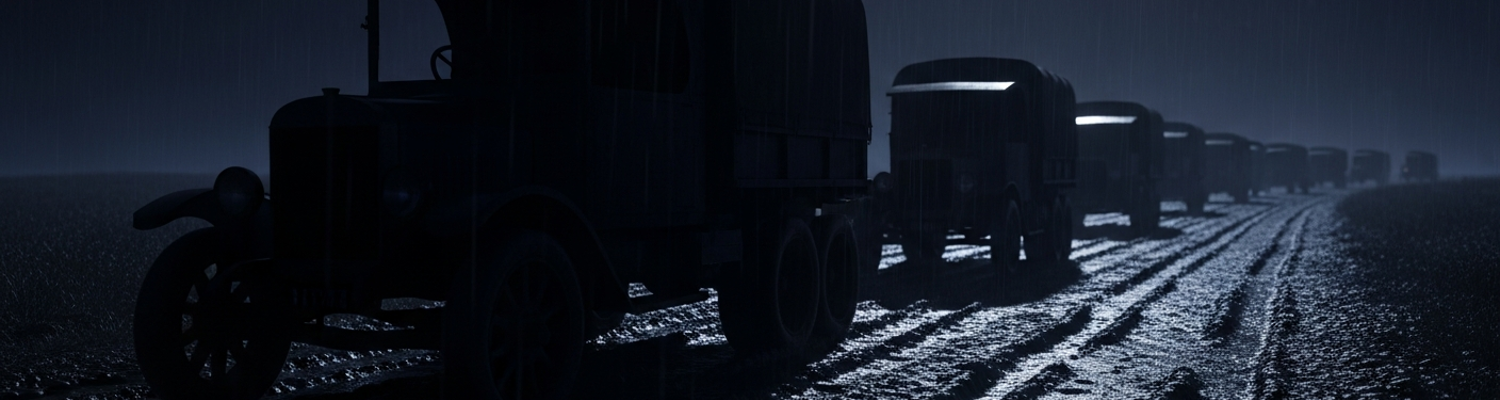

The terrain of the Western Front consumed roads. Cobbled paths dissolved into primordial swamps of clinging mud. Freezing rain turned battlefields into sheets of ice, while summer sun baked the cracked ground until it choked men and machines with abrasive dust. This environment was actively hostile to mechanical transport. Wheels sank, axles snapped, and engines, fouled by grit and water, seized.
For the American Expeditionary Forces arriving in France in 1917, this was a logistical disaster in the making. The AEF’s Quartermaster Corps found a complete breakdown of motorized order. The existing transport fleet was a chaotic collection of over 290 different makes and models of vehicles. Some archival sources suggest 213 of those were American-made. This created an impossible maintenance situation. One French depot reportedly housed a 12-story building staffed by clerks managing over two million distinct, non-interchangeable parts. The 1916 Pancho Villa Expedition had already demonstrated the unsustainability of relying on a patchwork of civilian vehicles. In France, the scale of the problem threatened to cripple the American war effort entirely.
A solution was needed immediately. The call for a standardized military truck was a matter of operational survival.
In July 1917, the Quartermaster Corps and the Society of Automotive Engineers (SAE) convened a committee. Fifty of America’s top automotive engineers were brought to Washington. The directive was severe: design a heavy-duty, 3-to-5-ton truck from scratch. The design had to be free of existing patents, allowing any manufacturer to produce it without legal delay. In a series of intense sessions, the committee, which included representatives from rival companies, pooled their knowledge. They designed an engine by committee. Buda, Waukesha, Continental, Hercules, and Wisconsin all contributed designs for specific components like timing gears, crank cases, and pistons. The entire process, from initial drawings to the first two working prototypes, took 69 days. These first two trucks, assembled in secret at the Gramm-Bernstein and Selden plants, were driven over 400 miles to Washington D.C. They arrived on October 19, 1917, for presentation to the Secretary of War.
The approval of the Class B Standardized Military Truck program triggered a massive industrial mobilization. The design was simple, built for reliability over speed, with a 52-horsepower engine and a top speed of just 15 miles per hour. Its true innovation was total interchangeability. Production was decentralized. Over 150 different suppliers were contracted to produce the 7,500 individual parts. Fifteen primary manufacturers, including Packard, Diamond T, Garford, and Republic, were tasked with final assembly. A crankshaft forged by one company had to fit perfectly into an engine block cast by another. This demanded an unprecedented level of precision among commercial competitors. The newly formed Motor Transport Corps, established on August 15, 1918, was created to manage this new fleet. Though many of the 9,364 Liberty Trucks produced would arrive in France too late to see extensive service before the Armistice, the system that created them set a new standard for military-industrial cooperation.
The first Standard B trucks arrived in France in October 1918, during the Meuse-Argonne Offensive. The machine, born of a rapid design sprint, was built for theory, not the French environment. A close review of operational logs indicates the engine’s cooling system was a primary vulnerability. The flat-finned tube radiator was simple to manufacture but inefficient at dissipating heat from the 425-cubic-inch engine, especially during long, low-gear hauls through mud. A poorly designed fan and fan belt assembly, prone to slippage and breakage, compounded the problem and led to rampant overheating. Drivers reported having to stop convoys frequently to allow engines to cool, a dangerous practice on roads within range of German artillery.
Its drivetrain was a source of constant trouble. The worm-drive rear axle, chosen for its high torque multiplication, proved to be a high-maintenance liability. It demanded specific and consistent lubrication that was difficult to ensure in forward areas. Its internal friction generated significant heat, adding to the vehicle’s overheating problems. The solid rubber tires, while immune to punctures, offered poor traction on the slick, churned-up roads, causing trucks to slide into ditches or become hopelessly bogged down. The Series 1 trucks also featured a dual-ignition system with both a battery-powered distributor and a magneto backup, plus electric lighting. This complexity was a significant weakness. AEF mechanics, many with limited electrical knowledge, struggled to diagnose and repair systems easily fouled by water and dirt. These design defects turned the AEF's logistical apparatus into a daily struggle for mechanical survival.
The promise of total parts interchangeability fractured against the realities of wartime production. While the design was standardized, execution by over 150 parts suppliers and 15 assembly plants was not perfectly uniform. The Motor Transport Corps, headquartered in Tours, France, found itself grappling with a supply chain that was far from seamless. Parts that were supposed to be identical often required filing or modification to fit. The supply depots, such as the intermediate storage facility at Gievres and the main locomotive repair shops at Nevers, were overwhelmed. Breakdowns were constant. The practice of stripping parts from one disabled truck to keep another running became standard procedure, just as it had during the Pancho Villa Expedition. This created a cycle of degradation, turning repairable vehicles into skeletal hulks and masking the true scale of the spare parts shortage from higher command.
In response, front-line mechanics and drivers initiated unauthorized adaptations. Some units removed engine side panels for better airflow and jury-rigged improvements to fan belt tensioners. An official change came with the introduction of the Second Series Liberty truck. Acknowledging the unreliability of the advanced electrical system, the army reverted to a simpler, more robust magneto-only ignition. The electric lights were replaced with acetylene gas lamps, with a gas generator mounted on the cowl. This was a direct admission that the technology had outpaced the training and operational environment of its users. A reserve fuel tank was also added under the passenger seat, with a manual pump to transfer fuel to the main tank, providing a buffer against running dry during long convoy movements.
The American Expeditionary Forces' push into the Meuse-Argonne sector, commencing on September 26, 1918, was an operation of a scale that relied entirely on motorized transport. Despite its mechanical deficiencies, the arrival of the Liberty Truck represented a massive increase in logistical capability. The new Motor Transport Corps was tasked with organizing this flood of machines into a coherent system. Operational logs from the AEF First Army show an immediate and total dependence on these trucks. For the 47-day battle involving 1.2 million American soldiers, the Liberty Truck became the default vehicle for moving the immense quantities of materiel needed to sustain the advance.
Every round of ammunition, every can of beef, every bandage arrived on the back of a truck.
Maintaining the arteries to the front was a round-the-clock effort. AEF planners, including Colonel George C. Marshall, had less than two weeks to shift 600,000 men and nearly a million tons of supplies into the new sector following the St. Mihiel operation. This created traffic jams of historic proportions on the few available roads. The MTC, under Brigadier General Meriwether Lewis Walker, instituted strict traffic control measures. Special truck route maps designated main roads for one-way traffic in loops from the railheads to forward distribution points and back. The main road through the sector became a scene of organized pandemonium, with Liberty Trucks sharing the mud-choked, shell-cratered path with horse-drawn wagons, artillery caissons, and marching infantry. The truck's slow top speed of 15 miles per hour helped regulate convoy pace, preventing faster vehicles from creating bottlenecks. Engineer units worked constantly to keep these roads passable, laying down corduroy surfaces of logs and filling shell holes, but the routes were in a perpetual state of disintegration.
To support the initial days of the attack alone, logisticians pre-positioned 40,000 tons of artillery shells. At a standard 3-ton load capacity, this single requirement translated into over 13,000 individual truckloads. Archival evidence from the AEF’s Services of Supply indicates that daily deliveries to the First Army averaged thousands of tons. A typical Liberty Truck leaving a railhead depot might carry a mixed load of 75mm artillery shells, crates of .30-06 rifle ammunition, sacks of flour, drums of gasoline, and bundles of barbed wire. This relentless delivery schedule was only half of the Liberty’s function. On their return trips, the trucks were systematically repurposed for casualty evacuation. The same cargo beds that brought shells to the front were used to transport the wounded back to field hospitals. This grim dual-use was a necessity born of the offensive’s high casualty rates, which totaled over 122,000 American soldiers killed and wounded.
As the AEF advanced in the final weeks of the war and then marched into Germany for occupation duty, MTC convoys faced a landscape seeded with deliberate traps. The retreating German Army conducted a methodical withdrawal, and their skilled engineer units were masters of defensive delay. A primary tactic was the mining of roadways. A review of AEF operational logs from the III and IV Corps' advance toward the Coblenz Bridgehead reveals repeated instances of Liberty Trucks falling victim to this strategy. The lead truck in a convoy, pushing forward on a road deemed clear, would detonate a pressure-activated anti-tank mine concealed in a repaired pothole. The blast would shatter the solid front axle, buckle the steel channel frame, and often crack the engine block, rendering the vehicle a total loss. The two-man crew in the open cab was completely exposed. This single event would halt an entire truck company, creating a vulnerable, stationary target.
The systematic destruction of infrastructure posed an equally disruptive challenge. Throughout the Meuse-Argonne region, and later in the Mosel River valley, every significant bridge was demolished. Steel truss bridges were cut with explosive charges, and stone arch bridges had their keystones blown out. For an MTC convoy, arriving at a destroyed crossing meant a dead stop. This forced logisticians to rely on AEF engineers, like the 23rd Engineers, to throw temporary pontoon bridges across the water. These structures were perilous for heavy trucks. A Liberty Truck, weighing over five tons empty, had to navigate steep, muddy inclines to descend to the bridge level. Its solid rubber tires offered minimal grip, and the worm-drive rear axle was placed under immense strain. A single miscalculation by a driver could send a truck sliding off the causeway, blocking the crossing for hours.
These physical hazards were made more deadly by a failure of battlefield intelligence. Information gathered by forward units often failed to reach MTC planners and convoy commanders in time. An Army Engineer patrol might identify a mined section of road, but this data was slow to disseminate through the overburdened communication lines of 1918. A convoy commander leaving a supply depot like Gievres would be issued route maps that could be hours, or even a full day, out of date. The pace of both the German withdrawal and the American advance meant the tactical situation was fluid. There was no centralized, real-time intelligence apparatus to provide MTC dispatchers with an accurate picture of the road network ahead. The lead truck of the convoy itself often served as the primary method of route reconnaissance, placing the burden of discovery directly upon the enlisted drivers.
With the Armistice signed, the Liberty Truck’s war was not over. Thousands were shipped back to the United States, creating a huge surplus of heavy-duty vehicles. The U.S. government sold them at low prices to state highway departments and private citizens. This massive sell-off helped build countless small, independent trucking companies in the early 1920s, but it also flooded the market, depressing sales for manufacturers trying to sell new, more advanced designs. Many Liberty Trucks were adapted for civilian use, converted into fire engines and buses. A few saw continued military service, participating in the 1919 Transcontinental Motor Convoy, an exercise that highlighted the poor state of American roads and influenced a young Lt. Col. Dwight D. Eisenhower. The trucks also served with American forces in Siberia between 1918 and 1920.
Obsolescence was rapid. The features that made the truck a success in 1918, simplicity and a patent-free design, made it an antique by 1925. Post-war civilian truck technology advanced quickly. Competitors like Mack, whose AC model gained a reputation for toughness, remained in production until 1938. The commercial market demanded more than the Liberty could offer. Enclosed cabs replaced the open-air bench. Pneumatic tires, offering a smoother ride and better traction, became standard and rendered solid rubber tires obsolete. Four-wheel brakes, more powerful engines, and electric starters became common features that the Liberty design lacked.