
Signals Doctrine and Joint Board 319
Radio operators crouching over a battery powered receiver near the Abucay line detected the first uncoordinated bursts of Japanese field transmissions cutting across local frequencies. These sudden enemy broadcasts triggered an immediate warning to their battalion command post. Captains and staff messengers scrambled down the chain of command to notify headquarters, but their urgent reports stalled the moment they attempted to cross into naval channels monitoring Manila Bay. Joint Board 319 had established the formal division of radio intelligence jurisdictions and tactical intercept responsibilities between the Army Signal Corps and the Navy OP 20 G in 1933. That interwar agreement assigned land based military networks to Army listening posts, while naval stations on Corregidor tracked fleet traffic and maritime movements under strict security walls that prevented direct tactical cross talk. Soldiers crouched in earthen trenches were forced to route raw tactical alerts up through corps headquarters rather than sharing target data directly with nearby naval gunboats or coastal batteries.
Gunboats and naval intercept sections operating inside the Malinta Tunnel remained completely isolated from these frontline Army warnings due to rigid liaison channels established by Major Spencer Akin. Akin had co drafted key provisions outlining inter service frequency coordination and cryptographic liaison procedures prior to serving as Chief Signal Officer for United States Army Forces in the Far East. His interwar planning had produced administrative mechanisms that required physical couriers to carry deciphered transcripts and coordination slips between separate service command posts. Tropical dampness, Japanese artillery barrages, and severed road networks on Bataan quickly broke these deliberate handoff schedules. Akin ordered his signal officers to improvise direct courier runs and emergency schedule swaps to keep the two services exchanging raw target data across the bay.
Water crossings and emergency links proved nearly impossible to execute because the prewar doctrine prioritized administrative jurisdictional boundaries over technical hardware standardization and field level equipment interoperability. Army field sets like the SCR 131 operated on different frequency bands and utilized different power supplies than the tactical transmitters installed aboard Navy patrol craft or used by Fourth Marine regiments along the beaches. Transmitters built for infantry battalions could not lock onto naval channels without custom crystals, leaving field operators unable to talk across service lines even when sharing the same patch of jungle. Technicians spent daylight hours rebuilding circuit coils, winding copper wire around salvaged wooden pegs, and hand filing quartz crystals to force incompatible transmitters onto shared frequencies. Enlisted operators then carried these retuned radios back toward the front lines, testing whether their improvised signals could travel through the dense jungle canopy and reach naval receivers across the water.
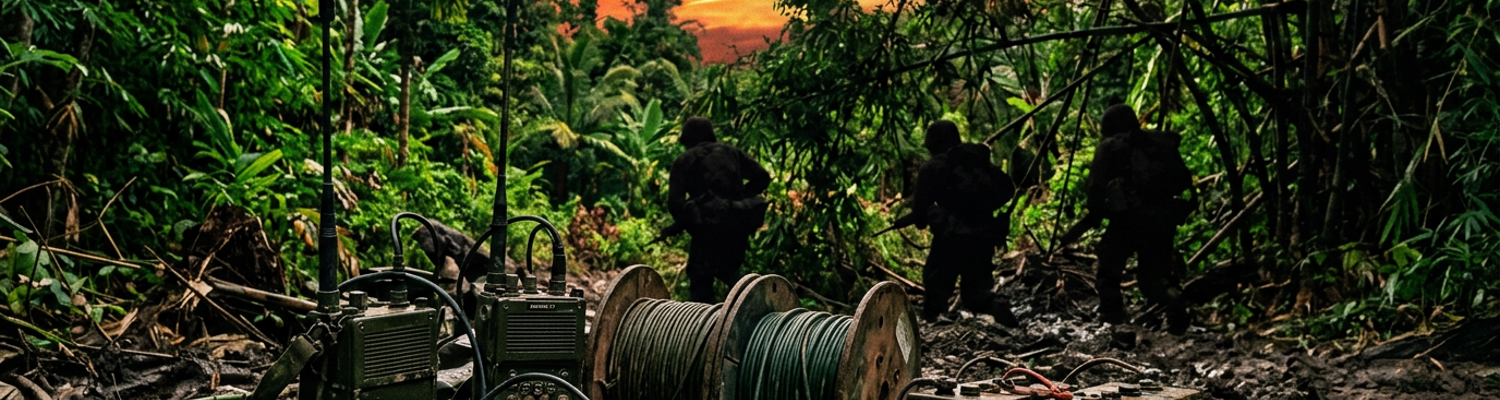
Foliage and dense water absorbed these uncertain radio links, forcing wiremen to shoulder heavy reels of insulated cable and push into the undergrowth under mortar fire to establish direct telephone connections. Shell fragments tore through overhead lines faster than repair crews could string fresh wire, forcing men to crawl through dense bamboo on their stomachs to find severed ends by touch in the dark. Operators wrapped stripped copper wire with friction tape and buried the lines beneath damp jungle soil to protect them from truck tires and exploding shrapnel. Soldiers took turns cranking hand generators until their palms blistered, feeding current into the spliced networks so spotters could report Japanese movements back to corps command. Battalion headquarters logged the incoming grid coordinates onto grease pencil maps and issued fire orders to artillery batteries dug into the reverse slopes.
Artillery Communications Breakdown on the Orion Bagac Line
Slopes provided cover for artillery crews who rammed explosive shells into howitzer breeches and fired across the ridges to break up advancing enemy formations. Japanese artillery barrages and heavy mortar fire immediately hammered back across the forward slopes, chewing through tree trunks and churning the jungle floor into deep mud. These repeated shell bursts routinely severed surface laid W 110 assault wire running along trails and across rocky ravines, instantly isolating regimental command posts from forward observation points. Linemen crawled from their foxholes into blinding smoke to trace the snapped lines by hand, finding shredded cotton braid, ruined rubber insulation, and frayed copper strands scattered across cratered hillsides. Technicians worked on their bellies under continuous sniper fire to splice the raw metal together and seal each joint with sticky black friction tape. Fresh mortar rounds blew the lines apart faster than the men could tape them, forcing forward observers trapped in frontline rifle pits to abandon their dead magneto telephones and unpack their field radios.
Radios like the SCR 131 and SCR 161 offered the only remaining link across the broken ground, yet these fragile battery operated units struggled against the brutal island environment. Frontline defenders holding the Orion Bagac Line in early 1942 carried the cumbersome metal boxes through swamp water and thick volcanic dust, cracking delicate vacuum tubes and corroding internal wiring along the way. Jungle canopy attenuation severely degraded outgoing radio waves as dense mahogany trees, hanging banyan vines, and damp bamboo thickets absorbed high frequency ground signals before they could travel more than a mile through the ridges. Operators cranked heavy hand generators until their knuckles bled and swapped out swollen acid leaking batteries that had spoiled in the tropical heat. Receiver headsets produced only deafening static while soldiers shouted into carbon microphones in a desperate attempt to reach the rear echelons. Command posts on the reverse slopes caught only garbled fragments of vital target coordinates, leaving staff officers completely blind to whether front lines still held along the river valleys or if enemy assault units were slipping around their flanks toward Manila Bay.
Manila Bay beaches became the next critical vulnerability as Army signalmen watching Japanese movements discovered that disparate service frequency assignments prevented direct tactical coordination between Army infantry and naval elements. Theoretical liaison channels collapsed locally because prewar Joint Board directives had divided military radio bands into rigid non overlapping service sectors. Offshore naval craft and Corregidor stations utilized crystal sets that could not tune to frontline infantry transmitters. Soldiers watching enemy landing barges assemble along the shoreline had no mechanical way to transmit gun coordinates directly to nearby motor torpedo boats or coastal artillery emplacements without routing paper messages miles inland through crippled corps switchboards. Signal officers attempted to bridge the widening gap by sending motorcycle dispatch riders and foot messengers toward the beaches, but Japanese snipers and falling mortar shells regularly killed the runners along the exposed jungle trails. Coastal infantry units finally abandoned all radio protocol, climbing out onto rocky bluffs to fire red distress flares into the dark sky so offshore patrol boats could spot enemy troop concentrations by sight.
Pyrotechnics and Assault Wire Splicing
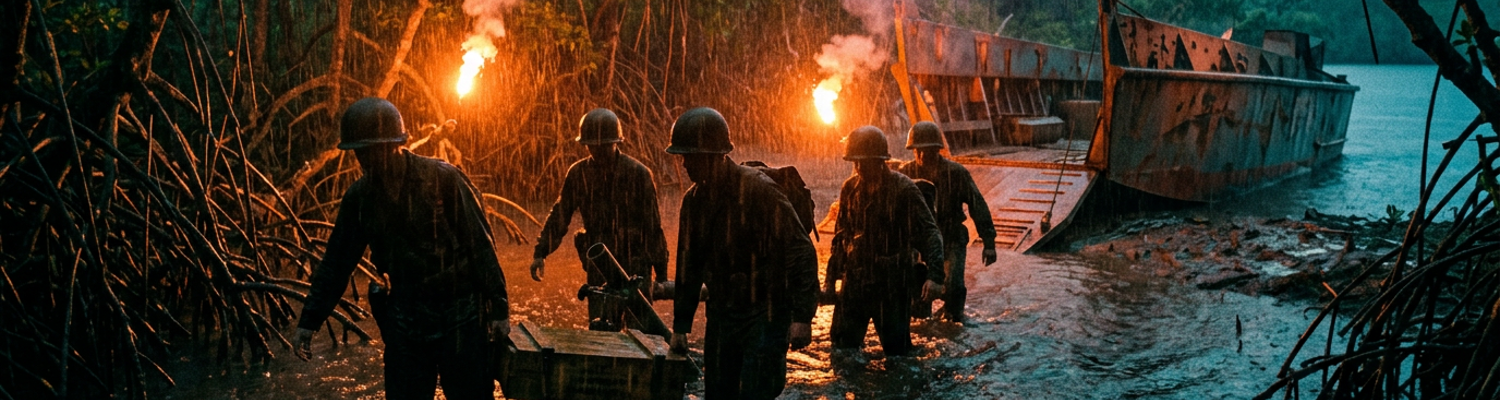
Pyrotechnics drew immediate attention from Japanese artillery batteries, who locked onto the flares within seconds and threw high explosive barrages into the supply hollows linking the coastal bluffs to rear headquarters. Shrapnel sliced clean through the primary communications corridors, cutting forward infantry regiments off from both artillery support and command coordination. Enlisted Signal Corps wiremen crawled through bamboo thickets under magnesium illumination flares to locate and splice shattered twisted pair wire by touch. Sharp bamboo splinters tore through wet uniforms as the men dragged their bodies forward through the mud, keeping their fingers pinned to the buried line until they reached the jagged torn ends of the insulation. Technicians worked completely blind in the dark between flare bursts, feeling for fractured metal strands with numb hands while Japanese mortar rounds exploded close enough to shower their backs with stones and dirt. Operators pulled the severed leads together and secured temporary knots with their bare fingers, leaving the lines stretched across open ground for testing teams to verify.
Teams carrying EE 8 field telephones faced sustained sniper fire and continuous concussion while tracing these stretched lines through ravine choke points. Japanese marksmen tied into high banyan branches zeroed in on the narrow creek beds where wire runs naturally clustered together, firing at every helmet that broke the surface of the mud. Heavy howitzer shells exploded along the stone walls of the ravines every few minutes, pounding the air with violent shockwaves that knocked the wiremen flat, ruptured eardrums, and caused bleeding from the nose and mouth. Repairmen hooked the test clips of their heavy leather EE 8 handsets directly into the spliced pairs every fifty yards, turning the hand cranks to ring switchboard operators buried in the forward division bunkers. Dead silence answered almost every ring because hidden breaks still lurked farther down the line. Linemen shouldered their field gear and crawled deeper into the impact zones to find the remaining fractures.
Shrapnel inside the impact zones had pulverized entire segments of cable beyond basic field repair, exhausting the forward battalions of fresh spool inventory. Acute wire shortages forced linemen to salvage fragmented remnants and twist bare copper strands together without vulcanizing tape, leaving circuits vulnerable to torrential dampness. Tropical downpours and humid ground mist soaked the uncovered joints within minutes of completion, leaking battery current into the saturated soil and killing signal strength across the entire loop. Technicians stripped scraps of rubber from vehicle floorboards or tied dry banana leaves around the exposed copper with medical adhesive tape to keep the raw conductors off the mud. Signal officers pushed these patchy waterlogged loops straight into battalion switchboards, giving forward artillery spotters a few fragile minutes of talk time to call in defensive fire before the circuits grounded out completely. Artillery officers caught those hurried fire coordinates over the rasping receivers and immediately passed firing solutions to battery crews hidden along the reverse slopes of Mount Samat.
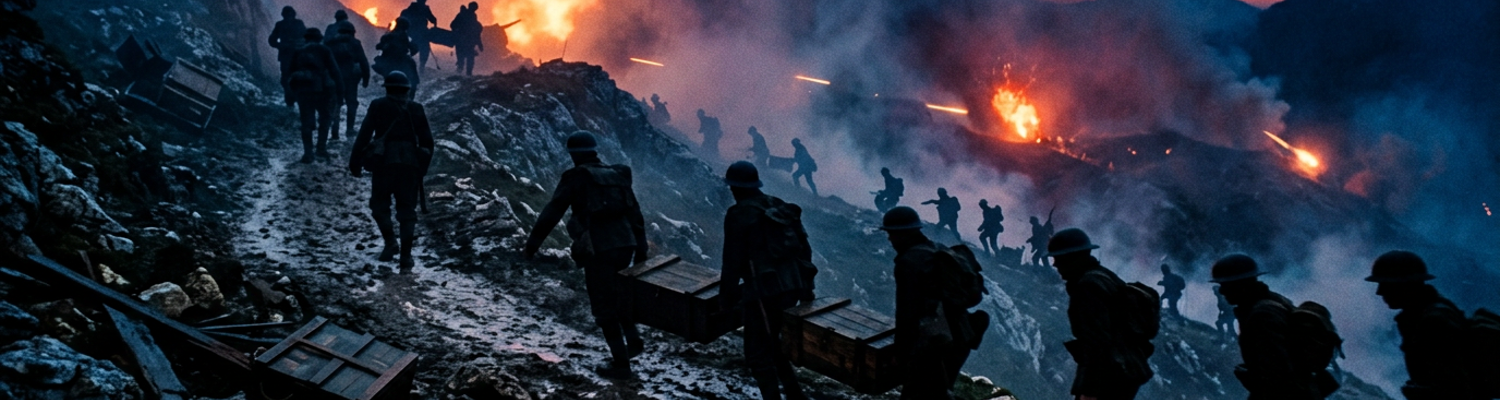
Mount Samat gun crews slammed seventy five millimeter shells into open breeches and fired counter battery volleys across the ridges to suppress the Japanese mortar pits threatening the wire teams. Incoming counter battery rounds from enemy positions immediately pounded back across the American gun pits, setting the jungle canopy on fire and severing the newly restored circuits all over again. Signal detachments grabbed fresh reels of salvaged wire from the rear trenches, dropped back onto their stomachs in the burning brush, and began tracing the dead lines through the smoke to rebuild the network. Linemen tracing those severed lines through the burning brush soon discovered that Japanese artillery had pulverized the assault wire beyond any possibility of field repair. Company commanders immediately turned to tactical field radios to maintain contact across the Orion Bagac line, but the standard dry cell battery packs inside the sets had already died from tropical dampness and weeks of non stop combat operation. Cut off from resupply by the offshore naval blockade, frontline radio operators scavenged civilian and military vehicle wet cell lead acid batteries to keep tactical transmitters operational.
Transmitter Power Scavenging and Field Improvisation
Transmitters required constant power, prompting signal teams to creep into bombed out motor pools, transport parks, and roadside ditches under continuous mortar fire. Soldiers used pocket tools to unbolt batteries from disabled Dodge trucks, command sedans, and artillery prime movers. Men dragged the heavy lead acid blocks out of crushed engine compartments, lashed the black casings to bamboo poles, and carried them through jungle ravines back to forward communication trenches. Wiremen quickly cut short lengths of salvaged copper wire and bolted them directly onto the lead terminal posts to fashion heavy duty power cables for the transmitters. Technicians inspecting those scavenged batteries inside the forward bunkers found that rough terrain and bomb concussions had cracked the cell casings and drained the fluid. Signal personnel improvised battery acid by diluting industrial electrolytes with river water, scouring wrecked sugar mills, machine shops, and supply sheds for commercial sulfuric acid to fill the empty cells.
Cells filled with impurities and silt from the muddy river water contaminated the chemical mixture, causing erratic voltage discharges that fluctuated wildly whenever an operator pressed the microphone switch. Acidic fumes boiled out of the uncapped battery casings in the humid bunker heat, filling the dugouts with stinging vapors and corroding radio terminals with thick green crusts of copper sulfate. Voltage spikes caused by the unstable chemical reaction repeatedly burned out delicate vacuum tubes, forcing technicians to strip spare parts from damaged receivers to keep at least one set working. Radio operators used bayonet points and strips of canvas to scrape the corroding binding posts clean before every call, fighting to keep the raw metal surfaces connected to the improvised cables. Batteries hooked to those improvised cables rapidly lost their electrical charge under the heavy current draw of the tactical transmitters. Depleted power reserves forced command detachments to enforce strict transmission rationing, limiting radios to scheduled brief contacts rather than continuous nets.
Headquarters officers abolished continuous nets across the division, ordering frontline units to keep their radio sets completely powered down between designated check in windows. Forward observers had to draft their target coordinates, infantry casualty reports, and defensive requests on paper before touching the equipment, ensuring that no transmission lasted longer than two minutes. Operators closed the main knife switches only when their designated contact window arrived, transmitted their encoded Morse code messages at top speed, and immediately pulled the battery clips off the posts to save the remaining power. Battalion signal officers logged each battery unit remaining voltage in pencil on dugout walls, reserving the final ampere hours exclusively for urgent artillery barrages when Japanese assault troops pushed into the frontline wire. Batteries inside frontline radios could not bridge the wider distances across Manila Bay, and severe disruption of underwater landline cables completely severed direct telephone and teletype circuits between the Bataan peninsula and Corregidor. Japanese aerial depth charges and heavy dragging anchors from scuttled merchant ships repeatedly snagged the lead sheathed cables on the bay floor, ripping the copper cores apart and flooding the inner insulation with saltwater.
Saltwater Disruption and Courier Sorties
Saltwater flooding the underwater terminals at the Mariveles and Cabcaben cable huts registered dead circuits on wiremen galvanometers, proving that physical repair under active enemy air patrol was technically impossible. This total loss of submerged wire forced commanders on both sides of the bay to rely on manual couriers and small motor launches to maintain operational liaison across the water. Headquarters officers assembled courier details from infantry runners and signal staff, packing duplicate copies of tactical orders, tactical maps, and situation reports into waterproof canvas pouches. Naval boat details scoured the rocky coves near Mariveles harbor for surviving thirty six foot motor launches, diesel workboats, and wooden whaleboats. Mechanics fueled the civilian engines with drained aviation gasoline to establish a makeshift shuttle line. Sailors and army runner details navigated Japanese coastal artillery corridors and patrol boats across the North Channel under cover of darkness.
Darkness provided the only shield for coxswains who waited for absolute nightfall to cast off from camouflaged piers, steering without running lights and wrapping canvas blankets around engine exhaust pipes to muffle the sound of their machinery. Japanese coastal artillery batteries emplaced on the southern shore of Manila Bay watched the channel corridors continuously, firing high velocity shells whenever engine rumbles or wake phosphorescence betrayed a crossing vessel. Japanese picket boats and armed motor launches patrolled the narrow maritime gap between Cabcaben and the fortress docks, forcing American helmsmen to kill their engines and drift silently through choppy black water while enemy searchlights swept the open swells. Shrapnel from near miss explosive shells punched holes through thin wooden hulls, compelling couriers to bail out incoming water with their steel helmets while sailors plugged shattered strakes with tallow soaked canvas strips. Naval coxswains guided their battered craft through the lethal minefield gaps guarding Corregidor northern approaches, finally ramming the wooden bows against the splintered pilings of the North Mine Dock or Engineer Dock under mortar bombardment. Paper message packets carried ashore by these exhausted boat couriers introduced multi hour operational delays into artillery coordination and casualty reporting across the besieged perimeter.
Dock personnel stationed at the perimeter grabbed the soaked canvas pouches from the couriers and sprinted into Malinta Tunnel, where cryptographic teams faced backlogs of enciphered reports requiring manual decryption with codebooks. Physical transport of enciphered paper messages meant that urgently requested fire coordinates for Japanese artillery concentrations arrived at fortress batteries four to six hours after infantry spotters had first noted the targets. Corregidor gunners manning twelve inch mortars and coastal guns regularly received fire requests for enemy positions that Japanese units had already abandoned hours earlier, rendering heavy counter battery barrages ineffective. Casualty figures and emergency ammunition requisitions sent from the Bataan front lines suffered the same crippling operational lag, leaving field surgeons without fresh blood plasma and forward infantry battalions without rifle cartridges while duplicate orders sat waiting for the next midnight crossing. Corps commanders attempting to direct tactical counterattacks received morning frontline assessments only after night had fallen again, leaving staff officers to draft defensive operational plans around troop dispositions that no longer existed. Officers in rear command posts burned their obsolete grease pencil maps as Major General Edward King sent white flag emissaries forward to surrender the starving garrison.
Garrison Capitulation and Doctrine Failures
Garrison capitulation on Bataan exposed Joint Board 319 fundamental failure to harmonize tactical radio sets and field level supply chains. Infantry battalions had run out of vacuum tubes, dry cell batteries, and assault wire weeks before the final collapse because prewar planners had never established unified procurement channels or interchangeable hardware standards between the services. Army field sets required completely different operating voltages, antenna connectors, and replacement quartz crystals than naval radio receivers, preventing isolated garrisons from pooling their remaining maintenance stocks or salvaging spare parts across branch lines. Linemen and operators had spent months scavenging lead plates from commercial truck engines and diluting chemical waste with muddy river water because no shared depot system existed to funnel standard military dry cells to the front. Radio operators smashed their useless transmitters with sledgehammers, chopped field telephone cables into short pieces, and cast dead lead acid batteries into jungle ravines rather than letting intact gear fall into enemy hands. Sledgehammers and saltwater destroyed what little equipment remained across the peninsula, leaving the surviving signalmen to burn their codebooks before Japanese infantry overran the final defensive perimeters.
Surrender protocols finalized the defeat, yet institutional compartmentalization between the Army Signal Corps and naval communications detachments had hindered unified tactical fires and joint defense planning throughout the four month campaign. Naval communications detachments guarding the Mariveles naval base and Corregidor kept their watch frequencies, cryptographic systems, and fire control networks tightly isolated within separate message centers. Army artillery batteries dug into the reverse slopes of Mount Samat never received direct wire links or common tactical frequencies to call down naval gunfire from gunboats patrolling the coastal flanks. Joint defense planning withered into fragmented localized skirmishes because neither service possessed the authority, common operating manuals, or shared switchboards needed to direct combined fires against advancing Japanese columns. Staff officers from both branches sat in separate concrete dugouts only hundreds of yards apart, unable to coordinate defensive counterattacks without sending written messages on paper across mud choked trails. Paper dispatches and tactical debriefings carried out of the Philippines by evacuated signal personnel soon reached General Douglas MacArthur newly formed Southwest Pacific Area headquarters in Melbourne.
Melbourne planners in the War and Navy Departments reviewed these debriefings and discarded the jurisdictional boundaries established by Joint Board 319, replacing service specific communications commands with unified joint communications boards under theater commanders. Military procurement officers compelled industrial manufacturers to engineer standardized tactical radios with interchangeable vacuum tubes, standard terminal connectors, and universal dry cell battery packs that fit both Army and Navy field sets. Theater signal officers established joint signal operating instructions that assigned shared crystal frequencies to ground units, landing craft, and naval gunnery ships, eliminating the technical barriers that had silenced combined fires on Bataan. Combat communications detachments deployed in subsequent operations across New Guinea and the Solomon Islands carried these standardized sets onto the beaches, plugging directly into unified command networks. Frontline infantry units transmitted target coordinates over these shared frequencies, instantly linking ground spotters to offshore naval batteries and closing the communication gaps that had doomed the earlier defense.