
By 1995, a full twenty percent of all high-altitude reconnaissance sorties flown by the United States Air Force over the Korean peninsula resulted in an operational mission abort. This occurred from either component failure or prohibitive weather. It was not a statistic that appeared in public-facing Pentagon reports. It was, however, a number known intimately by the crews on the ground at Osan Air Base.
The end of the Cold War had reshaped the American military. The Korean theater was no exception. A close review of operational logs shows a force grappling with budget cuts. Seventh Air Force command, headquartered at Osan, oversaw a leaner, consolidated presence. The 51st Fighter Wing at Osan operated A-10 Thunderbolt IIs and F-16C/D Fighting Falcons, tasked with close air support and defense of the base. At Kunsan Air Base, the 8th Fighter Wing, the Wolf Pack, also flew F-16s. These units projected power. The strategic eyes and ears of the peninsula were a small, overtaxed collection of specialized assets. The post-Cold War drawdown meant fewer airframes, a smaller pool of maintenance personnel, and constant pressure to do more with less. Aircraft that had been workhorses since the 1970s and 80s were now showing their age. Parts availability became a persistent issue that complicated readiness for the fighter wings and the reconnaissance platforms alike.
Archival evidence shows that the primary intelligence collection objectives for the United States in 1995 were intensely focused. Following the October 1994 Agreed Framework, which was intended to freeze Pyongyang’s plutonium production, verification became a paramount concern. The U-2R Dragon Lady aircraft of the 5th Reconnaissance Squadron, the Blackcats operating out of Osan, were central to this mission. Their flight plans were designed to gather imagery and signals intelligence on the Yongbyon Nuclear Scientific Research Center. They looked for any sign of activity that violated the agreement, such as steam venting from reactor buildings or vehicle movement near spent fuel rod ponds. Beyond the nuclear file, collection priorities included locating and identifying Nodong-1 and Scud-B/C missile launchers. Many were hidden in caves or were mobile, making them difficult to track. Another major objective was mapping the thousands of hardened artillery sites north of the Demilitarized Zone, many of which held Seoul within their range. RC-135V/W Rivet Joint aircraft, flying standoff patterns over the Yellow Sea and the Sea of Japan, were tasked with intercepting North Korean command and control communications. This provided a window into the Korean People’s Army’s operational readiness.
The shadow of Operation Desert Storm loomed large over the strategic thinking of the mid-1990s. It fostered a powerful perception of American technological dominance. The public success of assets like the F-117 Nighthawk and precision-guided munitions created a narrative of near-invincibility. This confidence masked a more complex picture on the Korean peninsula. The high-altitude U-2, while capable of flying above 70,000 feet and beyond the reach of most air defense systems, was notoriously difficult to fly and maintain. The Dragon Lady required specialized physiological support for its pilots. It was susceptible to aborts from something as simple as unforecasted jet stream turbulence. North Korea possessed one of the world’s densest air defense networks, a layered system of Soviet-era SA-2, SA-3, and SA-5 surface-to-air missiles, supplemented by over 11,000 anti-aircraft artillery pieces. While much of this equipment was old, its sheer volume forced standoff reconnaissance platforms like the RC-135 into predictable, repetitive orbits far off the coast. This predictability allowed North Korean operators to know exactly when and where the American aircraft would be. It enabled them to curb or disguise any activity they did not want observed. The mountainous terrain of the peninsula itself was a significant obstacle. It created extensive radar shadows that could hide entire military formations from the synthetic aperture radars on the U-2s and other platforms.
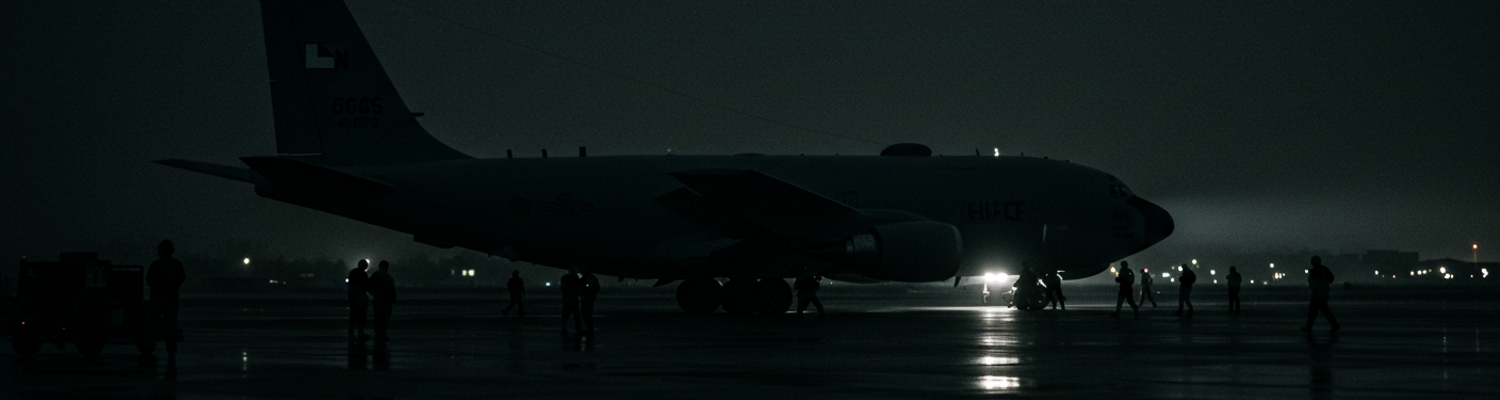
A 1995 reconnaissance sortie over the Sea of Japan illustrated the operational penalties of a strained logistics chain. The mission was flown by an RC-135V Rivet Joint from the 82nd Reconnaissance Squadron operating out of Kadena Air Base, Japan. It was designed to monitor North Korean military communications from a standard orbit east of the peninsula. Central to this task was the aircraft’s ability to disseminate collected signals intelligence (SIGINT) in near real-time to ground-based analysts and theater commanders. This capability was wholly dependent on a specific piece of hardware. The AN/USQ-113 Communications Intelligence and Emitter Location System’s primary data link transponder. This module connected the aircraft’s massive sensor suite to the Tactical Information Broadcast Service (TIBS). It allowed the dozens of intelligence operators in the cabin to transmit data via secure satellite communication links. Several hours into the flight, this transponder failed completely. The consoles of the electronic warfare officers and intelligence specialists went static. The live connection to the 390th Intelligence Squadron and the wider intelligence apparatus was severed. The multi-million dollar reconnaissance platform, with its crew of over 30 personnel, was instantly rendered a simple data storage device. Its primary mission of providing immediate threat warning and intelligence was nullified.
The failure was not sudden.
It was the predictable result of systemic issues. A close review of maintenance logs for the specific airframe, a Boeing 707 derivative manufactured in the early 1960s, reveals a persistent and unaddressed history of malfunctions related to the data link module. The component was located in an aft electronics rack, a section of the fuselage known to be subject to high levels of structural vibration from the four aging TF33-P-9 turbofan engines. For months leading up to the incident, maintenance crews at Kadena had repeatedly documented intermittent fault codes indicating the module was overheating. The unit would be flagged in the maintenance debrief. It would be inspected. Often the fault could not be replicated on the ground, leading to it being reset. The problem was an advanced case of vibration fatigue. Microscopic cracks in the module’s solder joints and circuit boards were beginning to fail under the combined stress of high operational temperatures and constant shaking. The supply of replacement Line Replaceable Units (LRUs) for this specific system was critically low throughout Pacific Air Forces. This was a direct consequence of post-Cold War budget tightening. A command-level decision was made to accept the operational risk, prioritizing aircraft availability over rectifying an intermittent, non-flight-critical fault.
Onboard the Rivet Joint, the failure presented an immediate tactical dilemma for the aircraft commander. With the primary intelligence-gathering function inoperative, continuing the 12-hour mission offered limited value. The aircraft could maintain its orbit, acting as a visible deterrent and forcing North Korean air defense networks to remain active. It could no longer listen to their responses. After a brief consultation with the senior electronic warfare officer and confirming the module could not be reset in-flight, the decision was made to abort. The aircraft broke from its racetrack pattern over the Sea of Japan. It began the long flight back to Kadena. The mission was officially logged as an operational failure due to equipment malfunction. It left a significant intelligence gap for the duration of its scheduled time on station.
The aborted sortie translated into a tactical intelligence void. The AN/USQ-113 data link was severed. The high-resolution signals intelligence payload was not simply degraded; its primary function was rendered inoperable for near-real-time purposes. The system’s importance was not just its ability to intercept communications, but its capacity to precisely geolocate the origin of those signals and stream that data to analysts on the ground. Onboard, the magnetic tape recorders continued to spool. They captured the raw electromagnetic spectrum for later analysis. This archival function, however, was a mission failure. The core purpose of the RC-135V was to provide immediate, actionable intelligence to theater commanders. To see the electronic order of battle as it formed, not to reconstruct it from a tape hours or days later. The more than two dozen intelligence operators and electronic warfare officers in the aircraft’s cabin were effectively blind to the meaning of the data they were collecting. They could not correlate their intercepts with other intelligence sources, such as satellite imagery or reports from human assets. They could not provide time-sensitive warnings directly to forces in the region.
The intelligence blackout was immediate. A review of archival intelligence summaries from that period suggests the operational cost of this specific failure. During the precise multi-hour window the RC-135V was off-station, a North Korean army unit, believed to be the VI Corps stationed near the city of Chongjin, conducted a significant communications exercise. This was not a routine event. Declassified analyses point to this period as one of extreme internal instability within the DPRK, culminating in a large-scale purge of the VI Corps leadership. The radio traffic intercepted by other, more distant collection assets was assessed as being heavily encrypted and utilizing burst transmission techniques designed to evade simple monitoring. North Korean military communications in 1995 still relied heavily on older, often Soviet-supplied, radio equipment. They had developed sophisticated protocols to mask their intentions. The Rivet Joint, with its unique ability to get close to the origin of such signals and analyze them on the spot, was the only asset capable of potentially decrypting or at least geolocating these transmissions with enough precision to understand the scope of the activity. Without it, the transmissions were logged as anomalies. Their connection to an impending internal coup attempt was missed entirely.
The silence from the RC-135 was not just an absence of data. It was an active vulnerability. This single incident cast a harsh light on a systemic weakness in the U.S. airborne SIGINT architecture of the era. The dependence on a single, aging data link for the dissemination of time-sensitive intelligence represented a catastrophic single point of failure. The entire reconnaissance system, from the multi-million-dollar aircraft and its highly trained crew to the ground-based processing, exploitation, and dissemination (PED) cells, was bottlenecked by one non-redundant, decades-old transponder. Post-mission analysis within Pacific Air Forces and the Air Intelligence Agency identified this specific flight as a key case study demonstrating how budget-driven delays in modernization and a depleted inventory of spare parts could have direct tactical consequences. The event underscored the asymmetric risk posed by relying on complex, aging platforms for missions where real-time data was the primary product. While the RC-135 was a powerful collector, its value diminished exponentially with every minute the data remained exclusively on board. The failure drove subsequent requirements for redundant satellite communication links and the accelerated replacement of legacy analog components with more reliable, solid-state digital systems in later Rivet Joint block upgrades.
North Korean military doctrine, by the 1990s, was an obsession with the physical security of its command-and-control apparatus. This was not a theoretical principle. It was engineered into the very landscape of the nation. Intelligence assessments from the period detail a vast, redundant network of hardened landlines forming the primary communication method for the Korean People’s Army (KPA). These were not simple telephone wires. A review of the system’s architecture reveals a complex web of copper and, in certain areas, nascent fiber-optic cables buried deep underground. They were often encased in concrete and routed through the peninsula’s mountainous spine. This subterranean network connected the KPA high command in Pyongyang with frontline artillery units poised along the Demilitarized Zone, air defense headquarters, naval bases, and key corps-level commands, such as the VI Corps in Chongjin. The entire philosophy was a direct reflection of the state's Juche (self-reliance) ideology. It created a communications system almost entirely impervious to the airborne signals intelligence platforms that formed the backbone of American electronic warfare. For an RC-135 Rivet Joint orbiting miles away, a significant portion of the KPA’s most critical command loop was simply a ghost. It produced no emissions, offered no signals to intercept, and left no electronic trace.
This system was a direct counter to perceived American strengths. For the limited communications that could not be trusted to landlines, primarily involving mobile units like Scud missile launchers or forward-deployed special operations forces, the KPA employed a brutally effective and disciplined radio protocol. They relied on meticulously timed, low-power burst transmissions. A compressed digital message, often just a few milliseconds in length, would be broadcast from a low-wattage transmitter. This made it difficult to detect against the background noise of the electromagnetic spectrum. These transmissions were not random. A review of KPA communications exercises shows that units adhered to strict schedules, transmitting only at pre-arranged, constantly shifting times and frequencies. This prevented US SIGINT platforms from developing a pattern or lingering on a specific frequency in anticipation of a transmission. The low power ensured the signal's footprint was geographically small. It was often too faint for a standoff asset like the Rivet Joint to reliably intercept from its orbit over the Sea of Japan. The combination of short duration and low power represented a deliberate embrace of low-probability-of-intercept (LPI) techniques designed specifically to frustrate the automated search and detection systems aboard Western reconnaissance aircraft.
These defensive layers fundamentally defied the logic of conventional American airborne interception strategies. The RC-135V/W Rivet Joint was an exceptional platform for monitoring and analyzing sustained radio traffic. Its sophisticated sensor suite was optimized to find and listen to conversations, not to catch digital ghosts. The operational challenge was twofold. The extensive use of hardened landlines meant that entire segments of the KPA's command structure were electronically silent. This created dangerous blind spots for US commanders. There was no way to know if orders were being passed to the thousands of artillery pieces threatening Seoul because those orders traveled through buried cables. For the radio traffic that did exist, the burst transmission techniques presented a different problem. An RC-135's onboard systems might register a brief flicker of energy, but without enough time to lock onto the signal, geolocate its origin, and analyze its content, the intercept was operationally worthless. It was the electronic equivalent of seeing a shadow move at the edge of one’s vision. By the time one turned to look, there was nothing there. This asymmetric strategy effectively neutralized a key technological advantage. It forced intelligence analysts to piece together a picture from fleeting, incomplete digital fragments rather than a clear, continuous stream of intercepted data.
Archival evidence shows that by the mid-1990s, North Korean military planners were already investing in electronic warfare capabilities. Their specific purpose was to counter U.S. reconnaissance assets. A review of intelligence reports indicates that the Korean People’s Army (KPA) began importing communications and radar jamming equipment from Russia and other former Soviet states during this period. These systems were not theoretical. They were operational. KPA electronic warfare doctrine organized these assets into dedicated units. Reports point to a regiment-sized element near Pyongyang and several smaller, battalion-sized units deployed closer to the Demilitarized Zone (DMZ). The explicit purpose of these forward-deployed units was to disrupt allied command, control, and surveillance systems. Their primary hardware consisted of vehicle-mounted jammers capable of interfering with GPS signals within a radius of 50 to 100 kilometers. This range was sufficient to cover significant portions of the DMZ and threaten key allied staging areas and flight paths. The KPA’s operational tactics involved using these jammers intermittently, often in short, 10-minute bursts. This made it difficult for U.S. and South Korean forces to pinpoint the signal’s origin. This electronic threat was a direct and calculated response to the perceived technological superiority of U.S. forces, creating an asymmetric challenge for nascent unmanned systems.
This emerging electronic warfare environment directly impacted the initial trial deployments of American unmanned aerial vehicles. The RQ-1 Predator, then a new airframe designated as an Advanced Concept Technology Demonstration (ACTD), was first operationally deployed in 1995, primarily in the Balkans. While there is no public record of a dedicated Predator deployment to the Korean peninsula in 1995 for operational missions, the platform’s known vulnerabilities informed U.S. strategic planning for its potential use there. The Predator system, comprising the air vehicle, a ground control station (GCS), and satellite communication links, was designed for reconnaissance in what the Air Force deemed moderate risk areas. Its operational history was marked by a high accident rate. Many losses were attributed to equipment failure and operator error. The system’s reliance on both line-of-sight and satellite data links for command and control (C2) and sensor data transmission made it susceptible to electronic interference. The KPA’s documented investment in vehicle-mounted GPS and communications jammers presented a direct threat to the Predator’s ability to operate safely and effectively along the DMZ. A disruption of the GPS signal could disable the drone’s navigation. Interference with the C2 data link would sever the pilot’s ability to control the aircraft.
The loss of the command-and-control link, a condition known as lost link, was a point of failure for early UAV systems like the Predator. A lost link event could be triggered by equipment malfunction, terrain obstruction, or deliberate electronic jamming. In such an event, the aircraft was programmed with automatic emergency procedures. These typically involved a pre-set command to return to a designated location (Return to Home or RTH) or loiter in a holding pattern. These early systems were not foolproof. A complete failure of the primary control module or its internal circuitry could prevent the aircraft from executing its emergency mission, leading to a total loss of the asset. When facing signal degradation or intermittent data loss from the sensor payloads, such as the electro-optical/infrared video feed, the remote pilot and sensor operator had to manually troubleshoot the connection while attempting to maintain control of the aircraft. This often meant trying to re-establish the link by adjusting the aircraft’s position or rebooting ground-side systems. In a contested electronic environment like the one developing along the DMZ, such procedures would be fraught with risk. The loss of telemetry data meant the ground crew was effectively blind. They were unable to receive intelligence and forced to fly the aircraft without visual confirmation from its own sensors, relying solely on basic flight data if the link was not completely severed. If the link could not be re-established, the protocol often required notifying air traffic control and, in some scenarios, terminating the flight. This could involve a controlled crash into a safe area.
A review of Seventh Air Force and Pacific Air Forces intelligence tasking orders from 1995 reveals a disconnect between strategic requirements and the physical limitations of available collection platforms. National-level intelligence consumers demanded constant, near-real-time verification of the 1994 Agreed Framework, focusing on the Yongbyon nuclear complex. Theater commanders required persistent surveillance of Korean People’s Army (KPA) artillery dispositions, Scud missile sites, and corps-level command posts. The platforms assigned to meet these demands, principally the U-2R Dragon Lady and the RC-135V/W Rivet Joint, were technologically incapable of satisfying all requirements simultaneously. The U-2, while flying at extreme altitude, was fundamentally a line-of-sight collector. Its Senior Year Electro-optical Reconnaissance System (SYERS-2) camera, a powerful instrument, was still constrained by weather and the geometric reality of its narrow field of view from over 70,000 feet. A single bank of clouds over a target area could nullify a multi-hour sortie. The RC-135, forced into predictable standoff orbits far from the coast, was simply too distant to capture many of the signals it was tasked to find. The mountainous terrain of North Korea created vast electronic and radar shadows, rendering entire valleys and reverse slopes invisible to both platforms. This chasm between the intelligence demanded by leadership and what the hardware could actually deliver placed crews in a state of continuous operational friction.
The operational crews of the 82nd Reconnaissance Squadron and other SIGINT units were the first to fully comprehend the sophisticated defensive measures employed by North Korean communications specialists. It was a dawning awareness, confirmed in post-mission debriefs and internal technical reports, that KPA communications doctrine was not primitive but was instead deliberately asymmetric. Intelligence assessments from the period show that the KPA relied on a massive network of buried landline cables for all command and control traffic, a system completely impervious to airborne interception. For the limited instances where radio was necessary, such as with mobile forces, they practiced a disciplined and effective low-probability-of-intercept (LPI) strategy. Transmissions were short, high-speed digital bursts on constantly shifting frequencies. They were often too brief for the RC-135’s systems, which were designed for analyzing more sustained traffic, to lock onto, geolocate, and decrypt. The operators on the Rivet Joint could see the flickers of energy across the spectrum, but they were digital ghosts. Present one moment and gone the next. This operational realization was sobering. The United States’ premier airborne listening post was being systematically defeated by a low-tech, high-discipline opponent. The enemy had chosen a battleground of silence and fleeting signals where American technological superiority was largely negated.