
Tank Dozers and the Pulverized Infrastructure of Aachen
Drive sprockets on an M4A3 Sherman tank dozer locked with a sharp metallic crack when chunks of reinforced concrete jammed between the track shoes and the forward idler wheel. Internal gears sheared inside the final drive casing, filling the crew compartment with blue oil smoke as the engine sputtered and died under the sudden mechanical strain. Driver Technician Fourth Grade James Miller slammed both steering levers forward and cut the ignition before the differential ruptured. Commander Sergeant Thomas Vance kicked open his turret hatch, leaped down into the wet rubble, and swung a heavy iron pinch bar against the wedged ballast to free the broken track pins. His tank dozer was attempting to clear a passage for advancing convoys following the final assaults by the 1st Infantry Division and 30th Infantry Division, which had spent weeks closing an encirclement around the burning city. Their grinding offensive culminated beneath the ruins of the Rütscherstrasse air raid shelter, where German garrison commander Colonel Gerhard Wilck agreed to surrender his remaining troops on October 21, 1944.
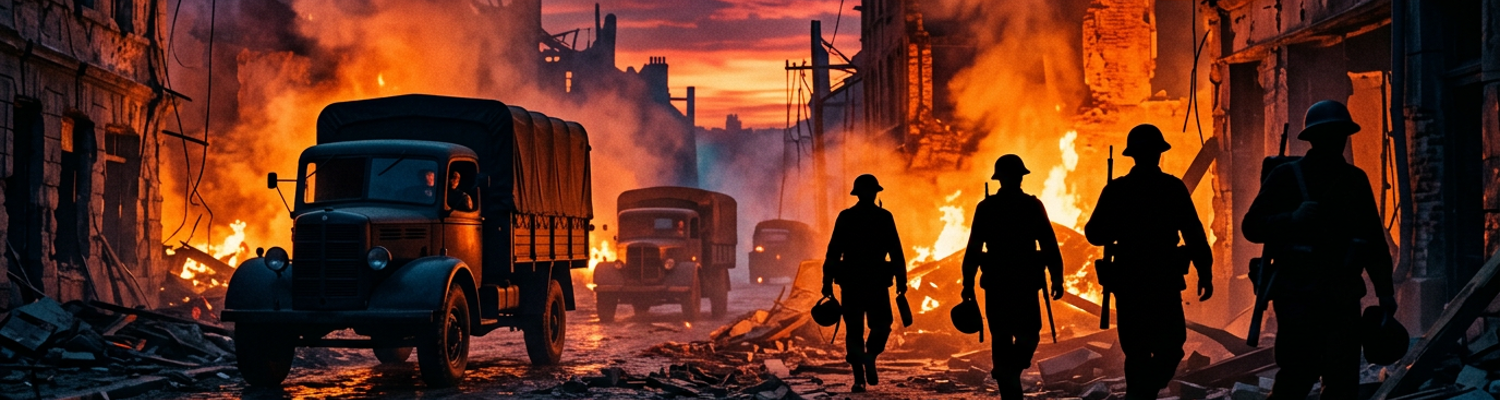
Colonel Gerhard Wilck handed his personal sidearm to American infantry officers outside the battered bunker entrance and ordered his surviving soldiers to lay down their rifles. This formal capitulation brought an end to organized German defense, yet the cessation of gunfire only exposed the terrifying scale of physical destruction across Aachen. Artillery shells, aerial bombs, and close range tank fire had leveled or heavily damaged over eighty percent of all municipal architecture throughout the city. Row houses, historic stone halls, and industrial warehouses collapsed inward, burying major thoroughfares beneath massive piles of masonry and splintered timber. Explosive detonations had severed electrical grids, ripped apart underground gas mains, and pulverized the pressurized municipal water system into useless, gravel choked trenches. Raw sewage, escaping water from fractured pipes, and steady autumn rain pooled in bomb craters, creating deep puddles of toxic sludge across every sunken intersection.
Sludge contaminated with soot, broken glass, and coal ash immediately trapped the lead transport convoys of the American support echelons as they pushed into the city. Heavy two and a half ton cargo trucks, mobile water tankers, and field ambulances sank down to their wheel hubs in the foul, pulverized mire. Narrow side streets offered no bypass routes because multistory building facades had fallen across the roads, forming impassable barriers of red brick and twisted structural steel. Drivers tried wrapping tire chains and rigging steel winch cables to nearby streetcar tracks, but the heavy pulling forces simply tore loose the shattered rails without freeing the bogged vehicles. This complete physical paralysis froze the supply lines along the outer ring road, halting tons of vital rations, plasma crates, and field dressing kits outside the central district. Motor pool officers scrambled through the rain with grease guns and tow cables, directing crews who fought to drag the stalled trucks out of the deep ruts.
Engineers from combat pioneer battalions brought up heavy diesel road graders and air compressors, chipping manually at the highest rubble mounds to create a single passable lane for emergency traffic. Work crews bypassed the buried thoroughfares by clearing footpaths with pickaxes, dragging handcarts loaded with stretchers, chloride tablets, and canvas water bags over the stone piles. Civil affairs teams from the Supreme Headquarters Allied Expeditionary Force moved behind the pioneers, following the smell of coal smoke and decay toward deep subterranean shelters where thousands of civilians remained trapped. Officers checked their compasses, marked chalk arrows on surviving doorframes, and began their descent into the dark cellar openings below the street.
Detachment I1G2 and the Subterranean Population
U.S. Army Civil Affairs Detachment F1G2 navigated through these shattered subterranean entrances, arriving in the smoldering center of Aachen as the first Allied military government unit on Reich territory. Detachment officers carried carbines, battery lanterns, and bilingual German and English proclamations intended to establish civil order among an urban population that military planners originally believed had fled eastward. Weeks of intense street fighting had instead trapped thousands of civilians below the rubble line, where German district officials and municipal police forces had completely disintegrated under the artillery siege. American personnel stepped over fractured timber support beams, dangling high voltage cables, and pulverized sewer tiles, directing their searchlights along narrow subterranean passages that branched across entire city blocks. Distant human cries, shuffling footsteps, and hollow coughing echoes guided the search parties through damp utility corridors toward massive blast doors sealed shut against the surface fires.
Concrete air raid bunkers, flooded cellars, and arched drainage conduits concealed roughly twenty thousand noncombatants who had retreated underground during the prolonged artillery bombardments. Detachment personnel pried open jammed steel hatches with pickaxes, revealing subterranean vaults illuminated only by flickering tallow candles and makeshift kerosene wick lamps. Families huddled together on damp wooden duckboards, resting on mildewed blankets and bundles of wet clothing while sewage tainted groundwater seeped across the concrete floors. Infants, elderly residents, and wounded civilians filled every square foot of corridor space, leaving no room for medical teams to maneuver without stepping over recumbent bodies. Officers quickly recognized that the compulsory evacuation orders issued by Nazi Party authorities weeks earlier had collapsed, leaving this vast civilian enclave marooned without municipal administrators, functioning hospitals, or organized emergency relief.
Carbon monoxide accumulated in the deepest shelters because smoldering rubble fires above drew toxic combustion gases straight down through fractured ventilation shafts. Hypothermia spread rapidly through the subterranean population as autumn chills and icy drainage water soaked their bedding in dark, unheated vaults where temperatures hovered near freezing. Potable water did not exist within the bunker networks, forcing dehydrated noncombatants to drink contaminated runoff from fractured sewage lines or scoop foul liquid directly off muddy cellar floors. Acute claustrophobia gripped hundreds of trapped civilians who suffered violent panic attacks in the airless darkness whenever candle flames guttered and died from oxygen starvation. Field doctors accompanying Detachment I1G2 documented cases of gastrointestinal infection, respiratory failure, dysentery, and deep shock multiplying by the hour among the shivering crowds.
Medics unloaded portable canvas litters, chlorine water purification tablets, and plasma crates directly into the shelter entryways to establish immediate emergency triage. Detachment officers organized able bodied German civilians into labor details, directing them to carry stretcher casualties up slippery stairwells to awaiting field ambulances parked along cleared roadways. Engineers rigged portable gasoline generators and motorized ventilation blowers on street corners, feeding heavy canvas ducts down into the stifling corridors to exhaust the lethal buildup of carbon monoxide. Captains from the civil affairs staff drafted emergency supply requisitions to seize captured Wehrmacht food depots and dispatched radio teams to request five hundred gallon mobile water trailers from rear echelons outside Aachen. Civil affairs personnel then painted white stenciled serial numbers onto each inspected bunker bulkhead and posted armed sentries at every exit to regulate civilian traffic until evacuation convoys could mobilize.
Triage Operations and Typhus Suppression Protocols
Stretcher teams guided by medics carried casualties past those posted sentries into cellar clearing stations where doctors handled severe blast induced trauma under strict blackout conditions. Thick woolen blankets and canvas tarps hung across shattered window frames to block every sliver of artificial light from escaping into the night sky, where lone German reconnaissance aircraft still circled overhead. Inside the dim basements, medical personnel worked under the weak yellow glow of red lensed flashlights and Coleman lanterns, treating men, women, and children pulled from collapsed bomb shelters. Artillery explosions and falling masonry had crushed dozens of noncombatants, leaving victims with jagged compound fractures of the femur and crushed pelvises that required immediate splinting with scrap pine boards. Many survivors had remained trapped beneath concrete slabs for days without care, and their neglected puncture wounds had developed into severe necrotic tissue infections with blackened flesh and foul drainage. Surgeons used curved shears and scalpels to slice away dead muscle without adequate anesthesia, placing color coded sorting tags on each patient to separate critical casualties requiring immediate operations from those requiring basic wound debridement.
Surgeons gathered captured German medical supplies from seized Wehrmacht storage lockers across the city to sustain these urgent surgical operations before rear supply columns could arrive. Orderlies carried armfuls of captured paper bandages, glass ampoules of ether, and German surgical steel instruments down into the basement operating rooms, supplementing the depleted aid bags carried by frontline combat medics. Frontline U.S. Army medical depots outside the city limits rushed supplemental shipments forward on light weapons carriers, delivering wooden crates packed with sterile morphine syrettes, sulfa powder packets, and dried blood plasma units. German civilian physicians and American army surgeons worked side by side over makeshift operating tables assembled from salvaged dining room doors resting on wooden ammunition crates. These surgical teams mixed distilled water into powdered plasma bottles, injected local novocaine into infected puncture wounds, and tied off severed arteries by lantern light as the backlog of wounded civilians stretched down the cellar steps. Nurses washing these surgical wounds quickly discovered body lice swarming across the filthy wool clothing of nearly every patient admitted from the subterranean shelters.
Soldiers deployed manual dusting guns outside the shelter exits to execute mass delousing protocols and suppress louse borne epidemic typhus among sheltered civilians. Dusting teams poured ten percent DDT dusting powder into the hoppers of hand cranked sprayers, pumping the fine chemical dust under civilian coat collars, down shirt sleeves, and directly into trouser waistbands. Military police and civilian volunteers worked down the lines of shivering refugees, coating their hair, knit caps, and wool blankets with thick white powder to kill lice and fleas before the parasites could spread typhus through the overcrowded bunkers. Bedridden patients received direct applications of the ten percent DDT powder across their litters, ensuring that contaminated mattresses and clothing stopped harboring vector insects inside the hospital holding rooms. Technicians monitored the air inside the cellars while checking skin reactions, confirming that the chemical barrier halted insect movement among the treated crowds. Dusting crews logged each decontaminated resident in tally books and loaded the treated civilians onto flatbed cargo trucks waiting along the cleared road.
Teletype Dispatches and Emerging Occupation Doctrine
Cargo trucks hauled these decontaminated civilians toward temporary holding camps outside the city while civil affairs officers compiled the resulting passenger tallies and casualty figures. Officers from Detachment I1G2 transcribed these numbers into urgent weekly field dispatches addressed directly to the G-5 Division of Supreme Headquarters Allied Expeditionary Force. These reports detailed an overwhelming noncombatant death toll, hundreds of untreated blast trauma cases, and crippling resource deficits that threatened immediate starvation across the battered municipality. Field captains emphasized that Aachen possessed zero surviving coal reserves, contaminated surface water reservoirs, and fewer than five hundred intact rooms to shelter more than twenty thousand citizens through freezing autumn storms. Municipal flour mills had collapsed into the streets, commercial bakeries lacked electrical power to run their mixing equipment, and transport wagons had vanished during the final days of artillery shelling, while the lack of soap and clean water caused skin ulcers and digestive ailments to spread rapidly through the refugee staging areas. Motorcycle couriers transported these typed field assessments through driving rain to regional communications trailers, alerting senior army commanders that the physical catastrophe inside Germany far outstripped standard medical and logistical provisions.
Teletype operators relayed these urgent field assessments to military government analysts at supreme headquarters, where the incoming data exposed systemic gaps in pre invasion planning for heavily destroyed, hostile German urban areas. Civil affairs manuals written before the cross Channel invasion had assumed that retreating German authorities would leave intact municipal records, operational police forces, and functioning utility systems behind them. Allied planners had also predicted that civilians would either flee eastward with retreating Wehrmacht columns or welcome occupation troops with passive cooperation rather than sullen hostility and silent noncompliance. The actual physical condition of Aachen revealed a hostile urban battleground where the entire local administration had evaporated, Nazi Party officials had burned municipal registries before fleeing, and artillery bombardments had obliterated every public utility. Staff officers documented that existing doctrine contained no practical instructions for feeding thousands of civilians trapped inside toxic ruins, leaving rear supply units without authorized tonnage allocations for noncombatant flour, medicine, or water purification chemicals. Frontline teams were forced to scramble for immediate solutions, writing daily addendums to obsolete manuals as they scavenged captured enemy warehouses to prevent widespread civilian deaths.
Planners in the G-5 Division used these practical field improvisations to formulate early occupation guidelines that tackled a severe legal and operational dilemma. Strict non fraternization policy directives ordered American personnel to avoid any friendly contact, handshakes, casual conversation, or visible sympathy toward German noncombatants. At the same time, customary international law and basic humanitarian obligations under military governance required occupying armies to prevent epidemic disease, mass starvation, and general civil collapse behind the combat lines. Supreme headquarters resolved this contradiction by directing civil affairs officers to enforce military control with rigid, impersonal detachment while permitting the release of emergency rations and essential medical aid. Guidelines permitted officers to identify and appoint vetted German civilian administrators to organize local labor crews, restoring basic civic functions under continuous military intelligence screening. Military police posted these newly printed bilingual regulations onto surviving stone walls across Aachen, positioning armed guards over seized grain elevators and ordering German work details to shovel debris away from central water mains.
Aqueduct Repairs and Interim Municipal Administration
Pipes fractured beneath the rubble required specialized municipal engineers and a unified local authority to coordinate repairs across the ruined city. Civil affairs officers from Detachment I1G2 interviewed local figures untainted by Nazi Party affiliation, consulting closely with Aachen Bishop Johannes Joseph van der Velden to find an acceptable civilian leader. Franz Oppenhoff, a forty year old local attorney who had defended Catholic priests and anti regime citizens against National Socialist prosecution, emerged as their primary candidate to lead the devastated population. Major Leo A. Swoboda conducted intensive vetting interviews with Oppenhoff inside a damaged municipal office, confirming that the lawyer had never joined the Nazi Party or endorsed regime policies. Swoboda and his civil affairs staff formally installed Franz Oppenhoff as Oberbürgermeister on October 31, 1944, charging him with organizing an interim civilian administration from the ground up. Oppenhoff took his oath of office at a battered wooden desk and immediately started assembling department heads for finance, public health, and food distribution.
Laborers organized by Oppenhoffs newly appointed staff formed civil brigades to clear primary supply routes for incoming Allied truck convoys. Work crews hauled shattered brick, broken streetcar rails, and twisted iron girders onto horse carts and wheelbarrows, creating two lane transit corridors through the center of the city. Plumbers and municipal technicians descended into ruptured aqueduct culverts outside the city perimeter, patching smashed masonry conduits with lead sleeves, concrete mortar, and salvaged iron fittings to restore water pressure to neighborhood standpipes. Distribution clerks opened emergency rationing offices in surviving school basements, issuing stamped identity cards to institute emergency caloric rationing for the civilian population. Rations provided an emergency baseline of approximately one thousand calories per day, consisting mostly of rye flour, dried peas, and small portions of potatoes retrieved from seized warehouses. Oppenhoff supervised the registration of children, the elderly, and manual workers, authorizing supplementary bread and potato allocations for the civil labor brigades clearing debris from key thoroughfares.
Agents from the Counterintelligence Corps halted these work brigades at military checkpoints, suspecting that unvetted Nazi Party members were infiltrating the municipal workforce. Tactical combat commands still fighting nearby viewed every German civilian as a potential saboteur, creating fierce jurisdictional friction with civil affairs officers who needed administrative functionality to prevent chaos. Tactical intelligence officers argued that Oppenhoff was hiring former city clerks and utility managers who held active Nazi Party memberships, demanding immediate dismissals and rigid ideological purges. Civil affairs officers pushed back against these combat commands, insisting that experienced technicians and administrators were essential to operate the municipal water pumps, maintain basic sanitation, and prevent mass starvation. Oppenhoff defended his staffing choices by arguing that skilled technicians were indispensable regardless of their past political affiliations, further infuriating combat commanders who prioritized absolute counterintelligence security over local recovery. Intelligence officers confiscated personnel dossiers and interrogated Oppenhoffs newly appointed department heads inside military police headquarters, stalling municipal recovery while artillery duels continued along the adjacent frontline.
Sabotage Threats and Long Term Stabilization Lessons
Paper folders stacked inside the interrogation rooms reflected pervasive operational anxiety regarding stay behind Nazi Werwolf guerillas and civilian sabotage targeting American logistics lines. Frontline commanders reported that retreating German units had scattered caches of explosives, sniper rifles, and wire cutters across ruined basements to support clandestine resistance cells. Supply columns moving ammunition and fuel toward the front faced constant threats from severed telephone wires, booby trapped roadblocks, and spiked metal plates concealed beneath mud puddles. Military police battalions enforced a rigid dusk to dawn curfew across the ruins of Aachen, positioning machine gun teams at major intersections and searching basement shelters for hidden weapon stashes. Sentries checked German identity documents at bayonet point along the supply corridors, turning away any civilian whose paperwork lacked official military government validation stamps.
SS and Luftwaffe commandos slipped past these military checkpoints during Operation Carnival in late March 1945 to carry out the targeted assassination of Oberbürgermeister Oppenhoff. Parachutists dropped from a captured American B-17 bomber behind Allied lines in dense border forests, gathering equipment before hiking through the night toward Aachen with the aid of local guides. Infiltrators cut the telephone wires outside Oppenhoffs residence on Eupener Strasse, walked up the steps, and falsely identified themselves as downed German airmen in need of civilian assistance. Gunfire shattered the confrontation when an SS commando drew a pistol and shot Oppenhoff through the head on his doorstep after the mayor attempted to persuade the intruders to surrender. Killers fled into the surrounding woods before responding American patrols arrived, though one assassin died and another suffered crippling wounds when they stumbled into a defensive landmine during their escape.
Investigators from the Counterintelligence Corps collected discarded German parachutes, weapons, and severed wires from the outskirts of Aachen, confirming that high ranking Nazi leaders had organized the assassination to paralyze Allied civil governance. Civil affairs officers responded by assigning round the clock military police bodyguards to replacement German mayors and establishing fortified perimeter guards around essential municipal offices. Planners in the SHAEF G-5 Division gathered these security reports alongside the earlier triage and sanitation records from Aachen to rewrite occupation field manuals before Allied armies crossed the Rhine. Aachen provided the operational blueprint that proved civilian populations could not be governed through improvisation, driving headquarters to establish rigid administrative screening systems that balanced rapid denazification against the need for competent municipal engineers. Headquarters codified these practical lessons into standard operating procedures that mandated pre assembled military government detachments move directly behind frontline combat divisions into newly captured German cities.
Quartermasters loaded two and a half ton cargo trucks with standardized stabilization kits containing DDT dusting guns, water purification units, emergency flour rations, and bilingual public notices. Supply companies earmarked dedicated cargo space exclusively for civilian survival, ensuring that field commanders no longer had to divert combat rations or scavenge destroyed enemy depots to prevent mass starvation in urban pockets. Civil affairs teams advancing into the Ruhr Valley and the Rhineland carried pre printed questionnaires to vet prospective municipal workers on the spot, rapidly identifying essential utility technicians while barring verified Nazi officials from administrative authority. Military police units set up guarded compounds to protect newly appointed German civic administrators from Werwolf hit squads, maintaining secure telephone switchboards and monitoring utility infrastructure around the clock. Drivers cranked the diesel engines of these civil affairs convoys and pulled out from regional staging depots, following armored spearheads eastward into the interior of the collapsing Reich.