Full Calendar
THIS DAY IN U.S. MILITARY HISTORY • APRIL 29 1975 U.S. Marine Corps / U.S. Navy Vietnam War

Operation Frequent Wind and the Final Evacuation of Saigon

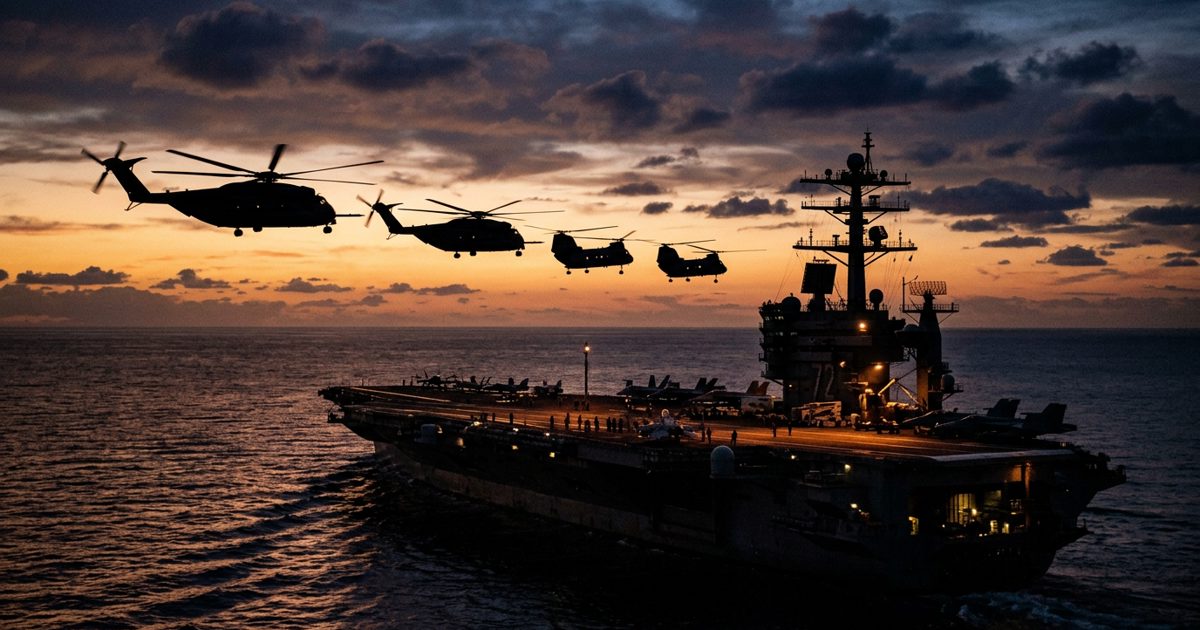
Marine and Navy helicopters execute the largest rotary wing evacuation in history under artillery fire in South Vietnam.
Operation Frequent Wind and the Final Evacuation of Saigon

North Vietnamese artillery shells hammered Tan Son Nhut Air Base outside Saigon in the pre-dawn darkness of April 29, 1975, cratering runways and destroying parked transports. Shrapnel from the bombardment killed Marine Corporals Charles McMahon and Darwin Judge at their perimeter post, leaving rotary aircraft as the sole remaining avenue of escape. Admiral Noel Gayler ordered the immediate execution of Operation Frequent Wind across the Seventh Fleet at 1051 hours. Radio stations broadcast coded signals across the capital, directing designated personnel to assemble at prearranged extraction zones throughout the city.

Marine Heavy Helicopter Squadron 462 and Squadron 463 launched waves of CH-53 Sea Stallions and CH-46 Sea Knights from amphibious assault ships positioned seventeen miles off the Vietnamese coast. Flight crews navigated through ground fire and heavy overcast toward the Defense Attache Office compound and the United States Embassy rooftop. Marine security teams from the 2nd Battalion, 4th Marines secured landing zones on the ground, holding back desperate crowds while loading evacuees into waiting aircraft. Flight decks aboard the aircraft carriers USS Midway, USS Hancock, and USS Coral Sea quickly became congested with arriving aircraft, forcing sailors to push jettisoned South Vietnamese helicopters into the South China Sea.

Helicopters continued lifting evacuees throughout the night under illumination provided by automotive headlights and hand-held flares. Marine pilots flew continuous sorties for over nineteen hours, completing 682 rotary missions between Saigon and the offshore flotilla. Ambassador Graham Martin departed aboard a Marine CH-46 helicopter in the early morning hours, followed by the extraction of the remaining ground security detachment. Task Force 76 successfully transported 1,373 Americans and 5,595 Vietnamese and foreign nationals to safety before North Vietnamese armor entered the center of the capital.

CHRONOLOGICAL RECORD

April 29 Across U.S. Military History

9 Verified Events
1814 U.S. Navy • War of 1812

USS Peacock Captures Royal Navy Sloop Epervier

Master Commandant Lewis Warrington steered the sloop-of-war USS Peacock into combat against the British brig-sloop HMS Epervier off Cape Canaveral, Florida. American gunners dismantled the adversary rigging and hull in forty-five minutes of broadsides. Warrington secured the battered prize with its valuable cargo of specie without losing a single sailor.

1862 U.S. Navy Landmark Event • Civil War

Union Troops and Sailors Occupy New Orleans

Flag Officer David Farragut landed a detachment of sailors and Marines to secure public buildings in New Orleans, Louisiana. Sailors raised the United States flag over the United States Custom House and City Hall, formalizing the loss of the largest port in the Confederacy. Major General Benjamin Butler subsequently landed five thousand soldiers to establish military administration.

1863 U.S. Navy • Civil War

Gunboats Bombard Confederate Defenses at Grand Gulf

Rear Admiral David Dixon Porter led seven Union ironclads into a five-hour bombardment against Confederate forts guarding Grand Gulf, Mississippi. Heavy return fire damaged several warships, prompting Ulysses S. Grant to march his infantry further south to cross at Bruinsburg. Boatswain Mate John Woon received the Medal of Honor for maintaining gunnery aboard USS Pittsburg.

1898 U.S. Navy • Spanish-American War

Naval Squadron Engages Shore Batteries at Cienfuegos

Commander Bowman McCalla guided the protected cruiser USS Marblehead, gunboat USS Nashville, and yacht USS Eagle to enforce the blockade off Cienfuegos, Cuba. Warships engaged Spanish coastal artillery and armed gunboats, driving hostile vessels into port. Crewmen on the Nashville captured the Spanish steamer Argonauto along with military mail and personnel.

1918 U.S. Army Air Service • World War I

Eddie Rickenbacker Scores His First Aerial Victory

Lieutenant Eddie Rickenbacker pursued a German Albatros scout plane over Baussant, France, while flying a Nieuport 28 alongside Captain James Norman Hall. Coordinated machine-gun fire forced the enemy aircraft into a fatal dive inside German territory. Rickenbacker earned his first Distinguished Service Cross for the aerial engagement.

1944 U.S. Navy Landmark Event • World War II

Task Force 58 Strikes Japanese Bastion at Truk

Vice Admiral Marc Mitscher deployed twelve aircraft carriers from Fast Carrier Task Force 58 to bomb Japanese airfields and facilities across Truk Atoll. Carrier aviators flew hundreds of combat sorties, downing dozens of enemy aircraft and destroying shore installations. The operation neutralized Japanese air strength across the central Caroline Islands.

1945 U.S. Army Landmark Event • World War II

Seventh Army Formations Liberate Dachau Concentration Camp

Troops from the 42nd Infantry Division, 45th Infantry Division, and 20th Armored Division breached the perimeter of Dachau concentration camp outside Munich, Germany. Soldiers eliminated resisting SS guards and liberated over thirty thousand surviving prisoners held behind electrified barbed wire. Seventh Army medical units immediately arrived to distribute food and quarantine rampant typhus.

1970 U.S. Army Landmark Event • Vietnam War

Allied Forces Launch the Cambodian Campaign

Armor and infantry units crossed the border into Cambodia to assault North Vietnamese logistical sanctuaries inside the Parrots Beak. American air support and military advisers accompanied South Vietnamese troops during initial ground penetrations. The joint offensive captured vast caches of enemy munitions and disrupted supply movements along the Ho Chi Minh Trail.

1986 U.S. Navy • Cold War

USS Enterprise Executes Historic Suez Canal Transit

Aircraft carrier USS Enterprise entered the Suez Canal under nuclear propulsion, navigating north from the Red Sea into the Mediterranean Sea. The passage made the vessel the first nuclear-powered aircraft carrier to transit the Egyptian waterway. Enterprise completed the voyage to relieve the USS Coral Sea during heightened regional operations off Libya.

MEDAL OF HONOR ACTION 1945

Desmond Doss Begins His Gallant Stand at Hacksaw Ridge

Private First Class Desmond Doss reported to the front lines of Okinawa with the Medical Detachment of the 307th Infantry Regiment, 77th Infantry Division, on April 29, 1945. American assault battalions confronted a jagged 400-foot limestone cliff known as the Maeda Escarpment, heavily fortified by concealed Japanese caves and pillboxes. Artillery barrages and mortar strikes battered Company A as soldiers reached the summit, creating dozens of casualties and pinning the assault force under intense crossfire. Doss refused to seek cover, crawling into open terrain without a weapon to administer plasma and dress shrapnel wounds.

Doss lowered wounded men down the steep face of the escarpment using an improvised rope sling secured around tree stumps. Japanese snipers and mortar squads directed fire at his position, yet the unarmed medic persisted through repeated ascents over the plateau. His actions on April 29 marked the opening of a three-week rescue effort that ultimately saved seventy-five wounded infantrymen. President Harry S. Truman presented Doss with the Medal of Honor in October 1945, recognizing him as the first conscientious objector to earn the decoration.