Full Calendar
THIS DAY IN U.S. MILITARY HISTORY • MAY 5 1945 U.S. Army World War II

American Tankers Defend Castle Itter in the Austrian Alps

Captain John Lee led an ad hoc force of American GIs and defecting German soldiers to protect French dignitaries from a Waffen-SS assault in May 1945.
American Tankers Defend Castle Itter in the Austrian Alps

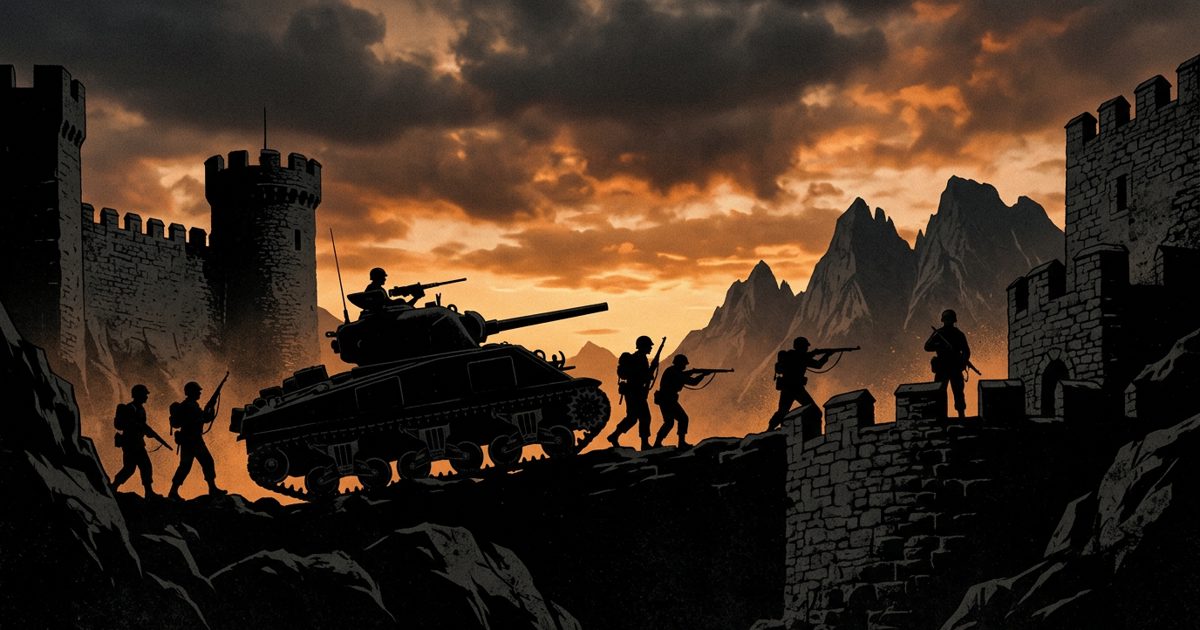
Captain John C. Lee Jr. deployed his lone M4A3E8 Sherman tank at the gatehouse of Schloss Itter in the North Tyrol mountains on May 5, 1945. Lee, an officer in Company B of the 23rd Tank Battalion, 12th Armored Division, led fourteen American soldiers to protect high-profile French prisoners held in the medieval fortress. His small force joined fourteen defecting German Wehrmacht soldiers under Major Josef Gangl and several Austrian resistance fighters who chose to resist Nazi fanatics. These defenders fortified the stone walls against approaching elements of the 17th SS Panzergrenadier Division. The French prisoners, who included former prime ministers Paul Reynaud and Édouard Daladier along with Generals Maurice Gamelin and Maxime Weygand, gathered small arms to help hold the ramparts.

Waffen-SS infantry launched their primary assault at dawn from the surrounding pine forests with machine guns and an 88-millimeter anti-tank gun. Shells from the German artillery piece slammed into the gatehouse and destroyed Lee's Sherman tank, killing the machine gunner and cutting off external radio communication. Defending riflemen returned fire from the medieval parapets, conserving limited rifle ammunition as enemy squads attempted to scale the lower walls. Major Gangl died from an enemy sniper round while pulling former French Premier Reynaud out of the line of fire. Shortages of ammunition forced the mixed garrison to retreat into the heavy stone keep as the attackers prepared a final breach using anti-tank rockets.

Reinforcements from the 142nd Infantry Regiment broke the siege during the late afternoon following a perilous run for help by French tennis champion Jean Borotra. American infantrymen and armor from the 36th Infantry Division swept up the mountain road, routing the Waffen-SS perimeter and taking roughly one hundred German prisoners. The relieving force secured all the French political captives without further casualties among the civilian VIPs. Lee received the Distinguished Service Cross for his tactical skill and steadfast command during the daylong engagement. The battle ended as one of the final combat actions in the European theater before the unconditional surrender of German forces.

CHRONOLOGICAL RECORD

May 5 Across U.S. Military History

9 Verified Events
1778 Continental Army Landmark Event • American Revolutionary War

Baron von Steuben Becomes Continental Army Inspector General

Delegates of the Continental Congress approved General George Washington's recommendation to appoint Prussian officer Friedrich Wilhelm von Steuben as Inspector General of the army on May 5, 1778. Steuben received the rank and pay of major general to formalize his administrative and drill reforms at Valley Forge. His system of standard manual drills and supply accountability reshaped the Continental Line into a cohesive fighting force.

1862 U.S. Army • American Civil War

Union Forces Engage Confederates at Williamsburg

Brigadier General Joseph Hooker attacked Confederate earthworks near Fort Magruder during a heavy rainstorm on May 5, 1862. Union divisions of the III and IV Corps pressed the retreating Confederate rearguard along the Virginia Peninsula, trading costly assaults across muddy ravines. Confederate forces evacuated their defensive line after dark, allowing Major General George B. McClellan's army to occupy Williamsburg.

1864 U.S. Army Landmark Event • American Civil War

Battle of the Wilderness Opens in Virginia

Lieutenant General Ulysses S. Grant launched the Overland Campaign as Union troops collided with General Robert E. Lee's army in dense thickets on May 5, 1864. Major General Gouverneur K. Warren's V Corps engaged Confederate infantry along the Orange Turnpike, triggering savage close-range fighting that ignited brushfires in the dry undergrowth. The opening clashes produced heavy casualties on both sides without yielding a decisive advantage.

1865 U.S. Army Landmark Event • American Civil War

Confederate Government Dissolves in Washington Georgia

President Jefferson Davis met with his remaining Confederate cabinet officers at the Heard House in Washington, Georgia, on May 5, 1865. The officials formally declared the Confederate civil government dissolved as Federal cavalry detachments swarmed the surrounding countryside in close pursuit. Davis continued fleeing south until Union cavalrymen of the 4th Michigan captured him five days later near Irwinville.

1877 U.S. Army • American Indian Wars

Sitting Bull Crosses the Canadian Border

Chief Sitting Bull led Lakota families across the international boundary into Canada on May 5, 1877. Constant winter maneuvers and pressure from Colonel Nelson Miles and the U.S. Army 5th Infantry compelled the remaining non-treaty bands to seek sanctuary under British authority. The migration marked the effective conclusion of major military field operations in the Great Sioux War.

1942 U.S. Marine Corps Landmark Event • World War II

Japanese Forces Launch Amphibious Assault on Corregidor

Marines of the 4th Marine Regiment and Army coast artillerymen engaged Japanese landing craft striking the eastern beaches of Corregidor on the night of May 5, 1942. American and Filipino defenders fought fiercely to contain the beachhead at North Point despite devastating enemy artillery preparatory fire. The lodgment permitted Japanese armor to land, forcing the island garrison to surrender the following day.

1945 U.S. Army Landmark Event • World War II

Eleventh Armored Division Liberates Mauthausen Concentration Camp

Soldiers of the 11th Armored Division reached the Gusen subcamp and the main Mauthausen complex on May 5, 1945. Armored reconnaissance troops disarmed remaining guards and prevented the planned demolition of underground tunnels packed with forced laborers. The entry of the division liberated tens of thousands of surviving political prisoners and civilians across Upper Austria.

1961 U.S. Navy Landmark Event • Cold War

Alan Shepard Completes First American Manned Spaceflight

Commander Alan B. Shepard Jr. launched aboard the Freedom 7 capsule atop a Mercury-Redstone rocket on May 5, 1961. Shepard, an active-duty U.S. Navy aviator, reached an altitude of 116 miles during the fifteen-minute suborbital mission. Marine Corps recovery helicopters lifted Shepard and his spacecraft from the Atlantic Ocean to the aircraft carrier USS Lake Champlain.

1968 U.S. Army • Vietnam War

Mini-Tet Offensive Erupts Across South Vietnam

Regiments of the Viet Cong and North Vietnamese Army launched coordinated strikes against Saigon and 119 military installations across South Vietnam on May 5, 1968. American infantry battalions and Marine air-ground teams immediately engaged infiltrating enemy units in intense urban and jungle fighting. Allied counteroffensives repelled the assaults over the ensuing weeks, inflicting heavy casualties on the attacking communist formations.

MEDAL OF HONOR ACTION 1945

Desmond Doss Saves Lives on Hacksaw Ridge

Private First Class Desmond T. Doss crawled through intense artillery and mortar fire on the Maeda Escarpment of Okinawa on May 5, 1945. Doss served as a company aid man with the Medical Detachment, 307th Infantry Regiment, 77th Infantry Division. Japanese defenders unleashed heavy machine-gun and sniper fire from concealed bunkers and caves as the 1st Battalion assaulted the 400-foot cliff known as Hacksaw Ridge. Doss, a conscientious objector who refused to carry a weapon, treated an injured artillery officer in the open field, dressing his wounds and administering blood plasma under direct bombardment. He then heard cries from another severely wounded soldier stranded near an active Japanese cave entrance.

Enemy gunners targeted Doss as he reached the fallen infantryman just yards from the cave opening. Doss treated the soldier's injuries in the dirt, lifted him onto his back, and carried him one hundred yards across exposed ground to safety. His rescues on May 5 added to the dozens of wounded soldiers he evacuated from the escarpment over three weeks of combat. Doss eventually evacuated an estimated seventy-five wounded men from the ridge using a rope litter system before sustaining severe wounds of his own on May 21. President Harry S. Truman presented Doss with the Medal of Honor at the White House on October 12, 1945.