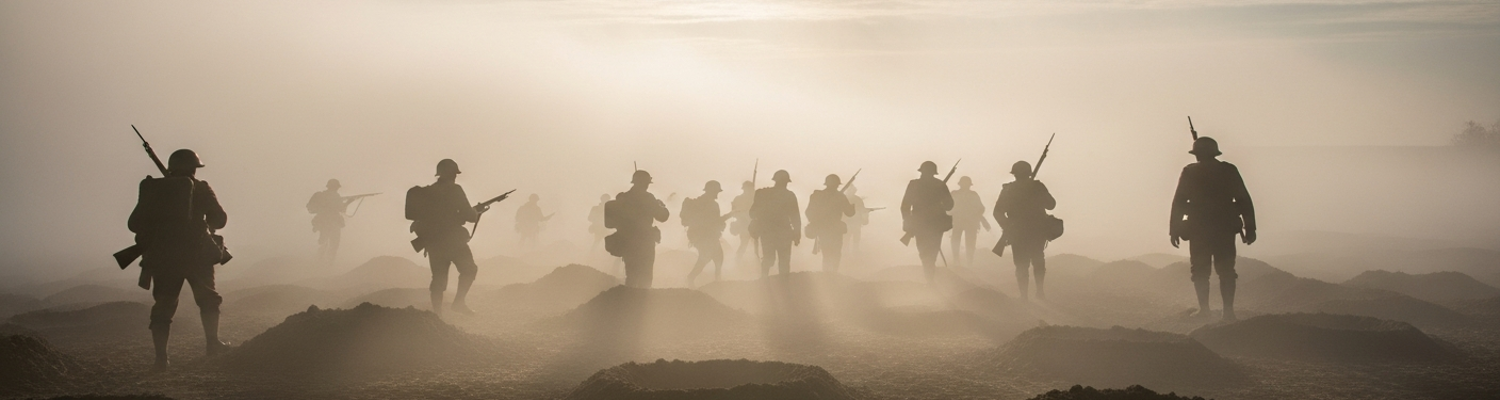

By July 1918, the German Army on the Western Front was a spent force. The series of massive spring offensives, beginning with Operation Michael in March, had failed to achieve their strategic objective of defeating the Allies before American manpower could turn the tide. These offensives punched deep, alarming salients into the Allied lines but bled the German military of its best remaining stormtroopers and stretched its logistical capabilities to the breaking point. The last of these pushes, the Second Battle of the Marne, created a large bulge pointing threateningly towards Paris. Yet it was a hollow threat. Allied Supreme Commander Ferdinand Foch recognized the German exhaustion and planned a decisive counterstroke.
The plan was audacious. Instead of attacking the salient's tip, Foch directed French General Charles Mangin's Tenth Army to strike its western flank, near the town of Soissons. The objective was to sever the Soissons to Château-Thierry road and its parallel railway line, the primary arteries supplying the German forces inside the pocket. A successful attack would trap them or force a general retreat. For this critical mission, Mangin required elite shock troops, divisions capable of rapid, deep penetration. He selected the American 1st and 2nd Divisions, alongside the French 1st Moroccan Division, to form the spearhead.
The American 2nd Division, commanded by Army Major General James G. Harbord, was an obvious choice. The division, a composite formation of an Army infantry brigade and the 4th Marine Brigade, had just emerged from a month of brutal combat at Belleau Wood. There, the Marines had proven their offensive spirit and their willingness to absorb appalling casualties to take an objective. This reputation, forged in the woods northwest of Château-Thierry, made them exactly the kind of instrument Mangin needed for his high-risk, high-reward offensive. The 4th Marine Brigade, comprising the 5th and 6th Marine Regiments and the 6th Machine Gun Battalion, received a flood of replacements to fill its depleted ranks and prepared for the next fight.
The Road to the Forest
Surprise was the central pillar of Foch's plan. Standard practice dictated a lengthy, multi-day artillery preparation to destroy enemy wire and trenches. This, however, always forfeited tactical surprise. Foch and Mangin opted for a different approach. There would be no preparatory bombardment. Instead, a massive rolling barrage would begin at the exact moment of the infantry assault, H-Hour, set for 4:35 AM on July 18. This required the assault divisions to be moved into their attack positions in absolute secrecy, just hours before the attack commenced. For the 2nd Division, this meant a grueling and chaotic approach march into the dense Forêt de Villers-Cotterêts.
The orders reached General Harbord late, leaving no time for proper reconnaissance of the attack zone. The movement into the forest was a logistical nightmare. A torrential downpour turned the packed roads into a morass of mud. French and American units, all moving under the cover of darkness, created monumental traffic jams. Marines and soldiers marched for hours, soaked to the bone, with no sleep and little food. The dense woods and narrow paths caused units to become disoriented and separated. The men of the 4th Marine Brigade, many of them green replacements who had never seen combat, were physically and mentally exhausted before the battle even began. They stumbled into their designated assembly areas in the forest, sometimes with only minutes to spare before H-Hour, and tried to find their formations in the pitch-black, dripping woods.
Zero Hour in the Wheatfields
At 4:35 AM on July 18, 1918, two thousand Allied guns opened fire simultaneously. The earth shook as the rolling barrage began its methodical creep across the German lines. From the dark edge of the Forêt de Villers-Cotterêts, the men of the 2nd Division surged forward. The 4th Marine Brigade, with the 5th Marine Regiment in the lead, stepped out of the trees and into a vast, open landscape of rolling hills covered in chest-high wheat. The terrain offered almost no cover. German defenders from the 46th Reserve and 11th Bavarian Divisions, though stunned by the suddenness and violence of the barrage, were professional soldiers occupying prepared positions.
The German response was immediate and savage. Machine-gun teams, concealed in the wheat and in small copses of trees, opened fire. Their interlocking fields of fire scythed through the advancing American lines. German artillery, directed by observers in tethered balloons, quickly found the range and rained high explosives and shrapnel onto the attackers. Platoons and companies seemed to evaporate into the smoke and dust. The supporting French Schneider and St. Chamond tanks, slow and mechanically unreliable, drew heavy anti-tank rifle and artillery fire. Most were knocked out or broke down before they could provide significant help to the infantry.
Despite the maelstrom of fire, the Marines advanced. Their pre-war training emphasized marksmanship and maneuver, the doctrine of "open warfare." In disciplined waves, they pushed through the German forward positions, using rifle fire and bayonets to overwhelm machine-gun nests. They advanced so quickly that they often ran into their own artillery barrage, forcing them to pause while the curtain of fire moved forward. The 5th Marines, alongside the Army's 9th Infantry Regiment on their flank, fought their way into and through the village of Vierzy. As the attack pressed deeper, the 6th Marine Regiment was committed, passing through the depleted ranks of the 5th to continue the drive east toward Tigny and the Soissons-Château-Thierry road.
The Price of Victory
The advance on July 18 was a stunning success by the standards of the Western Front. In a single day, the 2nd Division had penetrated nearly eight kilometers into the German lines. But the cost was catastrophic. The open terrain and the ferocity of the German defense inflicted casualties on an industrial scale. By the end of the first day, the 4th Marine Brigade had already suffered immense losses. The 3rd Battalion, 6th Marines, had started the day with 36 officers and 850 men. By evening, only 20 officers and 415 men were left standing.
The fighting on July 19 was even more brutal. The Germans, recovering from the initial shock, rushed reinforcements to the sector. They established a new defensive line, anchored on rugged terrain and farm complexes, and met the renewed American assault with a wall of fire. The 6th Marines bore the brunt of this fighting, launching repeated attacks against determined resistance. The losses were staggering. On July 19 alone, the 6th Marines lost over 1,200 men. After 48 hours of continuous combat, the 4th Marine Brigade had sustained over 2,200 casualties, with more than 1,000 killed in action. The division's medical services were overwhelmed. Evacuating the wounded from the forward slope under constant shellfire was a near-impossible task. By the afternoon of July 19, General Harbord informed the French command that his division could hold its gains but was no longer capable of offensive action. It was pulled from the line, a shattered but victorious formation.
The strategic impact of this sacrificial attack was immediate and decisive. The deep penetration by the American and French spearhead divisions had completely unhinged the German position. With their main supply route cut, the German command had no choice but to order a general withdrawal from the entire Marne salient. The threat to Paris was permanently eliminated. The Battle of Soissons marked the turning point of the war. From that day forward, the German Army was forced onto the strategic defensive, reacting to a relentless series of Allied attacks that would ultimately lead to the armistice four months later.
Lessons Forged in Fire
The Battle of Soissons provides timeless lessons on the nature of warfare. It powerfully demonstrates the value of operational surprise and offensive tempo. By forgoing a preparatory bombardment and striking with speed and violence, the Allies shattered the enemy's front line and disrupted his command and control cycle, preventing an effective response. The battle is a classic case study in seizing and maintaining the initiative.
The engagement also highlights the critical importance of combined arms integration. The failure of the primitive French tanks to effectively support the infantry advance underscores the challenges of coordinating new technologies on the battlefield. Without reliable communications and well-rehearsed procedures, tanks became isolated steel coffins rather than decisive weapons. This lesson about the intimate partnership required between infantry, armor, and artillery remains fundamental to modern combat.
Most significantly, Soissons validated the American Expeditionary Forces' doctrine of "open warfare" while also exposing its brutal cost. The emphasis on individual marksmanship, aggressive maneuver, and the initiative of small-unit leaders proved devastatingly effective. When command structures broke down under the hail of fire, it was the NCOs and junior officers who carried the attack forward. However, this doctrine, when applied against a professional enemy in prepared defenses, resulted in casualty rates that were unsustainable. The battle serves as a stark reminder that tactical aggression must be balanced with force protection and a realistic appreciation for the lethality of the modern battlefield. General Harbord himself captured this brutal calculus, stating the division's gains were worth the price, a chilling testament to the human cost of victory in total war.