
Sula Sea Patrol Operational Challenges
The silence of the Sula Sea was a lie. In the pre-dawn hours of February 1901, the only sounds aboard the USS Pampanga were the rhythmic churn of its single-screw propeller and the low hiss of steam. Stationed off the coast of Mindanao, the gunboat was a lonely expression of American will in a region that had resisted outside authority for centuries. The deployment of the Asiatic Fleet’s shallow-draft gunboats into these southern Philippine waters was a direct result of the ongoing insurrection. Their mission was to sever supply lines and suppress the piracy that served as resistance and economic warfare. Vessels like the Pampanga, its sister ship the USS Paragua, and other captured Spanish gunboats such as the Calamianes were tasked with patrolling a vast maritime battlespace.
These were small ships. They displaced just over 240 tons and were crewed by around 30 men, designed for the challenges of riverine and coastal operations. Their shallow draft, under eight feet, was a necessity for navigating the treacherous reefs and estuaries of the archipelago. An examination of operational logs (NARA Record Group 38) from this period indicates these patrols were constant, grinding affairs, intended to project power and interdict the movement of men and materiel between the islands.
The maps were a fiction. Navigational charts for the Sula and Celebes Seas in 1901 were dangerously inaccurate, a patchwork of outdated Spanish surveys and speculative cartography. Passages marked as clear could hide jagged coral heads capable of tearing through an iron hull. Aboard the gunboats, the continuous call of a sailor manning the lead line was the most reliable form of navigation. Currents were unpredictable, shifting with the monsoons and capable of pushing a vessel into peril with little warning. Commanders, many of them junior officers on their first commands, relied heavily on experienced local pilots when they could be found and trusted. The alternative was a constant state of high anxiety, particularly during night patrols or the sudden, violent squalls that could reduce visibility to mere yards. The risk of running aground was an immediate and persistent threat that shaped every decision.
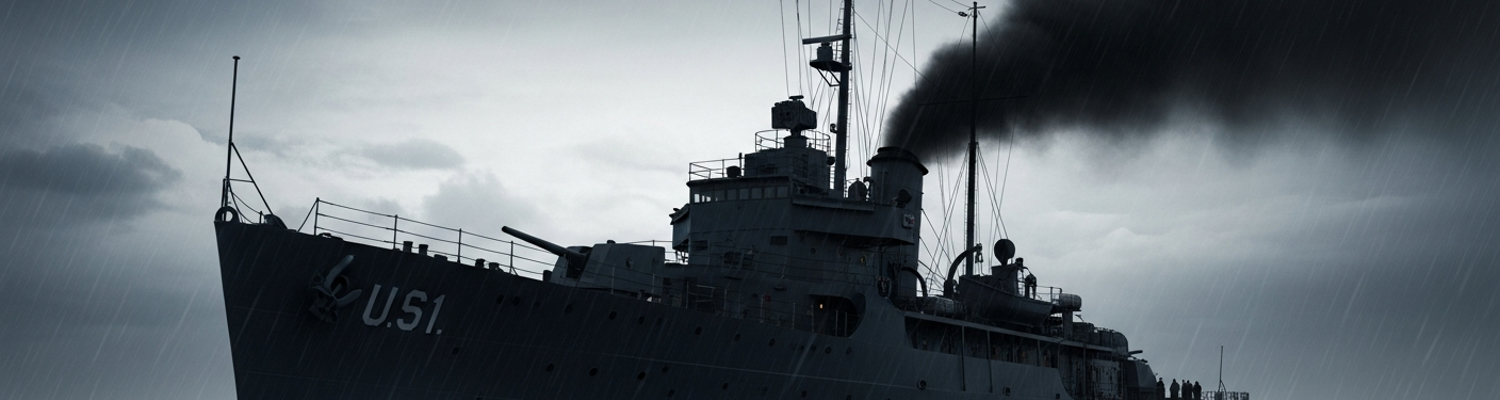
The environment attacked the ships themselves. The oppressive, salt-laden humidity of the tropics was relentless. It caused wooden superstructures to swell and warp, while a film of moisture coated every metal surface, accelerating corrosion. The iron hulls, operating in warm, nutrient-rich waters, were subject to aggressive marine biofouling. Barnacles and marine grasses rapidly encrusted the undersides, creating significant drag that reduced speed and burned through precious coal reserves. A ship’s speed could be cut by knots in a matter of weeks. The very fuel for the engines presented its own problems. The bituminous coal available at distant coaling stations like Cavite was often of poor quality. It burned inefficiently, produced thick, black smoke that announced a gunboat’s presence from miles away, and left behind hard deposits, or clinkers, that choked boiler tubes. Engineering crews faced the back-breaking work of constantly cleaning these tubes to maintain steam pressure, a task made all the more grueling by the intense heat of the engine rooms.
Tropical diseases were a constant foe, often inflicting more casualties than combat. Malaria, transmitted by mosquitos, was rampant. Dysentery and other waterborne diarrheal diseases spread quickly in the close confines of a small ship. The U.S. Army and Navy medical corps in the Philippines were only beginning to understand the scale of the threat. Beriberi, a nerve inflammation caused by vitamin deficiency, was also a documented problem among sailors on extended patrols. A review of surgeon’s logs from the period details a grim litany of ailments that steadily eroded the fighting strength of the gunboat crews.
Embryonic Naval Supply Chain Failures
The gunboats were tethered to a logistical chain stretched to its breaking point. The Asiatic Fleet’s capacity for power projection was dependent on steam, which relied entirely on coal. The main naval supply depot at Cavite, near Manila, was hundreds of nautical miles north of the Sula Sea patrol sectors. This distance created a long and vulnerable supply line serviced by a small, ad-hoc fleet of colliers. The schedules for these colliers were frequently irregular, forcing gunboat commanders to plan patrols around uncertain resupply. The quality of the coal itself was a significant issue. Instead of high-energy anthracite, the remote stations were often stocked with lower-grade bituminous coal, sometimes sourced from Australia. This fuel burned with poor efficiency and produced thick plumes of black smoke that gave away a gunboat’s position from a great distance. For the engineering crews, it produced hard, glassy slag that would fuse to the boiler’s fire-grates, choking airflow and reducing steam pressure. Working in engine room temperatures that could surpass 120 degrees Fahrenheit, sailors faced the task of constantly chipping these deposits away. A vessel like the USS Pampanga, with a bunker capacity of roughly 30 tons, could burn through over three tons a day at a moderate patrol speed. This gave it an operational endurance of just over a week before it was forced to abandon its station and make for a coaling point.
Food and water were even greater constraints. The small, shallow-draft gunboats were never intended for long-duration, independent missions. Their onboard storage for provisions was minimal. Refrigeration was nonexistent. Any fresh meat or vegetables taken on at a supply depot would spoil within days. This forced crews onto a monotonous and nutritionally deficient regimen of hardtack, canned meats, and rice. Surgeon's logs from the era detail recurring instances of beriberi and scurvy among sailors on extended patrols.
The most immediate crisis, however, was often fresh water. The ship’s own steam-powered evaporators for distilling seawater were inefficient and prone to mechanical failure. Their output was seldom enough to meet the needs of a 30-man crew performing strenuous labor in the equatorial climate. This frequently compelled commanders to take a calculated risk: replenishing their water tanks from sources ashore. These local streams and wells were often contaminated, and records show a direct correlation between this practice and outbreaks of dysentery and cholera. A gunboat’s fighting effectiveness was often more severely degraded by sickness than by any hostile action.
This intersection of fuel and subsistence shortages created an operational calculus that hamstrung commanders. Every decision was dictated by consumption rates. A commander weighing the pursuit of a suspect Moro vinta had to balance the tactical gain against the high expenditure of coal required for flank speed, an action that could shorten his patrol window by a full day. Lingering in a promising area for interdiction meant burning through the crew’s finite supply of safe food and water. The operational endurance of these vessels, theoretically measured in weeks, was in practice often just a few days before they were compelled to withdraw from their own mission, defeated not by the enemy, but by the tyranny of distance.
Critical Naval Command Communication Gaps
Aboard the USS Pampanga, a silence of information reigned. In 1901, the Asiatic Fleet possessed no means of real-time communication over long distances. Once a gunboat steamed beyond the horizon, it was cut off from its superiors. The only tools available for ship-to-ship contact were visual, signal flags or Aldis lamps, and these were limited to line-of-sight in clear weather. Wireless telegraphy was an experimental technology not yet a factor in the operational fleet. Command for the entire Asiatic Fleet was headquartered at Cavite near Manila, hundreds of nautical miles north of the Sula Sea patrol zones. A subordinate command post at Zamboanga offered more immediate oversight but was itself isolated. For the commander of a gunboat like the Pampanga, a junior officer often in his first command, this meant that from the moment his vessel cleared the harbor, he was on his own. He could not report an engagement, transmit intelligence, or request support.
Information moved at the speed of the fastest ship. This reality imposed a crippling delay on the entire operational cycle. The system for transmitting orders and intelligence relied on the physical passage of documents by dispatch vessels. A review of operational logs from the period shows a consistent pattern of multi-week information lag. An intelligence report from the captain of the Pampanga in the southern archipelago would first have to wait for a rendezvous with a northbound vessel. That journey to the regional command at Zamboanga could take several days. From Zamboanga, it would take a faster ship another two to three days of steaming to reach fleet headquarters in Manila. By the time an admiral reviewed the intelligence and made a decision, the information was already more than a week old. The return journey for new orders meant that a directive might not reach the patrol area for three to four weeks after the initial sighting.
This temporal gap between information and action rendered naval command effectively blind. Flag officers in Cavite were forced to base large-scale planning on data that was dangerously out of date. The standard practice was to issue rigid, pre-programmed patrol orders that assigned gunboats to specific rectangular zones for weeks at a time. This lack of flexibility was a direct result of the communication void; it was impossible to dynamically re-task assets. Insurgent forces and local pirates, familiar with the region, quickly learned to recognize the predictable patrol patterns of the American gunboats, simply moving their operations to areas they knew would be unwatched. This system placed the gunboat commanders in an impossible position. They possessed the most current, ground-level intelligence but were bound by standing orders from a distant command that was ignorant of the immediate situation.
Misidentified Target Engagement Fallout
The intelligence that reached the USS Concord was already ten days old. A dispatch rider’s report, passed through the Zamboanga command post, described a large, three-masted Moro prahu set to deliver a shipment of German-made Mauser rifles to a depot on the western coast of Basilan Island. For Lieutenant Commander Franklin Hayes, captain of the Concord, it was the first actionable information he had received in three weeks of unproductive patrols. The pressure to demonstrate results was a palpable force within the Asiatic Fleet’s gunboat squadron.
The circumstances that precipitated the misidentification were a chain reaction of environmental, mechanical, and human factors. On the morning of the engagement, a pre-monsoon squall had descended upon the patrol sector, reducing visibility to less than 400 yards. Through a momentary gap in the downpour, lookouts sighted a vessel matching the general description from the intelligence brief. The Concord’s primary long glass, a powerful Bausch & Lomb instrument, had been damaged a week prior when a heavy sea broke over the bridge. The watch officer was forced to rely on a secondary, lower-magnification British-made glass that struggled to resolve details through the rain. The target was a ghost. Compounding the visual impairment was the Concord’s own smoke. Burning poor-quality Australian bituminous coal, the gunboat’s funnel belched a thick, black plume that the swirling winds kept pushing forward of the ship, further obscuring the field of observation. Lieutenant Commander Hayes, operating under the assumption that the target was the heavily armed prahu, made a command decision that bypassed established naval protocols.
He did not order a warning shot. The command to engage was relayed by voice tube to the forward gunnery station. The Concord, a 1,710-ton gunboat, was significantly more powerful than the smaller shallow-draft vessels, and its main armament included six 4-inch rapid-fire guns. The gun captain of the forward mount laid his weapon on the indistinct shape and fired a 33-pound common shell. The first round was a ranging shot. The second shot was a direct hit. It struck the vessel amidships, tearing through the unarmored wooden hull and detonating within its cargo hold. A secondary explosion erupted from the target. The Concord’s crew fired two more rounds in quick succession. The entire engagement lasted less than two minutes.
As the Concord closed the distance to the now-burning wreck, the rain squall passed. The rising sun broke through the clouds, illuminating the scene. The target was not a Moro prahu. It was the Orion, a Dutch-flagged merchant schooner under contract to a German trading company based in Sandakan. Its manifest, later recovered from a floating debris field, listed its cargo not as rifles, but as copra, rubber, and several hundred cases of kerosene for lamps, the source of the secondary explosion. From the splintered gaff of the mainmast, the red, white, and blue horizontal stripes of the flag of the Netherlands were clearly visible. The cove the ship had been sailing towards was not a secret military depot but a small, recognized trading settlement. Lieutenant Commander Hayes ordered his crew to lower boats to search for survivors, but the action had already been logged. A neutral vessel had been destroyed in an unprovoked, unauthorized attack.
Global Diplomatic Outcry Washington 1901
The news of the USS Concord's engagement arrived in Washington D.C. not by naval collier, but as a series of clicks from the undersea telegraph cable terminal. The information was fragmented, but the core facts were clear. Within hours, the city’s diplomatic corps was activated. State Department records show that the first formal inquiries came from the legations of the Netherlands and the German Empire. Baron Gevers, the Dutch minister, and Theodor von Holleben, the German ambassador, each requested urgent meetings with Secretary of State John Hay. They delivered formal diplomatic notes protesting the attack in the strongest possible terms. The Dutch note focused on the violation of their flag’s neutrality. The Germans, whose commercial interests were expanding in Southeast Asia, protested the destruction of a ship under contract to a German trading firm and the loss of its cargo. The atmosphere in the capital became one of acute crisis.
The legal accusations were precise. The core of the Dutch and German protests rested on established principles of international maritime law. An analysis of the diplomatic notes reveals allegations of multiple, severe breaches of these protocols. The first failure was the Concord’s decision to open fire without any attempt to challenge the Orion. The law of nations required a warship to first hail the merchantman and signal it to stop for inspection. If the vessel did not comply, the next step was to fire a warning shot across its bow. Only if a vessel actively fled or resisted could a warship justifiably use force. The Concord’s immediate resort to its main battery against a vessel that had made no hostile move was seen as an act of aggression. The attack also violated the principle of neutral rights, the idea that a neutral state’s commerce should be free from the adverse effects of a conflict to which it was not a party.
This was a direct challenge to the geopolitical ambitions of two empires. For the German Empire under Kaiser Wilhelm II, the incident was viewed through the lens of its Weltpolitik, or world policy, which sought to establish Germany as a global power. German firms were actively expanding trade in the Pacific, and the German government was sensitive to any action that could be interpreted as a threat to its economic expansion. For the Netherlands, the attack was a dangerous precedent that threatened the stability of its own vast colonial holdings in the Dutch East Indies, which bordered the Philippines. The destruction of the Orion was seen in Berlin and The Hague as an act of American overreach. The fallout landed squarely on the desk of President Theodore Roosevelt. At the Department of the Navy, a frantic effort began to piece together the full sequence of events. At the State Department, Secretary Hay was tasked with managing the increasingly angry demands for explanation and compensation from the German and Dutch governments.
Domestic Political Scandal Aftermath
The story of the Orion arrived in the United States as a cascade of damaging facts carried by undersea cables. Major dailies, particularly the fiercely competitive New York press, seized upon the incident. William Randolph Hearst’s New York Journal and Joseph Pulitzer’s New York World ran banner headlines depicting a trigger-happy U.S. Navy bullying a small, neutral trading vessel. Cartoons portrayed President Roosevelt with an oversized naval uniform, recklessly endangering American relations with European powers. The public, already growing weary of the guerrilla war in the Philippines, reacted with a mixture of anger and embarrassment. The incident was framed not as a mistake in the fog of war, but as a symptom of a lawless foreign policy.
The political firestorm hit Capitol Hill almost immediately. Congressional opponents of the Roosevelt administration and the Philippine annexation saw the Concord affair as a powerful weapon. An examination of the Congressional Record shows that members of the Senate Committee on Naval Affairs launched a formal inquiry. They demanded the Navy Department produce all relevant documentation: the USS Concord’s complete logbook, the original intelligence dispatch, Lieutenant Commander Hayes’s full service and fitness records, and the standing rules of engagement for the Asiatic Fleet. In the House of Representatives, Democrats and anti-imperialist Republicans called for public hearings, demanding that Secretary of the Navy John D. Long and senior admirals testify.
The inquiries exposed deep, systemic failures. When naval officers were compelled to testify, the hearings revealed the operational weaknesses that had plagued the Sula Sea patrol. The broken long glass aboard the Concord became a symbol of a poorly supplied force. Testimony regarding the low-quality bituminous coal that created vision-obscuring smoke highlighted the fragile logistics chain. The ten-day-old intelligence report was presented as evidence of a command structure rendered ineffective by its lack of modern communication. The Navy’s defense, that Lieutenant Commander Hayes acted under immense pressure and with degraded equipment in a war zone, was largely drowned out by the political clamor. The administration, seeking to contain the diplomatic damage, privately pressured the Navy to find fault with the man on the scene rather than the system. The result was a predetermined outcome.
Lieutenant Commander Franklin Hayes was recalled to face a court-martial at the Cavite naval yard. The charges were severe: culpable inefficiency, failure to obey naval regulations, and conduct to the prejudice of good order and discipline. His conviction was swift. While the proceedings acknowledged the difficult conditions, the final verdict held him solely responsible for the failure to positively identify his target. He was formally reprimanded and suspended from command, a career-ending judgment for an ambitious officer.
US Naval Doctrine Strategic Reassessment
The Orion incident exposed a fundamental gap between the nation’s strategic ambitions and its actual capabilities. The United States had acquired a Pacific empire, but the events in the Sula Sea demonstrated that it lacked a coherent system for policing it. For naval planners, the crisis was an operational one. It raised the question of how a single gunboat commander, operating on dated intelligence and with faulty equipment, could so easily precipitate an international crisis.
American strategic reach had proven to be an illusion. The crisis forced a reassessment of what it meant to project power across the Pacific. The Naval War College was tasked with producing a comprehensive analysis of the logistical posture of the Asiatic Fleet. The resulting report, presented to the General Board in early 1902, was a damning indictment. It contained charts showing the effective patrol radius of a Pampanga-class gunboat burning low-grade bituminous coal, concluding that a vessel might spend over 60 percent of its deployment simply transiting to and from the nearest coaling station. Its authors argued forcefully that American power was defined not by territorial claims on a map, but by the functional range of its steam-powered vessels. The report’s primary recommendation was a large-scale investment in fixed infrastructure. It called for a network of purpose-built, secondary supply depots throughout the southern Philippines, equipped with machine shops, secure magazines, and deep bunkers filled with high-grade anthracite coal shipped directly from the United States.
The rules of engagement were a study in fatal ambiguity. In the wake of the political scandal and the court-martial of Hayes, Secretary Long convened the Naval Procedures Review Board. Its mandate was simple: prevent another Orion incident. An examination of the board’s official report shows that its members concluded that field commanders had been placed in an impossible position. They were expected to aggressively interdict insurgent supply lines while simultaneously respecting complex tenets of international maritime law, all without clear guidance. The board’s primary output was a new, fleet-wide directive, “General Order Number 84: Procedures for the Interception and Search of Non-Belligerent Vessels in a Theater of Operations.” It replaced vague custom with rigid, sequential protocol. The order explicitly forbade the use of disabling fire against any vessel that had not first been challenged by flag signal, an audible warning shot from a small-caliber weapon, and a solid-shot warning round fired across its bow. Only after a vessel ignored these steps and made a clear attempt to flee could a commander use force to compel it to stop. The order also mandated that all commissioned warships carry a minimum of two pedestal-mounted, high-power long glasses on the bridge, with their operational status to be logged at the start of every watch.
Naval Logistical Policy Evolution
The embarrassment of the Orion incident acted as a powerful accelerant for institutional change. The General Board of the Navy was tasked with a top-to-bottom review of the Asiatic Fleet’s operational posture. The Board’s findings, submitted in a landmark 1902 report, were blunt: the Navy’s ability to operate in the southern Philippines was crippled by its reliance on the single, distant supply depot at Cavite. The board’s primary recommendation was the “Forward-Basing Initiative,” a congressionally-funded program to establish a network of permanent, advanced logistical hubs throughout the archipelago.
Implementation was swift. Naval appropriations between 1902 and 1905 show a significant reallocation of funds toward naval construction, not of warships, but of the infrastructure needed to support them. The existing coaling station at Zamboanga was dramatically expanded, its wooden pier replaced with a deep-water concrete quay. New depots were established from the ground up. A key location was Polloc Harbor in Mindanao, chosen for its deep, protected anchorage. Here, Navy Seabees and local labor erected dedicated coal sheds designed to stockpile high-grade American anthracite. They built machine shops stocked with lathes, drill presses, and spare parts for the specific boiler and engine types used in the gunboat fleet. These new forward bases were equipped with large-scale freshwater distillation plants, severing the dangerous need for commanders to replenish tanks from potentially contaminated local sources. This network of support stations fundamentally altered the operational calculus for patrol commanders, extending a gunboat’s effective time on station from days to weeks.
The information void that had isolated Lieutenant Commander Hayes was also systematically addressed. The Navy, which had only begun adopting wireless telegraphy in 1901, launched an aggressive program to equip the fleet. Early spark-gap transmitter sets, often bulky and unreliable German-made Slaby-Arco units, were installed first on cruisers and command ships. A study of Asiatic Fleet installation logs indicates that by 1904, every major combatant and every new forward operating base was outfitted with a wireless station. The system was imperfect. Its range was often limited to less than 100 miles, and atmospheric conditions could render transmissions unintelligible. Yet, it represented a revolutionary leap. An intelligence report from a gunboat in the Sulu Archipelago could now be relayed through the new station at Zamboanga and reach fleet headquarters in Cavite in hours, not weeks. This allowed, for the first time, a semblance of dynamic command.
The mechanical backbone of this new logistical and communications doctrine was the commissioning of a new class of vessel. These were not warships, but dedicated, purpose-built colliers and supply ships. They were faster and had a greater cargo capacity than the chartered merchantmen previously used. These new auxiliaries operated on a fixed, predictable schedule, creating a reliable conveyor belt of fuel, parts, and provisions that kept the forward bases stocked. Fleet readiness reports from 1905 show that the Asiatic Fleet could now sustain multi-division patrol operations in the southern archipelago indefinitely, a capability that was a direct result of the hard lessons learned from the destruction of the schooner Orion.