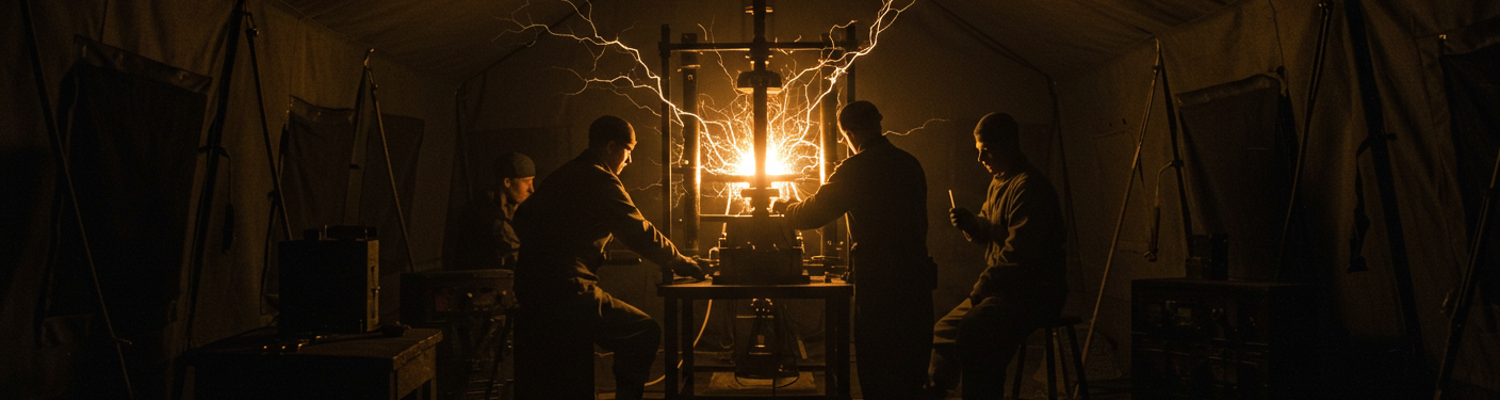

The transmission ended not with a sign-off, but with the acrid smell of ozone and a final, sputtering crackle from the Leyden jar capacitors. At a forward listening post south of Fort Huachuca, a detachment of the U.S. Army Signal Corps stared at their silent wireless set. The induction coil, laboriously hand-wound and insulated with shellac, had catastrophically failed. Its high-voltage spark, the very heart of the spark-gap transmitter, was dead. Without it, they had no way to send intelligence across the terrain back to headquarters. The unit was effectively blind. Their experimental mission to provide early warning of cross-border raids was severed by the failure of a few delicate, over-stressed components. This was the mechanism of early twentieth-century electronic warfare, a constant fight against the inherent fragility of the technology itself.
Operational logs from the period reveal such failures were the norm. The promise of trans-border wireless telegraphy for national defense was significant, but the equipment was primitive and profoundly unreliable. Signal Corps teams, newly tasked with deploying this nascent technology, grappled with spark-gap transmitters that were more fire hazard than communication device and coherer receivers that required constant physical tapping to function. Establishing a stable signal across even a few dozen miles of arid landscape was a monumental effort, subject to atmospheric interference, signal absorption by the ground, and simple mechanical breakdown. The strategic imperative was clear. The ability to communicate without physical wires, which could be easily cut, was a core objective for an army tasked with securing vast and remote territories. This drive pushed units to improvise solutions under extreme pressure, from modifying antenna lengths to fabricating replacement parts in field workshops.
This frantic troubleshooting was a direct consequence of United States national defense objectives in 1905. Under President Theodore Roosevelt, the nation was aggressively asserting its influence, a policy backed by the maxim to speak softly and carry a big stick. This was increasingly defined by a modern, technologically advanced military. War Department strategic documents from the era show a focus on two primary fronts: the defense of the Western Hemisphere under the Roosevelt Corollary to the Monroe Doctrine and the protection of new overseas possessions. The construction of the Panama Canal, which began in 1904, created a strategic chokepoint that required a significant naval presence to protect. Managing the Philippines demanded a method for coordinating army and naval forces across a sprawling archipelago. In both theaters, wireless was identified as the key to enabling the necessary command and control over vast distances, allowing for rapid fleet concentration and the coordination of land and sea assets without reliance on vulnerable cables.
The American push into wireless was also a reaction to the global power dynamics of the era. Great Britain possessed a dominant strategic advantage with its globe-spanning network of submarine telegraph cables that connected the British Empire. Inaugurated in 1902, this system gave London a secure and nearly instantaneous communication link to its colonies and fleets, a capability no other nation could match. For rising powers like the United States and Germany, who lacked such a network, investing heavily in wireless technology was a way to bypass Britain's established dominance. This competition played out in the corporate realm, with firms like the American De Forest company and Germany’s Telefunken racing to develop superior technology. The urgency of this race was made clear by the Battle of Tsushima in May 1905. During the battle, Admiral Tōgō's Japanese fleet used wireless reports to locate, track, and annihilate the Russian Baltic Fleet. News of the decisive role radio played in the Japanese victory circulated rapidly through the U.S. Office of Naval Intelligence, providing undeniable proof that mastery of wireless communication was no longer a theoretical advantage but an absolute necessity for survival in modern naval warfare.
War Department files from the early 20th century show that the northern border of the United States was a subject of increasing scrutiny. The recent memory of the 1903 Alaska Boundary Dispute left a deep strategic scar. That decision, arbitrated by a tribunal that included British and Canadian representatives, ultimately favored the American position on the location of the Alaskan panhandle’s border. This secured American control over the sea-lanes to the Klondike gold fields but generated immense bitterness in Canada, where the outcome was seen as a betrayal by their own imperial government in London. This resentment fueled a surge in Canadian nationalism and a quiet understanding in Washington that the 4,000-mile border could not be taken for granted. For American military planners, the dispute highlighted a key vulnerability. Vast, sparsely populated territories rich in resources were monitored by little more than customs agents and local constabularies. Any conflict would be a sudden affair, and the ability to rapidly communicate intelligence and orders across these enormous distances without relying on easily severable telegraph wires was a paramount concern.
The geopolitical tension was inseparable from the aggressive industrial competition of the era. American industrial capacity, centered in the Great Lakes region, was expanding at a rate that threatened to overshadow Canada’s own efforts at nation-building. Canada’s National Policy, a framework of protective tariffs, was a direct response designed to shield its young manufacturing and transportation sectors from being absorbed by the American economic giant. U.S. industries, hungry for raw materials like timber and ore, looked north, viewing Canada as both a source and a market. This economic rivalry had a distinct security dimension. Control of critical infrastructure like the Soo Locks, which connected Lake Superior to the lower Great Lakes, and the rail lines that fed industrial centers on both sides of the border was a major strategic consideration. A disruption in the flow of goods could cripple war-making capacity. American strategists understood that economic strength was the foundation of military power, and any contest with the British Empire would involve an economic battle for the resources and production of North America.
Canada existed within the defense framework of the British Empire. While Ottawa had increasing autonomy over its own militia, its ultimate security from foreign invasion was underwritten by the Royal Navy. For American war planners, this meant the Canadian border was the frontline in any potential conflict with Great Britain. Early strategic exercises that would eventually evolve into War Plan Red identified an invasion of Canada as the most effective way for the United States to prosecute a war against the British Empire. The plan was to seize key logistical hubs and deny their use to British expeditionary forces. British naval power was projected from major bases that flanked the United States, most notably the heavily fortified dockyards at Halifax, Nova Scotia, in the Atlantic, and Esquimalt, British Columbia, on the Pacific coast. Following confrontations with British commanders, the Canadian Militia Act of 1904 expanded Canada’s own small Permanent Force and established a Canadian-led Militia Council, signaling a move toward greater military self-reliance. The strategic reality remained unchanged. The experimental wireless sets being tested by the U.S. Army Signal Corps in the deserts of the Southwest were, in the larger strategic view, prototypes for a system needed to coordinate the defense of a continent against the world’s foremost naval power, whose garrisons and fleets were a permanent presence just across the northern border.
Operational logs show that the U.S. Army Signal Corps’ experimental wireless program in 1905 was inextricably linked to an intelligence-gathering mandate. The same teams wrestling with the temperamental spark-gap transmitters and finicky coherer receivers were tasked with more than just establishing communications; they were the forward ears of a nascent American signals intelligence apparatus. The work was physically demanding and technically frustrating. At remote outposts like Fort Huachuca, signalmen deployed cumbersome pack sets, entire wireless stations designed to be transported by a train of three mules. One mule for the hand-cranked generator, one for the chests of operating apparatus, and one for the sectional wooden mast and antenna wires. A 1911 manual describes the standard pack set as having a range of fifteen to twenty miles, a distance entirely dependent on clear ground and favorable atmospheric conditions. Operators were instructed that the equipment could be used to intercept messages sent by an enemy or interfere with the operation of his station, explicitly codifying an electronic warfare function from the outset. The primary focus was mastering the basics: erecting the 4-wire antenna array, managing the Leyden jar capacitors, and coaxing a stable spark from the induction coil, all while knowing the technology was so new that the field sets issued one year were considered obsolete the next.
The establishment of the Army Signal School at Fort Leavenworth in 1905 was a direct result of the need to professionalize this new form of intelligence work. While the school taught the mechanics of laying field lines and operating equipment, the larger context, understood from War Department directives, was preparing for a conflict where information superiority would be decisive. The Russo-Japanese War provided the effective proof. Reports on the Battle of Tsushima detailed how Japanese wireless operators tracked the Russian fleet, enabling its annihilation. This lesson was not lost on American observers. The Signal Corps' mandate was to prevent a similar technological surprise. Along the Canadian border, this translated into a quiet, undeclared electronic reconnaissance effort. The primary target was the British Royal Navy. The naval dockyard at Esquimalt, British Columbia, was the main base for Britain’s Pacific Station until it was formally handed over to Canadian authorities on March 1, 1905. American planners, however, knew that British naval power remained the ultimate guarantor of Canadian territory and that Royal Navy vessels would continue to operate from the port.
Early military espionage in this domain was a crude, challenging affair. It did not involve clandestine agents so much as technicians in isolated huts straining to interpret faint, crackling sounds in their headphones. The core of the mission was interception. Signal Corps teams would have used their receivers, which were just becoming selective enough to distinguish different wavelengths, to scan for transmissions originating from Esquimalt or ships at sea. They were listening for the distinct signatures of different spark-gap transmitters; a Marconi set used by the Royal Navy sounded different from a German Telefunken or an American De Forest system. Even primitive direction-finding techniques were being explored, using rotatable loop antennas to find the direction where a signal was strongest or weakest, a method dating back to Heinrich Hertz’s original experiments. An operator could slowly turn a loop antenna, listening for the null in the signal to get a rough bearing on a transmitter. The intelligence gathered was not yet about code-breaking, a discipline still in its infancy, but about traffic analysis: noting the time, frequency, and duration of transmissions to build a pattern of life for a potential adversary. For a Signal Corps unit in the Pacific Northwest, success meant distinguishing the routine Morse code of a commercial freighter from the disciplined transmissions of a British cruiser, a nearly impossible task given the wide-band noise of their own equipment and constant atmospheric interference.
Signal Corps operational logs from the Pacific Northwest reveal how an incidental technical failure birthed a new form of clandestine support. At a windswept listening post established to monitor British naval activity from the Esquimalt dockyard, the primary coherer receiver failed. The device, a fragile glass tube containing nickel and silver filings, had lost its ability to reliably detect incoming radio-frequency signals after repeated, crude physical tapping to decohere it between transmissions. Without it, the station was deaf. Normal military supply channels were too slow; a replacement part of that specificity would take weeks to requisition and deliver from the east coast. Facing mission failure, the detachment commander made an unauthorized decision. He dispatched a junior officer on a civilian ferry to Vancouver. There, in a small office shared with the Canadian Pacific Railway’s customs inspector, the officer made contact with a clerk from the U.S. Vice-Consulate. The arrangement was simple. A package containing a precision instrument for a timepiece, sourced from a cooperating watchmaker in Seattle, would be shipped to the consulate via the next northbound steamer. It arrived two days later, indistinguishable from other consular mail and protected from local inspection by diplomatic convention. The Vice-Consul himself likely had no knowledge of the package’s true contents or purpose, but the successful, improvised use of the diplomatic pouch provided a critical lesson.
This accidental success created the blueprint for a more deliberate operation on the opposite side of the continent.
Archival evidence from the War Department points to the U.S. Consulate in Montreal as a formal, if secret, logistical hub for Signal Corps operations along the eastern border. Montreal, a nexus of Atlantic shipping and continental railways, was the ideal location to manage a covert supply chain. Unlike the ad-hoc use of the Vancouver office, the Montreal operation was centrally directed by a military attaché serving under diplomatic cover. This officer’s task was to facilitate the importation of large quantities of commercial goods destined for a series of newly created shell companies. Fictitious entities like the Great Lakes Agricultural Survey Company and Northern Frontier Timber & Pulp were established as the official consignees for these shipments. Crates marked as agricultural implements contained the disassembled steel sections of portable antenna masts. Drums of industrial solvents were filled with the high-grade sulfuric acid needed for the massive lead-acid batteries that powered the spark-gap transmitters. The consulate’s role was to leverage its official status to ensure these shipments cleared customs at the Port of Montreal with minimal scrutiny before being loaded onto freight trains for transit to warehouses near the New York and Vermont borders, where they were received by Signal Corps personnel.
To maintain this cover, the entire communication architecture was designed to mimic civilian enterprise. Signal Corps operators, working as field surveyors or company telegraphers for these phantom businesses, were forbidden from using standard military-issue pack sets. Instead, they were equipped with modified commercial De Forest or Marconi wireless sets, whose spark signatures were less distinctive and more likely to be confused with the growing volume of commercial ship-to-shore traffic. Their most critical task was to disguise the intelligence they gathered. A system of commercial codes was developed, embedding operational data within seemingly mundane business messages. A report on shipping movements out of Halifax might be encoded as a list of lumber prices, while data on the signal strength of a British naval transmitter could be disguised as a weather report detailing atmospheric conditions. This method of traffic concealment was designed to defeat the kind of rudimentary signals intelligence that American forces knew was being practiced by other major powers. The intelligence itself was buried deep within numerical tables that appeared to be nothing more than agricultural price lists.
Field reports from Signal Corps detachments operating under the cover of the Great Lakes Agricultural Survey Company detail a constant, losing battle against the environment. The persistent humidity of the Great Lakes region was a profound adversary. In summer, moisture permeated every component. In autumn, lake-effect precipitation, either a soaking rain or a heavy, wet snow, shorted out high-voltage induction coils and Leyden jar arrays with frustrating regularity. Operators reported that the massive lead-acid batteries, which provided the primary power, would see their acidic electrolyte become diluted from moisture ingress, reducing their already limited capacity. Cold was an even more effective enemy. The shellac used to insulate hand-wound coils would become brittle and crack, creating invisible pathways for high-voltage electricity to arc to the frame, rendering a transmitter useless. A report from a station near Sault Ste. Marie describes a two-day effort to re-establish a link, ultimately traced to a hairline fracture in an insulator caused by a sudden temperature drop. The very ground itself was a variable. A good earth connection was non-negotiable for antenna performance, yet the Signal Corps teams found the ground conductivity changed dramatically with the seasons, from the deep, frozen soil of winter to the damp, loamy earth of spring, requiring constant adjustments to their grounding spikes and antenna tuning.
The entire system was an electromechanical nightmare, dependent on the physical stamina of the operators. The hand-cranked generator, typically a two-man device, required a perfectly consistent turning speed to produce stable voltage for the spark-gap transmitter. Any variation in cranking speed, a certainty as operators fatigued over hours of operation, would cause the voltage to fluctuate, which in turn altered the characteristics of the spark. This created a swinging signal that was nearly impossible for the receiving station to lock onto. The core of the receiver, the coherer, was a glass tube filled with nickel and silver filings that was sensitive to the slightest physical vibration or temperature change. Its function was based on the loose metal particles clinging together, or cohering, when a radio signal was present. To reset the device for the next signal, a small, electrically-powered hammer would tap the tube, a decoherer, to shake the filings loose. This constant, delicate cycle of cohering and decohering was the weak link in the entire chain. Field reports are filled with entries describing coherers that failed to reset, becoming permanently conductive, or that refused to cohere at all due to moisture clumping the filings or cold making them less reactive.
Site selection became a series of agonizingly poor choices. The operational directive required a location with a clear line of sight for erecting the eighty-foot sectional antenna mast, a necessity for achieving even a twenty-mile range with the low-power sets. This requirement for high, open ground ran directly counter to the mission’s need for concealment. A Signal Corps team masquerading as a timber survey crew could not plausibly erect a massive antenna in the middle of a cleared field without attracting notice from local landowners, hunters, or Canadian provincial police patrols. A detachment operating near the Niagara Escarpment reported having to dismantle their mast and hastily camouflage the components three times in a single week due to unexpected civilian traffic on a nearby farm road. This forced many teams into deep woods or swampy lowlands, where the dense foliage and damp ground severely attenuated their radio signals, sometimes cutting their effective range by more than half. Establishing a station near a railway, a logical move for a survey company, placed them in the most visible areas, subject to constant observation. The alternative was complete isolation, which created its own set of problems for resupply and emergency support, turning every technical failure into a potential mission-ending catastrophe.
After-action reports from late 1905 pinpoint a recurring and catastrophic point of failure in the experimental field sets: the rotary spark gap. Unlike the slower, less efficient stationary gaps, the rotary units used a heavy, precisely balanced brass or aluminum disc with multiple electrodes, spun at thousands of revolutions per minute by an electric motor. This high-speed rotation was necessary to produce the high-pitched, musical spark tone that allowed for more selective tuning and greater range. An incident report from a station operating under the cover of the Great Lakes Agricultural Survey Company near the Welland Canal provides a stark account. During a sustained transmission on November 2nd, the main bearing for the rotary disc in their modified De Forest transmitter seized. The resulting imbalance at 3,000 RPM caused the half-kilogram disc to disintegrate with explosive force, sending hot brass shrapnel through the canvas of the operating tent. The failure not only destroyed the transmitter but also shattered the station’s primary bank of Leyden jar capacitors, incapacitating the entire post for over a week while replacement parts were secretly routed through the consular network. The mission, to monitor shipping tonnage passing through the canal, was a complete loss. Field analysis later determined the bearing failed due to lubricant contamination from fine dust, an unavoidable consequence of operating in a supposedly agricultural context.
Forensic analysis of field logs reveals a more directed form of opposition. Operators at a listening post concealed near Cape Vincent, New York, with a mandate to monitor traffic from the Royal Military College of Canada in Kingston, began reporting a new phenomenon in the autumn of 1905. Their coherer receivers, tuned to the specific wavelength of their counterpart station, would suddenly be overwhelmed by a deafening roar of broadband static. The noise was described as a continuous, high-power spark that lacked the disciplined on-off cadence of Morse code. It effectively blanketed the entire receiving spectrum, making the detection of any faint, distant signal impossible. American operators initially attributed the interference to atmospheric conditions or commercial shipping on the St. Lawrence Seaway. A pattern emerged. The jamming signal would appear just minutes after the American station began its own scheduled transmissions, and it would persist for hours, tracking any changes in frequency the Americans attempted. The source was never definitively located, but Signal Corps intelligence suspected a high-power Marconi transmitter, possibly operating from Wolfe Island under the guise of a commercial relay, was being used by elements sympathetic to British imperial interests to deliberately blind the American network.
A confidential annex attached to quartermaster logs from the Northern Frontier Timber & Pulp front company details a series of events classified as suspected sabotage. At a remote supply cache hidden near the Vermont-Quebec border, a Signal Corps sergeant making a routine inventory check discovered that the entire stock of spare antenna wire had been compromised. The spools of copper-clad steel appeared intact, but closer inspection showed that someone had used heavy shears to introduce dozens of small, nearly invisible nicks along their length. The wire would still function for low-power tests but would immediately burn through at the damaged points when subjected to the high-voltage output of a spark-gap transmitter. Two weeks later, a different detachment reported that their emergency reserve of sulfuric acid for the station’s batteries had been neutralized. The cork seals on the ceramic jugs were undisturbed, but the contents had been diluted with water, rendering the electrolyte useless. There was no sign of forced entry at either location. The incidents were officially logged as shipping defects and weather damage to maintain operational security, but a common thread was noted by Signal Corps intelligence. The saboteur exclusively targeted the most difficult-to-replace components, ignoring valuable generators and other equipment, demonstrating a sophisticated understanding of which specific items would cause the most prolonged operational disruption.
Unofficial logs kept by Signal Corps technicians assigned to the border operations reveal a consistent pattern of psychological decline. These men, often working in two-man teams, were subjected to prolonged periods of intense isolation, a condition made worse by the high-stakes nature of their mission and the unending pressure to maintain a fragile, experimental technology. An operator’s diary from a station concealed near the St. Lawrence Seaway describes the mental burden of listening to nothing but atmospheric static for twelve-hour shifts, punctuated by the maddeningly inconsistent crackle of distant, unidentifiable transmissions. The strain was not merely boredom. It was a corrosive anxiety, born from the knowledge that a single missed or misinterpreted signal could compromise the entire intelligence-gathering effort.
The constant threat of equipment failure became a source of deep-seated dread. Operators wrote of a palpable fear of silence, not the silence of an empty ether, but the silence of a dead receiver. Each time a Leyden jar capacitor failed or a coherer tube ceased to function, it pitched the isolated team into a state of crisis. They were cut off, their primary purpose nullified, with no immediate prospect of support. Paranoia became a daily companion. The rustle of animals in the undergrowth could be a Canadian police patrol; a passing farm wagon could be an intelligence agent. This sense of being perpetually watched, combined with the technical frustrations and the deep isolation, created a condition that medical officers of the period had no framework to diagnose, though its symptoms of insomnia, anxiety, and periods of profound despair were recorded with clinical precision in field reports.
When components failed, which they always did, there were no manuals to consult. The entire operational methodology was one of forced, desperate improvisation. An incident report from a Northern Frontier Timber & Pulp unit details the failure of their primary hand-cranked generator. The main gear, poorly cast and subjected to continuous use, had sheared three teeth, making it impossible to maintain the consistent rotational speed needed to produce a stable voltage. Without a functioning generator, the spark-gap transmitter was useless. Facing mission failure, the two technicians on site spent 36 hours attempting a repair. They filed down the stub of a spare tent stake to fashion three replacement teeth, painstakingly fitting them into the damaged gear and securing them with wire stripped from a spool of their own antenna. The repair was crude, and it introduced a noticeable wobble into the generator’s rotation, but it allowed them to produce just enough power to send a short, encoded message confirming their status before the improvised teeth gave way. This type of field engineering was common, a direct response to a supply chain that was intentionally slow and circuitous to maintain cover.
A different report describes a team’s coherer becoming permanently clumped due to humidity. To fix it, they broke the glass tube, dried the nickel and silver filings over a low flame from their camp stove, and then attempted to reseal the tube using heated pine sap as a makeshift adhesive. The repair failed, contaminating the filings and rendering the receiver permanently inoperable. Success and failure were separated by the thinnest of margins, dependent entirely on the operator’s ingenuity and the materials they had on hand.
The unlamented work of these teams was a constant cycle of preventative maintenance that offered no glory. The Signal Corps operators were not just intelligence gatherers; they were janitors to a temperamental machine. Operational readiness depended on a tedious, repetitive checklist of tasks. Every morning involved cleaning the spark-gap electrodes to remove the carbon buildup from the previous night’s transmissions. Battery terminals had to be scrubbed of corrosive sulfate deposits. Coherer tubes required careful tapping and adjustment after every few transmissions to ensure the filings remained loose. It was a thankless, repetitive grind. An operator might spend an entire day disassembling, cleaning, and re-lubricating the bearings of a rotary spark gap, not to fix a problem, but to forestall one. The true measure of an effective team was a logbook filled with routine, uneventful entries, a record that completely obscured the hours of painstaking labor required to achieve that state of normalcy.
War Department procurement documents published in the decade following 1905 reveal a direct doctrinal shift born from the frustrations of the border operations. Future requirements documents began to specify ruggedization and environmental sealing, a direct lesson from watching moisture and dust incapacitate delicate equipment. The ad-hoc repairs, like fabricating generator gears from tent stakes, underscored a critical flaw in doctrine. Reliance on operator genius was not a sustainable strategy. This led to a new emphasis on modular design and field-replaceable units, allowing a technician under pressure to swap out a failed component rather than attempt to rebuild it from scratch. Later training materials from the Signal School at Fort Leavenworth began to include standardized troubleshooting procedures for signal fade, atmospheric interference, and poor ground connections, codifying the improvised solutions developed in the field into repeatable doctrine.
The institutional recognition of the Signal Corps’ efforts came not in the form of public praise, but through its quiet empowerment within the Army’s structure. The covert nature of the 1905 border missions meant there could be no open acknowledgment of the technical battles being waged. A new respect for the complexities of this emerging technology permeated the War Department. The work of far-sighted officers, who championed the development of wireless and even early aviation, gained institutional traction. This can be traced through subsequent budget allocations and the expansion of the Signal Corps’ research and development mandate. The establishment of new laboratories and permanent testing grounds, like those that would later appear at Fort Monmouth, was a direct consequence of the 1905 experience, which proved that experimental technology could not be perfected on the front lines of a sensitive intelligence operation. The Corps became the Army’s acknowledged authority on high technology, a position earned not in a blaze of glory, but in the quiet frustration of failed circuits and the persistent effort to overcome them. The primitive spark-gap sets of 1905 were rendered obsolete within a decade, replaced by the vacuum-tube-based systems and radiotelephones used in World War I. The widespread use of field telephones, more advanced radio, and military aircraft in that global conflict created a technological dividing line, making the earlier efforts seem insignificant by comparison. The historical narrative naturally gravitates toward the massive, world-changing applications of technology in the Great War, leaving the frustrating, formative, and highly secret efforts of 1905 as little more than a forgotten prologue to the age of electronic warfare.