Full Calendar
THIS DAY IN U.S. MILITARY HISTORY • APRIL 11 1945 U.S. Army World War II

Sixth Armored Division Liberates Buchenwald Concentration Camp

Patton's Third Army spearhead breached the perimeter near Weimar to uncover Nazi atrocities and secure over twenty-one thousand surviving prisoners.
Sixth Armored Division Liberates Buchenwald Concentration Camp

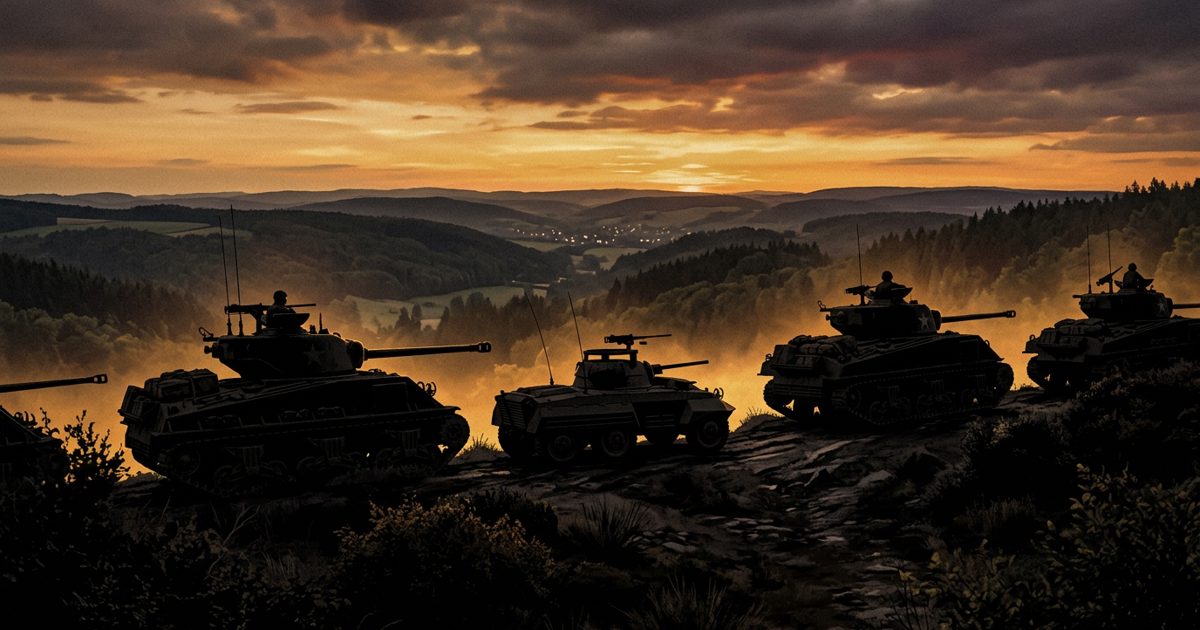
Scouts from Combat Team 9 of the 6th Armored Division drove their reconnaissance vehicles through the outskirts of Weimar during the rapid advance of the U.S. Third Army. Captain Frederic Keffer led a four-man reconnaissance patrol in an M8 Greyhound armored car toward reports of a large compound hidden in the woods near Hottelstedt. Gunfire from isolated German rear guards briefly engaged the column before the armored car reached the outer perimeter fence. Keffer discovered that the camp was Buchenwald, where thousands of political prisoners had risen up against the fleeing SS garrison just hours before American forces arrived.

Soldiers under Captain Keffer's command secured the main entrance gates while radioing division headquarters for urgent medical and logistical assistance. Reconnaissance teams observed catastrophic conditions throughout the barracks, uncovering mass graves, crematoria, and warehouses filled with stolen property. Medical personnel from the 120th Evacuation Hospital were dispatched immediately to stabilize more than twenty-one thousand starving and typhus-stricken survivors. Division officers organized perimeter security, detained captured guards, and coordinated initial emergency rations to prevent refeeding complications among the severely malnourished population.

General George S. Patton ordered combat engineers and medical units to prioritize supply convoys to Buchenwald over standard logistical runs. Third Army headquarters compelled several thousand German civilians from the nearby city of Weimar to tour the camp on foot to witness the systematic murders firsthand. American photographic and signal units documented the evidence thoroughly for upcoming international war crimes trials at Nuremberg. Military authorities transferred surviving children and critically ill patients to specialized recovery hospitals across western Germany over the following weeks.

CHRONOLOGICAL RECORD

April 11 Across U.S. Military History

9 Verified Events
1783 Continental Army Landmark Event • American Revolution

Continental Congress Halts Revolutionary War Hostilities

Delegates in Philadelphia approved a formal proclamation declaring the cessation of arms on land and sea against Great Britain. Congress directed military commanders to halt offensive movements following preliminary peace terms arranged in Paris. Continental regiments stood down operations while negotiations concluded the formal separation from the British Empire.

1862 U.S. Army Landmark Event • Civil War

Union Siege Batteries Force Fort Pulaski Surrender

Artillerymen under Captain Quincy A. Gillmore breached the brick walls of Fort Pulaski with rifled cannon from Tybee Island after thirty hours of shelling. Confederate commander Colonel Charles H. Olmstead surrendered the garrison of 385 soldiers to prevent an explosion in the powder magazine. Federal forces permanently sealed the strategic port of Savannah against Confederate blockade runners.

1898 Joint Landmark Event • Spanish-American War

President McKinley Requests Armed Intervention in Cuba

President William McKinley transmitted a formal message to Congress requesting statutory authorization to deploy American military and naval forces to Cuba. McKinley cited the destruction of the battleship USS Maine and ongoing humanitarian disasters to justify armed intervention against Spanish colonial authorities. Congress answered nine days later with a joint resolution recognizing Cuban independence and authorizing military force.

1900 U.S. Navy Landmark Event • Turn of the Century

Navy Purchases First Submarine USS Holland

Navy officials signed a contract purchasing the fifty-three-foot submersible Holland VI from the Electric Boat Company for 150,000 dollars. Inventor John Philip Holland combined internal combustion surface propulsion with electric battery power to demonstrate reliable submerged maneuvering. Fleet leaders commissioned the craft as USS Holland six months later to establish the modern United States Submarine Force.

1944 U.S. Army Air Forces • World War II

Eighth Air Force Strikes German Aircraft Centers

Bomber formations from the Eighth Air Force dispatched more than eight hundred B-17 Flying Fortresses and B-24 Liberators to attack assembly facilities at Sorau, Cottbus, and Stettin. Luftwaffe interceptors contested the raids aggressively across central Europe, shooting down sixty-four heavy bombers during the operation. American gunners and escorting fighters damaged multiple manufacturing plants while claiming dozens of defending German aircraft.

1945 U.S. Navy • World War II

Kamikaze Strikes Battleship Missouri off Okinawa

Gunners aboard the battleship USS Missouri opened fire on a low-flying Mitsubishi A6M Zero attacking Task Group 58.2 off the Ryukyu Islands. The kamikaze crashed into the starboard side below the main deck, sparking a brief fuel fire that damage control crews extinguished in minutes. Captain William M. Callaghan directed that the deceased Japanese pilot receive a formal military burial at sea.

1951 U.S. Army Landmark Event • Korean War

President Truman Relieves General Douglas MacArthur

President Harry S. Truman issued executive orders removing General of the Army Douglas MacArthur from command in the Far East and Korea. Truman cited public statements by MacArthur that conflicted with administration foreign policy regarding the containment of China. Lieutenant General Matthew B. Ridgway assumed command of United Nations forces to affirm civilian constitutional authority over the military.

1970 U.S. Marine Corps • Vietnam War

Marine Emilio De La Garza Protects Patrol

Marine Lance Corporal Emilio A. De La Garza Jr. shielded two comrades from an enemy grenade blast during a patrol near Da Nang. De La Garza had spotted an enemy soldier hiding in tall grass who suddenly pulled a grenade pin as Marines approached. His immediate decision absorbed the explosion, saving his platoon leader before he died from wounds.

2001 U.S. Navy Landmark Event • Post-Cold War

Diplomats Secure Release of EP-3E Aries Aircrew

Diplomats secured the release of twenty-four crew members of a U.S. Navy EP-3E Aries II surveillance plane detained on Hainan Island following tense international negotiations. Beijing had held the American aviators for eleven days after a mid-air collision with an interceptor forced an emergency landing. A chartered airliner flew the crew to Guam for debriefings before their return to the United States.

MEDAL OF HONOR ACTION 1966

Airman William Pitsenbarger Stands Ground at Cam My

Airman First Class William H. Pitsenbarger volunteered to descend a hundred-foot cable hoist from an HH-43 Huskie helicopter into heavy jungle near Cam My. Soldiers from Charlie Company, 2nd Battalion, 16th Infantry, 1st Infantry Division were surrounded by an enemy battalion and suffering heavy casualties. Pitsenbarger organized triage operations on the ground, treated severe wounds, and coordinated the evacuation of nine critical casualties up through the canopy. Hostile fire heavily damaged his rescue helicopter, forcing the aircraft to make an emergency departure before Pitsenbarger could be extracted.

Pitsenbarger refused a subsequent opportunity to leave, choosing instead to remain behind with the wounded infantrymen on the embattled perimeter. Rifle fire and mortar rounds tore through the trees as the enemy breached defensive positions on multiple sides. Pitsenbarger collected ammunition clips from fallen soldiers, distributed cartridges to surviving riflemen, and returned fire until he was fatally struck. Military leaders posthumously awarded him the Air Force Cross, which was upgraded to the Medal of Honor in December 2000 after surviving soldiers documented his actions.