Full Calendar
THIS DAY IN U.S. MILITARY HISTORY • APRIL 12 1861 U.S. Army American Civil War

Confederate Batteries Open Fire on Fort Sumter in Charleston Harbor

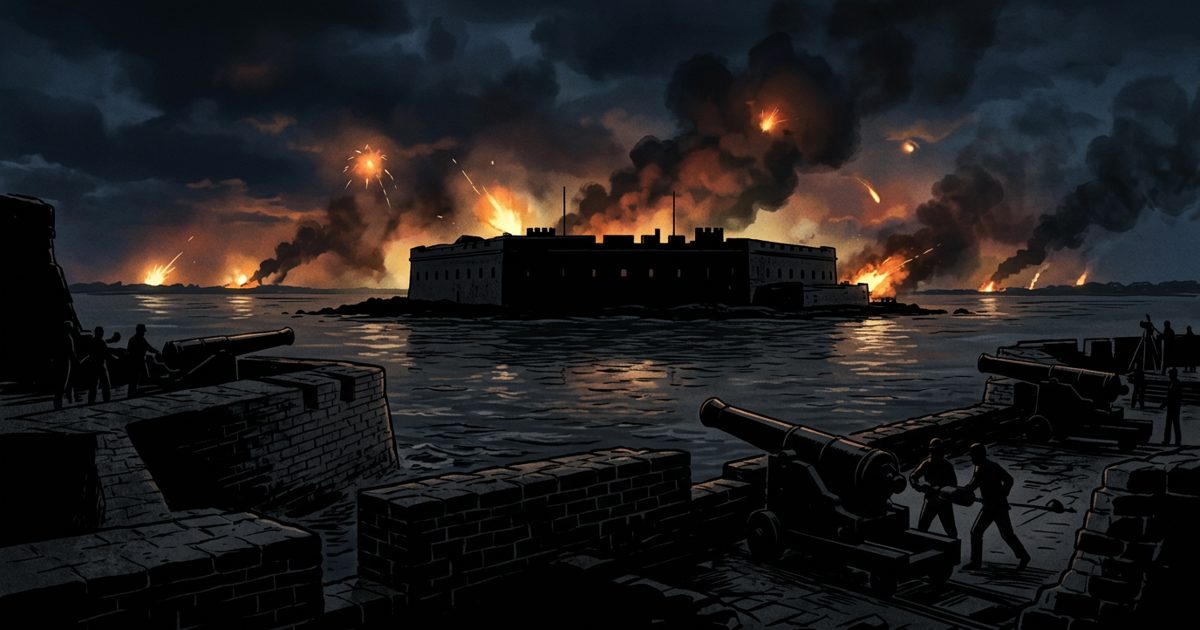
Major Robert Anderson and federal artillerymen endure a thirty-four-hour bombardment inside Charleston Harbor in 1861.
Confederate Batteries Open Fire on Fort Sumter in Charleston Harbor

Artillery batteries under Confederate Brigadier General P.G.T. Beauregard opened fire on Fort Sumter at half past four on the morning of April 12, 1861. Mortar shells from Fort Johnson arched over Charleston Harbor, bursting above the brick bastion and signaling surrounding coastal batteries to begin an immediate barrage. Major Robert Anderson commanded eighty-five federal soldiers and forty-three civilian laborers inside the unfinished fortification, having consolidated his garrison from Fort Moultrie four months earlier. Federal gunners manned lower tier cannons several hours later, deliberately choosing not to load upper level guns to shield crews from incoming fragmentation. Confederate gunners fired thousands of solid shot and explosive shells from positions ringing the harbor.

Cannonballs struck the wooden barracks and ignited fires that threatened the central powder magazines throughout the afternoon. Federal soldiers rolled dozens of powder kegs into the sea and bricked up storage doorways to prevent catastrophic internal explosions. Heavy smoke filled the casemates, forcing artillerymen to breathe through wet cloths while firing six smoothbore guns against rebel emplacements on Morris Island. Supply ships sent by President Abraham Lincoln lingered helplessly outside the harbor because Confederate artillery blocked the main ship channels.

Anderson evaluated his command after thirty-four hours of relentless artillery strikes collapsed chimney stacks and burned the administrative quarters to ash. Union gunners fired their last serviceable rounds on April 13 before raising a white flag of truce to negotiate terms with Beauregard. Federal troops suffered zero combat fatalities during the engagement and evacuated the installation with full military honors on April 14 after firing a planned fifty-gun salute. The departure ended federal control over Charleston Harbor and prompted Lincoln to issue an immediate call for 75,000 volunteer troops.

CHRONOLOGICAL RECORD

April 12 Across U.S. Military History

8 Verified Events
1862 U.S. Army Landmark Event • American Civil War

Andrews Raiders Seize Confederate Train at Big Shanty

Private Jacob Parrott and twenty-one Union soldiers hijacked the locomotive General at Big Shanty, Georgia, on April 12, 1862. The raiders steamed north toward Chattanooga to sever Confederate rail lines and telegraph wires. Confederate pursuers captured the party after an eighty-seven-mile chase, and Parrott later became the first soldier presented with the Medal of Honor.

1864 U.S. Army Landmark Event • American Civil War

Confederate Cavalry Assaults Union Redoubt at Fort Pillow

Major William Bradford assumed command of 557 Union troops after Confederate sharpshooters killed Major Lionel Booth at Fort Pillow, Tennessee, on April 12, 1864. Cavalry under Major General Nathan Bedford Forrest overran the earthworks and killed hundreds of federal defenders, including nearly two hundred African American artillerymen. The assault sparked national outrage and caused the Union to halt prisoner-of-war exchanges.

1865 U.S. Army Landmark Event • American Civil War

Federal Forces Occupy Confederate Port of Mobile

Major General Edward Canby accepted the formal surrender of Mobile, Alabama, on April 12, 1865, after Confederate forces evacuated the city overnight. Union troops from Major General Gordon Granger's XIII Corps marched into the port without opposition. The bloodless capitulation secured the last major Confederate seaport on the Gulf of Mexico for federal forces.

1945 U.S. Army Landmark Event • World War II

Ninth Army Tanks Cross the Elbe River

Tanks of the 2nd Armored Division, operating under Lieutenant General William H. Simpson's Ninth Army, established a bridgehead across the Elbe River near Magdeburg on April 12, 1945. Combat engineers ferried infantry and armor across the water, positioning federal forces fifty-three miles southwest of Berlin. Supreme headquarters subsequently ordered the division to hold positions along the river to await advancing Soviet forces.

1945 U.S. Navy • World War II

Destroyer Mannert L Abele Sunk by Rocket Bomb

Commander Alton E. Parker directed the destroyer USS Mannert L. Abele against massed kamikaze strikes off Okinawa on April 12, 1945. A Zero crashed into the starboard hull before a rocket-propelled Yokosuka MXY-7 Ohka flying bomb struck the waterline, breaking the warship in two. The disaster marked the first operational sinking of an American warship by a rocket-boosted suicide bomb.

1951 U.S. Air Force Landmark Event • Korean War

Superfortresses Clash with MiGs Over Sinuiju Bridges

MiG-15 fighters piloted by Soviet airmen intercepted forty-eight B-29 Superfortresses near the Yalu River on April 12, 1951. Enemy jets downed three bombers and heavily damaged seven others despite escorts from American fighters during the clash known as Black Thursday. The heavy losses forced Far East Air Forces to abandon daylight heavy bomber raids across North Korea.

1975 U.S. Marine Corps Landmark Event • Vietnam Era

Marines Execute Operation Eagle Pull in Cambodia

Helicopters of Marine Heavy Helicopter Squadron 462 launched from the amphibious assault ship USS Okinawa to evacuate Phnom Penh, Cambodia, on April 12, 1975. Infantrymen from 2nd Battalion, 4th Marines secured the landing zone near the American embassy as Khmer Rouge artillery shells fell nearby. The tactical airlift safely transferred 287 American, Cambodian, and foreign personnel to fleet vessels.

2009 U.S. Navy • Global War on Terrorism

Navy SEAL Snipers Rescue Hostage Captain Phillips

Snipers from SEAL Team Six stationed on the fantail of the guided-missile destroyer USS Bainbridge killed three Somali pirates on April 12, 2009. Commander Frank Castellano authorized the coordinated rifle shots when captors aimed a weapon at hostage Captain Richard Phillips. Operators immediately boarded the drifting craft and recovered Phillips unharmed after his five-day captivity.

MEDAL OF HONOR ACTION 1945

Staff Sergeant Henry Erwin Saves Superfortress Crew Over Japan

Staff Sergeant Henry Eugene Erwin served as radio operator aboard the Boeing B-29 Superfortress City of Los Angeles on April 12, 1945. Pilots steered the heavy bomber toward a chemical plant at Koriyama, Japan, while Erwin prepared to launch phosphorescent smoke bombs through a floor chute to signal incoming strike formations. A faulty white phosphorus flare ignited prematurely inside the chute and bounced back into the aircraft cabin. Intense flames burned Erwin, blinded both eyes, and filled the cockpit with thick white smoke.

Erwin grasped the 1,100-degree burning incendiary with his bare hands and crawled toward the front cockpit by feeling along the floor bulkhead. Pilot Captain George Simeral flew blind as the aircraft plunged toward the ocean, but Erwin pushed past the navigator table and hurled the flaming canister through the copilot open window. Simeral pulled the bomber out of its dive three hundred feet above the water and diverted to Iwo Jima for emergency medical treatment. Army leaders expedited the Medal of Honor, presenting the decoration to Erwin in a Guam field hospital one week later.