Full Calendar
THIS DAY IN U.S. MILITARY HISTORY • APRIL 6 1862 U.S. Army Civil War

Grant Holds the Line at Bloody Shiloh

Confederate divisions strike Union camps in southwestern Tennessee, opening the bloodiest battle the continent had yet witnessed.
Grant Holds the Line at Bloody Shiloh

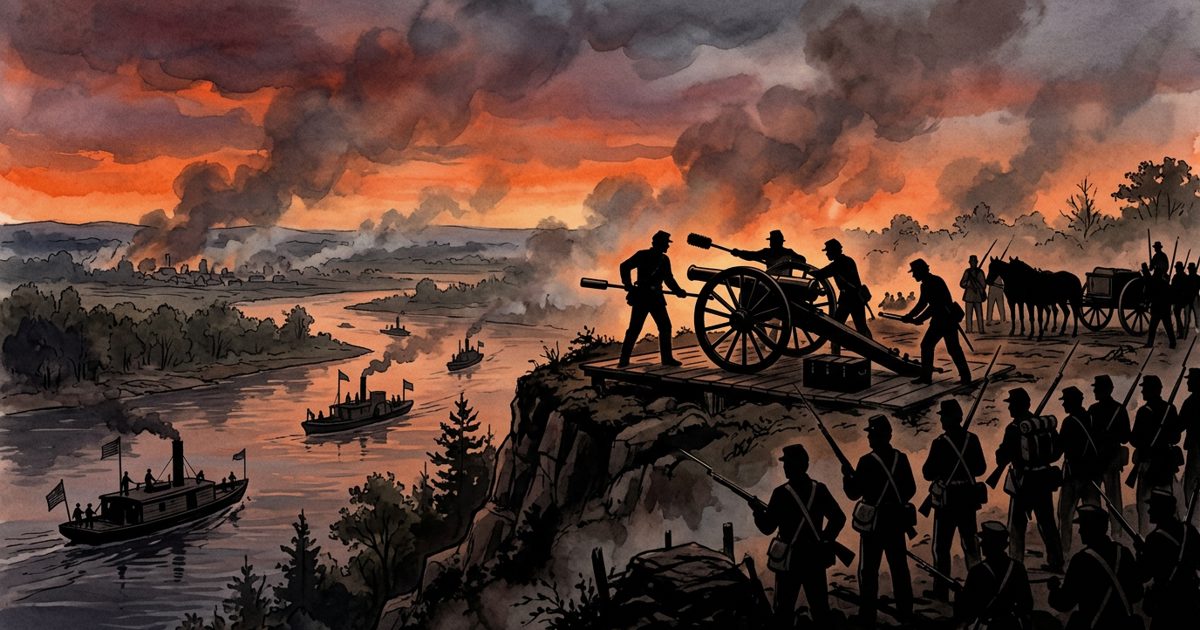
Confederate infantry divisions under General Albert Sidney Johnston surged out of the woods near Shiloh Church at dawn, catching forward Federal camps unprepared. Major General Ulysses S. Grant hurried to Pittsburg Landing by steamboat from Savannah, Tennessee, arriving to find his five encampments collapsing under relentless assaults. Union soldiers rallied around Brigadier General William Tecumseh Sherman near the church, while Brigadier General Benjamin Prentiss established an improvised defensive line along an overgrown sunken farm lane. Rebels hammered this position with repeated frontal assaults, dubbing the lethal thicket the Hornets Nest as bullets buzzed through the timber.

Artillery massed by Confederate Brigadier General Daniel Ruggles eventually wheeled sixty-two cannon into a grand battery, pulverizing the Hornets Nest with concentrated canister and solid shot. Prentiss surrendered more than two thousand Federal troops late in the afternoon, but their six hours of stubborn resistance allowed Grant to construct a formidable perimeter on the bluffs overlooking Pittsburg Landing. Johnston bled to death from a severed popliteal artery behind the front lines, passing Southern command to General P. G. T. Beauregard. Beauregard launched late afternoon charges against the final Union line, but massed Federal artillery and fire from timberclad gunboats broke every thrust.

Steamboats shuttled thousands of fresh Union soldiers across the swollen Tennessee River as darkness descended, bringing Major General Don Carlos Buell's Army of the Ohio into Grant's perimeter. Gunboats USS Tyler and USS Lexington hurled heavy eight-inch shells into Confederate bivouacs throughout the rainy night, denying the exhausted Southern soldiers rest. Grant reorganized his divisions alongside Buell and Major General Lew Wallace, amassing fifty-four thousand men for a decisive dawn counteroffensive. Morning light revealed Confederate units stalled without ammunition or reinforcements, setting up their complete tactical retreat toward Corinth the following afternoon.

CHRONOLOGICAL RECORD

April 6 Across U.S. Military History

7 Verified Events
1776 Continental Navy Landmark Event • American Revolutionary War

Continental Fleet Engages HMS Glasgow off Block Island

Ships of the newly formed Continental Navy under Commodore Esek Hopkins intercepted the British sixth-rate frigate HMS Glasgow off Rhode Island during their return from the Nassau expedition. Cannon fire damaged the American flagship Alfred and the brig Cabot, allowing the outgunned British vessel to outmaneuver the squadron and escape into Newport. Hopkins faced severe congressional reprimand for failing to capture the isolated enemy warship.

1865 U.S. Army Landmark Event • American Civil War

Union Armies Rout Lee at Sailor's Creek

Union cavalry commanded by Major General Philip Sheridan teamed with the Sixth Army Corps to sever General Robert E. Lee's retreat route near Farmville, Virginia. Assaults across the swollen creek overwhelmed three Confederate corps, resulting in the capture of 7,700 Confederate soldiers and eight generals, including Lieutenant General Richard Ewell. Lee lost one-fourth of his remaining army in this catastrophic defeat three days before Appomattox.

1917 Joint Landmark Event • World War I

United States Formally Declares War on Germany

Congress formally passed a joint resolution declaring war against the German Empire following months of unrestricted submarine attacks on American merchant vessels. President Woodrow Wilson signed the war declaration at 1:18 p.m., automatically transferring the U.S. Coast Guard into the Department of the Navy and activating American military mobilization. General John J. Pershing soon assumed command of the American Expeditionary Forces headed for the Western Front.

1945 U.S. Navy Landmark Event • World War II

Japanese Kamikazes Attack US Fleet off Okinawa

Japanese air forces unleashed Operation Kikusui No. 1, hurling nearly seven hundred aircraft, including 355 suicide planes, at Allied naval units surrounding Okinawa. Picket destroyers bore the brunt of the onslaught, with USS Bush and USS Colhoun sunk after multiple aircraft impacts while USS Newcomb survived severe damage. Navy anti-aircraft gunners and carrier fighters shot down over three hundred attacking planes during the nineteen-hour engagement.

1972 U.S. Air Force • Vietnam War

Operation Freedom Train Strikes North Vietnamese Targets

Air Force and Navy combat aircraft initiated Operation Freedom Train, resuming sustained aerial bombardment of North Vietnam below the 20th parallel to blunt the communist Easter Offensive. Strike packages targeted surface-to-air missile installations, bridges, and troop assembly areas across the southern panhandle. Aircraft carrier air wings averaged nearly two hundred combat sorties per day over the next week to suppress enemy supply movements.

2004 U.S. Marine Corps • War in Iraq

Second Battalion Fourth Marines Battles Insurgents in Ramadi

Marines assigned to 2nd Battalion, 4th Marine Regiment fought coordinated insurgent ambushes across Ramadi following simultaneous uprisings in western Iraq. Heavy small-arms and rocket-propelled grenade fire trapped foot patrols and Humvees in dense urban neighborhoods throughout the city. Twelve Marines were killed in action during intense house-to-house fighting while defending key government buildings and arterial roads.

2017 U.S. Navy • Operation Inherent Resolve

US Destroyers Launch Cruise Missiles into Syria

Destroyers USS Ross and USS Porter launched fifty-nine Tomahawk Land Attack Missiles from the eastern Mediterranean Sea into Shayrat Airbase in western Syria. Missiles struck aircraft hangars, fuel depots, radar systems, and ammunition bunkers in direct retaliation for a chemical weapons attack on civilians two days earlier. Pentagon assessments confirmed the targeted airfield sustained extensive infrastructural damage without casualties among American forces.

MEDAL OF HONOR ACTION 2008

Special Forces Assault in the Shok Valley

Helicopters inserted twelve soldiers from Operational Detachment Alpha 3336 and Afghan commandos into the remote Shok Valley to capture a senior insurgent commander. Insurgents concealed in stone fortifications on towering cliffs opened intense machine-gun and sniper fire, pinning down the command team in a frozen riverbed. Team medic Staff Sergeant Ronald J. Shurer II exposed himself to relentless fire to apply tourniquets and stabilize critically wounded comrades.

Sergeant Matthew O. Williams gathered four Afghan commandos and ascended a sheer hundred-foot cliff to reinforce the trapped element. Williams repeatedly carried wounded soldiers down the precipice on his back under direct fire, while attached combat controller Zachary Rhyner coordinated fifty close air strikes on insurgent bunkers. Helicopters successfully extracted all coalition personnel after seven hours of fighting, during which Shurer and Williams earned Medals of Honor and Rhyner received the Air Force Cross.