Full Calendar
THIS DAY IN U.S. MILITARY HISTORY • APRIL 9 1865 U.S. Army American Civil War

Surrender at Appomattox Court House Closes the War in Virginia

General Robert E. Lee formally surrenders the Army of Northern Virginia to Lieutenant General Ulysses S. Grant in the McLean parlor.
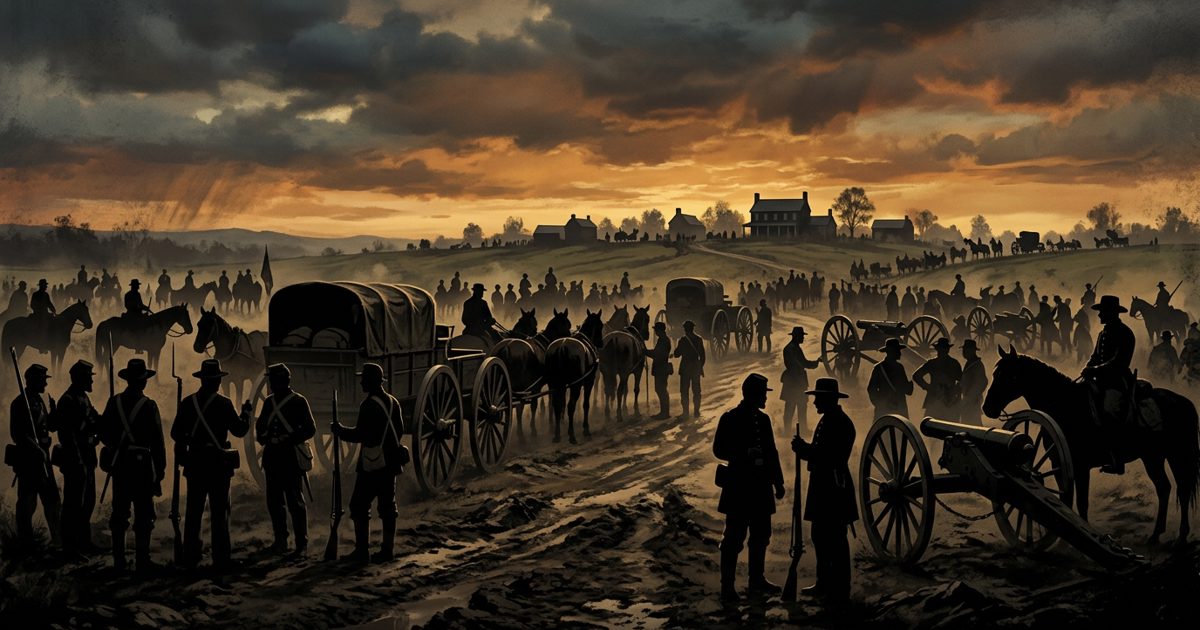
Surrender at Appomattox Court House Closes the War in Virginia

Major General John B. Gordon launched a sunrise assault against Union cavalry west of Appomattox Court House, attempting to secure an escape corridor toward Lynchburg. Gordon pushed back Major General Philip Sheridan's cavalry screen, but the sudden arrival of Major General Edward Ord's infantry deployed massive Federal lines across the road. Encircled on three sides and out of ammunition, General Robert E. Lee recognized that continued resistance meant slaughter for his exhausted force. Lee sent a rider under a white flag of truce to arrange an immediate conference with Lieutenant General Ulysses S. Grant.

Grant received Lee's dispatch near midday and rode directly into the village to confer inside the private home of Wilmer McLean. Lee arrived wearing a pristine dress uniform with a ceremonial sword, while Grant wore a mud-spattered field uniform and private's coat. Discussions began cordially as the two commanders recalled their shared service during the Mexican-American War before drafting the terms. Grant wrote surrender conditions requiring the Army of Northern Virginia to turn over military ordnance and sign paroles pledging not to fight again.

Provisions inserted by Grant permitted Confederate officers to retain sidearms and allowed soldiers to keep private horses for spring farm plowing. Grant also directed Union quartermasters to deliver twenty-five thousand field rations immediately to feed Lee's starving soldiers. Federal artillery units began firing victory salutes across the valley, but Grant halted the cannons to maintain military dignity. Lee signed the agreement at three in the afternoon, releasing 28,231 Confederate troops on parole and extinguishing armed rebellion in Virginia.

CHRONOLOGICAL RECORD

April 9 Across U.S. Military History

8 Verified Events
1864 U.S. Army • American Civil War

Union Forces Repulse Assault at Pleasant Hill

Major General Nathaniel P. Banks halted a Confederate counteroffensive led by Major General Richard Taylor outside Pleasant Hill, Louisiana. Taylor threw five brigades against the Union line, but Brigadier General William H. Emory's division anchored the Federal defense and launched a decisive bayonet charge. Union units held the battlefield overnight before falling back to Grand Ecore.

1865 U.S. Army Landmark Event • American Civil War

United States Colored Troops Storm Fort Blakely

Brigadier General John P. Hawkins led nine regiments of the United States Colored Troops in a mass assault against Confederate fortifications at Fort Blakely, Alabama. Hawkins' soldiers crossed dense abatis and explosive torpedo traps under heavy fire to overwhelm Redoubts One and Two. Union forces captured over two thousand Confederate defenders, clearing the eastern approach to Mobile.

1914 U.S. Navy • Mexican Border Conflict

Sailors Detained During the Tampico Incident

Soldiers of the Mexican Federal Army arrested nine unarmed American sailors loading drummed gasoline onto a whaleboat from the gunboat USS Dolphin at Tampico. General Pedro Ojeda ordered their quick release, but Rear Admiral Henry T. Mayo demanded a formal twenty-one gun salute to the American flag. Mexican refusal led President Woodrow Wilson to order the military occupation of Veracruz.

1941 U.S. Navy • World War II Pre-War

Battleship USS North Carolina Enters Service

Officers and crew commissioned the battleship USS North Carolina under Captain Olaf M. Hustvedt at the New York Navy Yard. North Carolina represented the first newly constructed American battleship completed in over two decades, carrying nine 16-inch main guns and twenty 5-inch secondary guns. Sea trials commenced immediately to prepare the warship for high-seas convoy escort and Pacific carrier screening.

1942 U.S. Army Landmark Event • World War II

American and Filipino Forces Surrender Bataan

Major General Edward P. King Jr. surrendered approximately seventy-five thousand starving American and Filipino troops on the Bataan Peninsula to Japanese Lieutenant General Masaharu Homma. King acted against orders to prevent the wholesale annihilation of his disease-stricken garrison after defensive lines collapsed. Japanese forces subsequently marched the exhausted captives north toward Camp O'Donnell in the brutal Bataan Death March.

1943 U.S. Army • World War II

Private Robert Booker Earns Medal of Honor

Private Robert D. Booker of the 133rd Infantry Regiment advanced across two hundred yards of open desert near Fondouk, Tunisia, while under direct machine gun fire. Booker carried a light machine gun and ammunition to an exposed position and silenced an enemy nest despite severe bullet wounds. Booker continued directing fire for his squad until receiving a fatal second hit.

1965 U.S. Navy • Vietnam War

Navy Phantoms Clash With Chinese Fighters

Pilots flying F-4B Phantom II jets from Fighter Squadron 96 aboard USS Ranger intercepted four Chinese MiG-17 fighters near Hainan Island. Lieutenant Junior Grade Terence M. Murphy destroyed one MiG with an air-to-air missile before his aircraft was lost during the engagement. The dogfight marked the first aerial combat victory credited to the F-4 Phantom platform.

2003 U.S. Marine Corps Landmark Event • Operation Iraqi Freedom

American Armed Forces Capture Central Baghdad

Marines from 3rd Battalion, 4th Marines, supported by armored columns of the 3rd Infantry Division, pushed into central Baghdad and secured Firdos Square. Combat engineers attached an M88 recovery vehicle to pull down a massive bronze statue of Saddam Hussein as local civilians celebrated. The capture broke organized Baathist military control throughout the capital city.

NAVAL WARFARE 1944

Task Group 22.3 Destroys Submarine U-515

Captain Daniel V. Gallery led Task Group 22.3 to corner the German submarine U-515 north of Madeira in the central Atlantic Ocean. Escort carrier USS Guadalcanal dispatched Grumman TBM Avengers and FM-2 Wildcats from Composite Squadron 58 to join destroyer escorts Chatelain, Flaherty, Pillsbury, and Pope in a coordinated search. Chatelain established sonar contact and fired hedgehog anti-submarine mortars alongside heavy depth-charge patterns that pounded the submerged vessel at extreme depth. Explosions ruptured the submarine's ballast tanks and forced Kapitanleutnant Werner Henke to blow remaining air tanks and surface into broad daylight.

Gunners across all four destroyer escorts opened fire with three-inch guns and forty-millimeter cannons while overhead Wildcats strafed the conning tower with rockets and machine guns. Aircraft rockets penetrated the submarine's outer casing and ignited exposed high-pressure air flasks aft of the sail. Henke ordered his crew to abandon ship as sea water flooded the fractured hull and swamped the electric engines. Destroyer escorts lowered motor whaleboats, rescuing Henke and forty-three German sailors while U-515 sank stern-first into deep water.