Full Calendar
THIS DAY IN U.S. MILITARY HISTORY • APRIL 8 1865 U.S. Army Civil War

Custer Traps Confederate Supply Trains at Appomattox Station

Union cavalry captures three supply trains and overruns reserve artillery to block General Robert E. Lee's escape west.
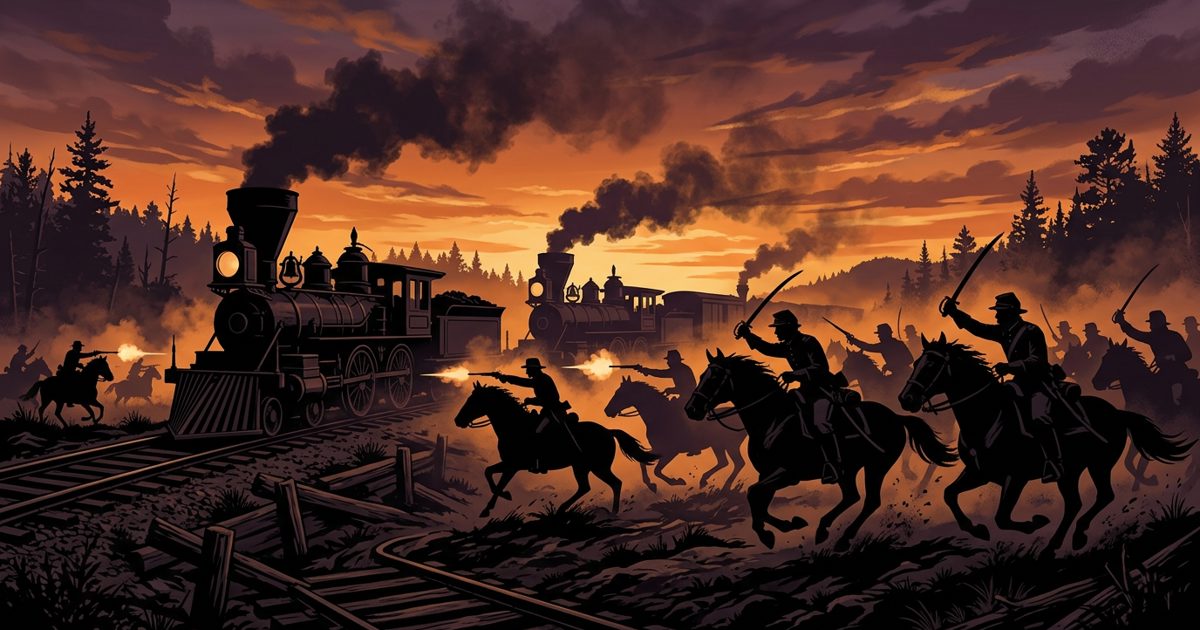
Custer Traps Confederate Supply Trains at Appomattox Station

Brigadier General George Armstrong Custer led his cavalry division toward Appomattox Station on April 8, 1865. Major General Philip Sheridan ordered the horsemen to outrun General Robert E. Lee's retreating Army of Northern Virginia. Confederate supply officials had sent four trains packed with rations, clothing, and artillery ammunition to meet Lee's famished troops. Troopers of the 2nd New York Cavalry charged into the station that afternoon and seized three trains before the engineers could reverse them. Experienced railroaders among the troopers blew the whistles and drove the captured locomotives eastward.

Locomotive whistles echoed through the woods just as Confederate reserve artillery opened fire north of the depot. Brigadier General Reuben Lindsay Walker had parked dozens of cannon and supply wagons in the timber without infantry support. Walker formed an improvised battle line, arming reserve artillerymen and wagon drivers with muskets to defend the guns. Custer deployed his brigades and ordered relentless mounted charges into the falling darkness. Repeated cavalry assaults swept through the woods until the Union horsemen shattered the Confederate artillery perimeter.

Union troopers captured twenty-five cannon, hundreds of supply wagons, and nearly one thousand prisoners in the nighttime rout. Custer suffered fewer than fifty casualties while securing the vital railhead and highway junction. Cavalry detachments immediately threw barricades across the Richmond-Lynchburg Stage Road, blocking Lee's last western retreat path. Confederate commanders recognized that their army was trapped without food or ammunition reserves. General Lee met Lieutenant General Ulysses S. Grant the next morning at Appomattox Court House to surrender his army.

CHRONOLOGICAL RECORD

April 8 Across U.S. Military History

8 Verified Events
1823 U.S. Navy • West Indies Anti-Piracy Operations

Navy Barges Capture Pirate Schooner Off Cuba

Lieutenant Commandant C. K. Stribling led the armed barges USS Mosquito and USS Gallinipper against the pirate schooner Pilot off Havana on April 8, 1823. Supported by the sloop USS Peacock, American bluejackets drove the vessel ashore and pursued the buccaneers inland. The action liberated a captive merchant vessel and protected regional shipping channels.

1832 U.S. Army • Black Hawk War

Sixth Infantry Deploys from St. Louis

Brigadier General Henry Atkinson embarked 300 soldiers of the 6th U.S. Infantry on river transports at Jefferson Barracks, Missouri, on April 8, 1832. Atkinson moved up the Mississippi River to Fort Armstrong at Rock Island to counter Chief Black Hawk's band. This deployment marked the official commitment of federal regular troops to the conflict.

1862 Joint Landmark Event • Civil War

Confederate Stronghold at Island Ten Surrenders

Brigadier General William W. Mackall surrendered Island Number Ten and its mainland batteries to Union forces on April 8, 1862. Combined operations by Major General John Pope's army and Flag Officer Andrew Foote's gunboats isolated the Confederate garrison near Tiptonville, Tennessee. The victory yielded over 4,500 prisoners and opened the Mississippi River down to Fort Pillow.

1864 U.S. Army Landmark Event • Civil War

Union Advance Halted at Mansfield

Major General Nathaniel P. Banks suffered a tactical defeat at the Battle of Mansfield in Louisiana on April 8, 1864. Confederate Major General Richard Taylor attacked along Sabine Crossroads, crushing the Union XIII Corps and capturing twenty artillery pieces. The defeat forced Banks to withdraw toward Pleasant Hill, wrecking the federal campaign toward Shreveport.

1865 U.S. Army • Civil War

Union Assault Breaches Spanish Fort

Major General E. R. S. Canby launched a dusk infantry assault that breached Confederate defenses at Spanish Fort near Mobile, Alabama, on April 8, 1865. Men of the 8th Iowa Infantry spearheaded the attack following a relentless thirteen-day siege. The breakthrough compelled the Confederate garrison to abandon their works and retreat toward Mobile.

1925 U.S. Navy Landmark Event • Interwar Period

First Night Carrier Landing on Langley

Lieutenant John D. Price piloted a TS biplane onto the flight deck of USS Langley off San Diego on April 8, 1925, completing the first planned night landing in U.S. naval history. Three other naval aviators followed in succession using deck floodlights and hand-held wands. The milestone proved that aircraft carriers could conduct continuous nocturnal flight operations.

1945 U.S. Army • World War II

Staff Sergeant John Crews Neutralizes Enemy Bunkers

Staff Sergeant John R. Crews of the 63rd Infantry Division assaulted two German machine-gun positions near Lobenbacherhof, Germany, on April 8, 1945. Crews charged up a hillside after his platoon commander was wounded, killed two enemy gunners, seized a weapon, and cleared an automatic rifle position despite wounds. His valor earned him the Medal of Honor.

1968 Joint Landmark Event • Vietnam War

Operation Pegasus Relieves Khe Sanh Base

Soldiers of the 1st Cavalry Division linked up with the 26th Marine Regiment at Khe Sanh Combat Base on April 8, 1968, officially lifting the seventy-seven day siege. Operation Pegasus reopened Route 9 through aggressive airmobile assaults and concentrated air strikes. The relief restored ground supply access to the western border sector of South Vietnam.

INTELLIGENCE AND RECONNAISSANCE 1950

Soviet Fighters Intercept American Patrol Aircraft Over Baltic

Patrol Squadron 26 launched a modified PB4Y-2 Privateer from Wiesbaden, West Germany, on a secret reconnaissance flight on April 8, 1950. Lieutenant John H. Fette commanded the patrol aircraft, nicknamed Turbulent Turtle, alongside nine crewmen on an electronic intelligence collection mission over the Baltic Sea. Navy intelligence officers sought radar frequencies and coastal communications from Soviet naval installations in Latvia. Four Soviet Lavochkin La-11 fighters scrambled from a coastal airfield to intercept the four-engine patrol plane. Soviet pilots fired heavy cannon rounds south of Liepaja, sending the unarmed American maritime reconnaissance plane into the sea.

Search aircraft from the United States Air Force and Navy scoured the freezing waters for ten days without finding survivors. Swedish fishing boats later hauled up punctured life rafts and landing gear struts that confirmed the violent loss of the aircrew. State Department officials delivered formal protests over the attack in international airspace, while Moscow claimed the plane had violated territorial boundaries. Navy leadership posthumously awarded the Distinguished Flying Cross to all ten lost crewmen. Declassified records subsequently verified the mission as one of the earliest direct aerial intelligence clashes of the Cold War.