Full Calendar
THIS DAY IN U.S. MILITARY HISTORY • DECEMBER 25 1776 Continental Army American Revolutionary War

General George Washington Crosses the Icy Delaware River

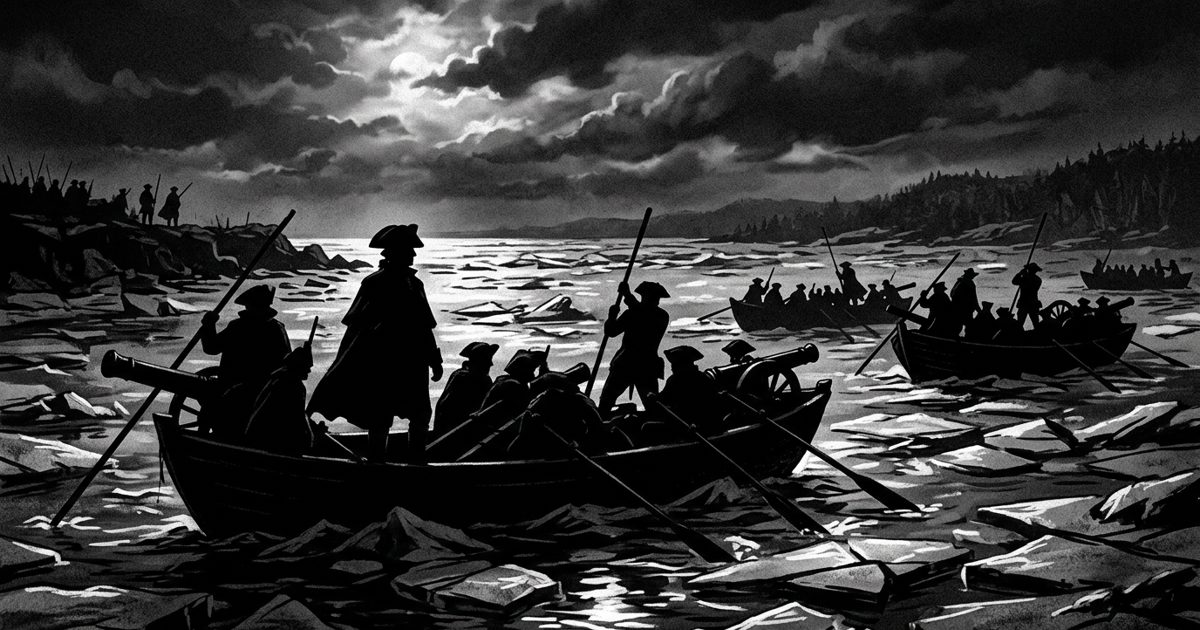
General George Washington leads 2,400 Continental Army soldiers across a frozen river on Christmas night to launch a surprise strike on Trenton.
General George Washington Crosses the Icy Delaware River

Soldiers of the Continental Army gathered along the snow-covered Pennsylvania bank of the Delaware River as darkness fell on Christmas night. General George Washington assembled 2,400 men, eighteen artillery pieces, and horses for a surprise crossing aimed at the Hessian garrison occupying Trenton, New Jersey. Heavy sleet, hail, and a violent nor'easter battered the troops as river ice churned through McConkey's Ferry. Experienced mariners from Colonel John Glover's Fourteenth Continental Regiment took command of forty-foot Durham boats and large flat-bottomed ferries, fighting ferocious currents and jagged ice floes to shuttle the expedition across the water.

Washington watched the delays mount through the freezing night as river conditions halted two supporting columns commanded by Colonel John Cadwalader and Brigadier General James Ewing. Only the main force under Washington's direct supervision managed to reach the New Jersey shore, completing the treacherous crossing at three in the morning. Artillery commander Colonel Henry Knox shouted commands into the blinding blizzard to direct the offloading of all eighteen heavy cannons without the loss of a single gun. Frozen mud and slush clung to the infantrymen as they formed ranks in the dark, preparing for an immediate nine-mile march south toward their objective.

Infantrymen split into two parallel assault columns under Major General John Sullivan and Major General Nathanael Greene as dawn broke over the snowbound New Jersey landscape. Wet powder rendered many muskets useless during the march, compelling officers to order bayonet charges upon reaching the outer Hessian outposts at eight o'clock in the morning on December 26. Surprised Hessian regiments under Colonel Johann Rall scrambled into the streets but collapsed under rapid American artillery fire and coordinated street sweeps. Washington secured nearly nine hundred prisoners, substantial arms, and vital winter supplies, recrossing the river into Pennsylvania with his victorious command.

CHRONOLOGICAL RECORD

December 25 Across U.S. Military History

8 Verified Events
1793 U.S. Army • Northwest Indian War

Anthony Wayne Establishes Fort Recovery in Ohio

General Anthony Wayne led three hundred soldiers of the Legion of the United States to the site of Arthur St. Clair's catastrophic defeat on December 25, 1793. Troops cleared unburied remains across the frozen Wabash River battlefield and began constructing Fort Recovery. The stockade provided an essential forward staging base for Wayne's victorious campaign at Fallen Timbers.

1826 U.S. Army • Early Republic

West Point Suppresses the Eggnog Riot

Cadets at the United States Military Academy concluded a night of drunken disorder inside North Barracks on December 25, 1826, after smuggling whiskey into the academy to spike holiday eggnog. Rioters smashed windows and threatened officers with weapons before reveille restored order. Superintendent Sylvanus Thayer court-martialed nineteen participants and established strict academy regulations.

1837 U.S. Army Landmark Event • Second Seminole War

Zachary Taylor Fights the Battle of Lake Okeechobee

Colonel Zachary Taylor commanded eight hundred regular infantrymen and one hundred thirty-two Missouri volunteers in a direct assault against four hundred fortified Seminole warriors on December 25, 1837. Soldiers waded through waist-deep sawgrass swamps under heavy fire, suffering twenty-six killed and one hundred twelve wounded. Taylor secured the field, earning promotion to brigadier general.

1864 U.S. Navy • American Civil War

Union Forces Bombard Fort Fisher in North Carolina

Warships under Rear Admiral David Dixon Porter bombarded Confederate earthworks protecting Wilmington at Fort Fisher on December 25, 1864, while two thousand soldiers under Major General Benjamin Butler went ashore. Butler decided the defenses were impregnable and abruptly evacuated his ground troops over Porter's protests. Union leadership replaced Butler soon after this initial failure.

1868 Joint Landmark Event • Reconstruction Era

President Andrew Johnson Grants Full Confederate Amnesty

President Andrew Johnson issued Presidential Proclamation 179 on December 25, 1868, extending an unconditional pardon to all individuals who participated in the rebellion against the United States. The blanket amnesty restored full constitutional and property rights to former Confederate soldiers, sailors, and officers without requiring formal oaths. This proclamation marked the final federal wartime pardon.

1941 U.S. Navy Landmark Event • World War II

Admiral Chester Nimitz Reaches Devastated Pearl Harbor

Admiral Chester W. Nimitz landed in a Navy Coronado flying boat at Pearl Harbor on December 25, 1941, to assume command of the battered Pacific Fleet. Nimitz surveyed sunken battleships, met with predecessor Admiral Husband Kimmel, and addressed shaken headquarters staff. His arrival established calm resolve and initiated immediate salvage and carrier task force operations.

1944 U.S. Army Landmark Event • World War II

Paratroopers Repel Christmas Panzer Assault at Bastogne

Soldiers of the 101st Airborne Division and attached tank destroyer crews crushed a determined armored assault by the German Fifteenth Panzergrenadier Division outside Bastogne on December 25, 1944. Defending infantrymen and 705th Tank Destroyer Battalion gunners knocked out eighteen German tanks attempting to penetrate the perimeter at Champs. Encircled American forces held the crossroads until relief arrived.

1972 U.S. Air Force • Vietnam War

Strategic Air Command Pauses Linebacker Bombing Missions

Commanders of Strategic Air Command observed a temporary thirty-six-hour operational pause over North Vietnam on December 25, 1972, during Operation Linebacker II. B-52 Stratofortress crews and ground personnel at Andersen Air Force Base and U-Tapao rested while commanders revised flight tactics following early bomber losses. Strikes resumed the following night with multi-axis attacks that forced Hanoi to sign peace accords.

MEDAL OF HONOR ACTION 1863

Contraband Robert Blake Earns the Medal of Honor

Gunners of a Confederate shore battery opened surprise artillery fire on the Union steam gunboat USS Marblehead at six o'clock on Christmas morning off Legareville, South Carolina. Enslaved before escaping to Union naval forces on the Santee River, Robert Blake served on board the vessel as an officer's steward with no assigned battle station. Exploding shrapnel from enemy howitzers ripped through the quarterdeck, knocking Blake down and killing a powder boy manning the ship's pivot rifle gun. Blake climbed to his feet, stripped down to his waist, and immediately took over the hazardous job of hauling heavy powder charges from the magazine to keep the weapon firing.

Marblehead delivered over two hundred rounds of explosive shell and shrapnel into the Confederate works on John's Island, forcing the hostile gunners to abandon their earthworks and leave two artillery pieces behind. Lieutenant Commander Richard Worsam Meade praised Blake's cool and brave conduct in his official action report to the South Atlantic Blockading Squadron. Secretary of the Navy Gideon Welles approved the award of the Medal of Honor to Blake on April 16, 1864. Blake became the first African American service member to physically receive the nation's highest decoration for combat valor.