Marines Secure Roi-Namur in Fierce Battle for Kwajalein
Major General Harry Schmidt led the 4th Marine Division into its combat debut to seize the vital Japanese airfield complex at Kwajalein Atoll in 1944.
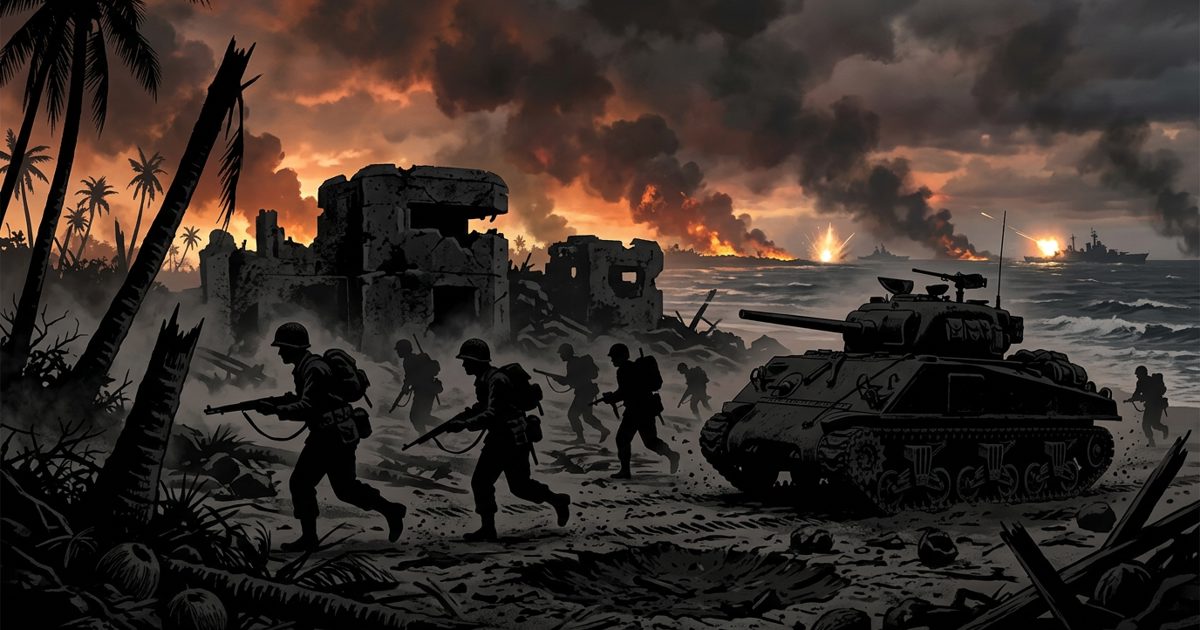
Marines of the 4th Marine Division stormed ashore at Roi-Namur at the northern end of Kwajalein Atoll, initiating their first combat operation of World War II. Operation Flintlock bypassed heavily fortified outer islands to strike directly into the heart of the Japanese Marshall Islands defense perimeter. Combat teams from the 23rd Marine Regiment attacked the flat airfield on Roi, while the 24th Marine Regiment drove into the dense jungle, concrete pillboxes, and blockhouses across adjacent Namur. Navy battleships and carrier dive bombers pounded the twin islands with naval gunfire before landing craft delivered the assault waves across shallow coral reefs. Japanese defenders mounted desperate resistance from interconnected bunkers, setting off intense close-quarters combat across every sector of the atoll.
Demolition teams moved forward to neutralize fortified Japanese bunkers on Namur. Marine sappers threw a heavy satchel charge into an unmapped reinforced bunker, unaware that the structure housed Japanese torpedo warheads and naval artillery shells. The resulting cataclysmic blast obliterated the building, hurled palm trunks hundreds of feet into the air, and killed twenty Marines while wounding dozens more. Shockwaves flattened vegetation across the island, yet assault platoons quickly regrouped under smoke and debris to resume their forward advance. Marines used flamethrowers, medium tanks, and shoulder-fired rockets to systematically reduce the remaining enemy strongpoints throughout the morning.
Infantrymen of the 4th Marine Division cleared the last organized pockets of enemy resistance on Namur by late afternoon on February 2, 1944. Marine commanders declared both Roi and Namur secure less than twenty-four hours after the main assault waves hit the beaches. The operation cost the 4th Marine Division 190 men killed and more than 500 wounded, while nearly all 3,500 Japanese garrison troops perished in the defense. Capture of the large airfield on Roi provided land-based air support for subsequent strikes across the central Pacific and unhinged the entire Japanese defense network in the Marshalls.