Full Calendar
THIS DAY IN U.S. MILITARY HISTORY • FEBRUARY 4 1899 U.S. Army Philippine-American War

Outpost Clashes at Manila Ignite the Philippine-American War

A lethal confrontation near the San Juan River brings American occupation forces and Filipino troops into full-scale conflict.
Outpost Clashes at Manila Ignite the Philippine-American War

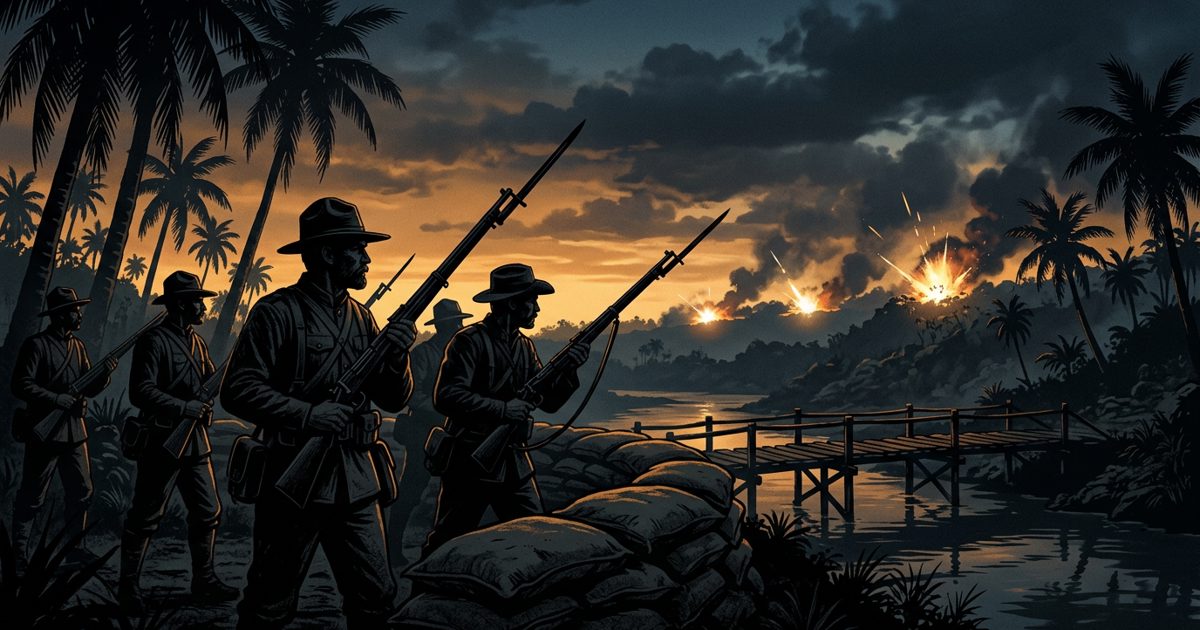
Sentries from Company B of the 1st Nebraska Volunteer Infantry manned an outpost near the junction of Sociego and Silencio streets in Santa Mesa outside Manila. Private William Walter Grayson challenged four Filipino soldiers advancing through the darkness across a contested boundary. Receiving no response to his halt orders, Grayson raised his rifle and fired. Return rifle fire immediately echoed from nearby insurgent trenches, triggering a cascade of gun battles across the northern perimeter of the city.

Filipino units under General Emilio Aguinaldo answered with volleys of Mauser fire across an arc spanning several miles. American lines held by the Eighth Army Corps, commanded by Major General Elwell Stephen Otis, mobilized rapidly into defensive positions. Brigadier General Arthur MacArthur ordered his 2nd Division to secure key river crossings and repel insurgent probes directed at suburban outposts. Gunboats from the United States Navy moved along the Pasig River and into Manila Bay, shelling hostile positions dug along the coastline and blunting coordinated counterattacks before dawn.

MacArthur launched a massive push at first light, backed by artillery, driving Filipino units from Santa Mesa and forcing a retreat across the San Juan River. Major General Otis rejected Aguinaldo plea for a ceasefire, insisting that the armed contest must proceed to an absolute resolution. Casualties mounted quickly, leaving dozens of American soldiers dead alongside hundreds of Filipino fighters and marking the start of three years of Philippine-American warfare.

CHRONOLOGICAL RECORD

February 4 Across U.S. Military History

8 Verified Events
1779 Continental Navy Landmark Event • American Revolutionary War

John Paul Jones Takes Command of Bonhomme Richard

King Louis XVI of France officially assigned the French merchant vessel Duc de Duras to Captain John Paul Jones for American service. Jones renamed the frigate Bonhomme Richard in honor of Benjamin Franklin. Conversion into an armed warship prepared Jones for his commerce-raiding cruise off the British coastline later that year.

1862 U.S. Navy • Civil War

Union Gunboat Flotilla Reconnoiters Fort Henry

Flag Officer Andrew Hull Foote moved ironclads USS Essex, USS Carondelet, and USS Cincinnati up the Tennessee River toward Confederate-held Fort Henry. Brigadier General Ulysses S. Grant watched from aboard the flagship as gunners exchanged initial rounds with Rebel shore batteries. The action confirmed defensive weak points, setting up the surrender of the garrison two days later.

1900 U.S. Army • Philippine-American War

Louis Gedeon Defends Mortally Wounded Commander

Private Louis Gedeon of Company G, 19th U.S. Infantry, stood his ground against an overwhelming insurgent force on Mount Amia, Cebu. Gedeon singlehandedly shielded his fallen company commander from enemy fire while maintaining an accurate defense until relief arrived. His exceptional gallantry earned him the Medal of Honor.

1919 Joint / Defense Policy Landmark Event • World War I

Congress Establishes Navy Cross and Distinguished Service Medal

Congress approved legislation establishing the Navy Cross and the Navy Distinguished Service Medal to honor extraordinary naval bravery and meritorious duty. The statute created defined awards ranking directly below the Medal of Honor. Retroactive eligibility honored sailors and Marines who served during the First World War.

1944 U.S. Army Landmark Event • World War II

Seventh Infantry Division Secures Kwajalein Island

Soldiers of the 7th Infantry Division declared Kwajalein Island secure after three days of close-quarters combat against fortified Japanese bunkers. Massive naval and aerial bombardments had preceded the assault, pulverizing defensive lines across the atoll. The swift conquest crushed the outer perimeter of Imperial Japan and expedited future Pacific advances.

1944 Joint / Defense Policy Landmark Event • World War II

Roosevelt Authorizes Creation of the Bronze Star

President Franklin D. Roosevelt signed Executive Order 9419 establishing the Bronze Star Medal for ground forces operating in combat theaters. Army Chief of Staff General George C. Marshall advocated for the decoration to recognize ground troops enduring prolonged frontline danger. Retroactive provisions extended eligibility back to the Pearl Harbor attack.

1948 U.S. Air Force Landmark Event • Cold War

Consolidation Creates Military Air Transport Service

Secretary of Defense James Forrestal announced the unification of the Air Force Air Transport Command and the Naval Air Transport Service into a single command. Designated the Military Air Transport Service under Air Force management, the merger combined interservice strategic airlift operations. The consolidated fleet immediately proved essential during the upcoming Berlin Airlift.

1958 U.S. Navy Landmark Event • Cold War

Keel Laid for First Nuclear Aircraft Carrier

Shipwrights laid the keel for USS Enterprise at Newport News Shipbuilding and Dry Dock Company in Virginia. The massive hull introduced eight nuclear reactors capable of powering an aircraft carrier continuously without refueling. Construction of the vessel initiated the era of nuclear-powered supercarriers for the United States Navy.

MEDAL OF HONOR ACTION 1951

Master Sergeant Stanley Adams Leads Bayonet Charge at Sesim-ni

Chinese infantry forces assaulted an isolated platoon outpost manned by Company A, 19th Infantry Regiment, near Sesim-ni, Korea. Master Sergeant Stanley T. Adams held positions roughly two hundred yards forward of the main battalion line when two hundred and fifty hostile troops attacked from three directions under intense mortar barrages. Heavy machine-gun fire forced the outpost defenders back toward the primary defensive trench. Seeing approximately one hundred and fifty enemy troops silhouetted on the ridgeline preparing to overrun his company, Adams ordered his men to fix bayonets and charged directly into the advancing wave.

Bullets struck Adams in the leg almost immediately, yet he continued pushing up the slope with thirteen soldiers. Enemy hand grenades detonated against his body and knocked him down four separate times, but he repeatedly regained his footing to spearhead hand-to-hand fighting with his bayonet and rifle butt. The ferocity of the counterattack shattered the enemy line, killing over fifty Chinese soldiers and routing the rest. Adams maintained covering rifle fire until his wounded comrades safely reached the main defense perimeter, earning him the Medal of Honor for his actions.