Full Calendar
THIS DAY IN U.S. MILITARY HISTORY • JANUARY 10 1862 U.S. Army Civil War

Garfield Breaks Confederate Lines at Middle Creek

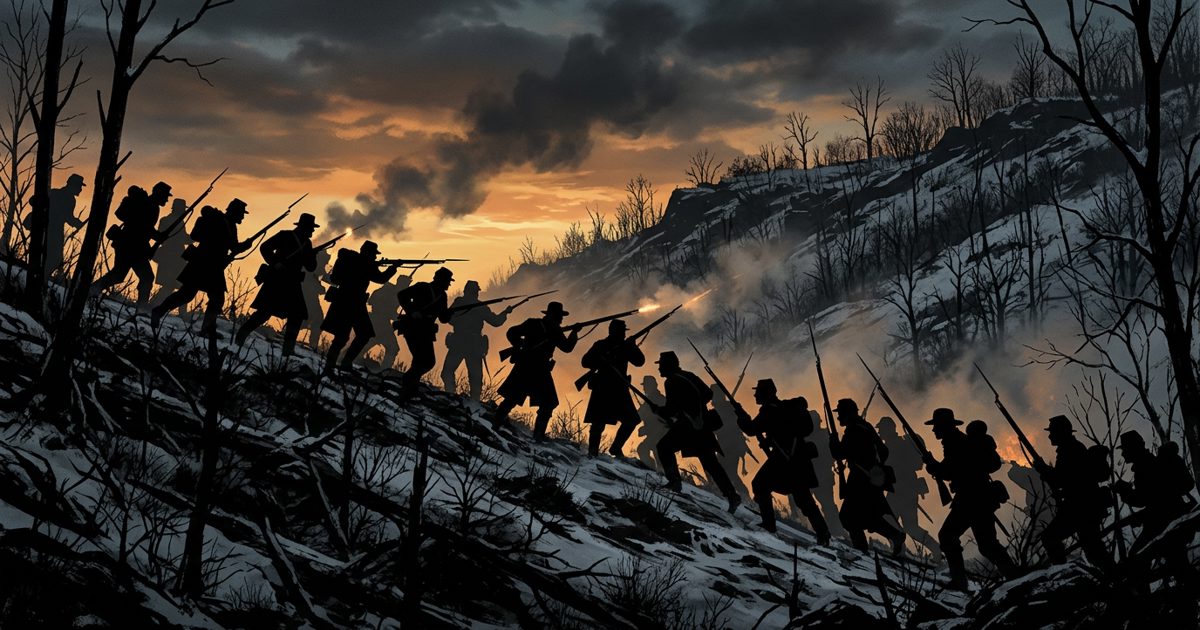
Union forces under Colonel James A. Garfield assault entrenched Confederate positions in eastern Kentucky to secure the Big Sandy Valley.
Garfield Breaks Confederate Lines at Middle Creek

Colonel James A. Garfield led eighteen hundred Union soldiers through freezing rain toward the Forks of Middle Creek in eastern Kentucky. Confederate Brigadier General Humphrey Marshall had deployed more than two thousand troops and four artillery pieces along the steep, wooded ridges south of the creek. Garfield sought to dislodge the Southern force and drive them out of the Big Sandy Valley. Skirmishers from the 42nd Ohio Infantry encountered Confederate cavalry pickets at dawn, pushing them back toward the main defensive line. By midday, Federal regiments stood deployed in the icy mud along the base of the ridges.

Union infantrymen advanced up the brush-covered slopes shortly after noon under continuous musket and artillery fire. Soldiers from the 40th Ohio and 22nd Kentucky scrambled up rocky bluffs, taking cover behind timber and returning fire into Marshall's positions. Confederate defenders mounted several countercharges down the hillsides to shatter the Federal assault line, but Garfield repositioned rifle companies to anchor his flanks. Rifle smoke blanketed the valley as both sides exchanged volleys at close range for more than three hours. Neither side yielded ground until Garfield committed his reserve units late in the afternoon.

Reserves from the 42nd Ohio and McLaughlin's cavalry reached the battlefield around four o'clock, surging up the heights to threaten Marshall's right flank. Confederate gunners expended their remaining canister shot before Marshall recognized that his ammunition reserves were depleted. Darkness brought an end to the gunfire, leaving Garfield's brigade in possession of the crests. Marshall ordered a retreat during the night, burning his surplus wagons and supplies before withdrawing toward the Virginia border. The victory permanently secured eastern Kentucky for the Union and earned Garfield promotion to brigadier general of volunteers.

CHRONOLOGICAL RECORD

January 10 Across U.S. Military History

9 Verified Events
1861 U.S. Army Landmark Event • Civil War

Federal Troops Evacuate Fort Barrancas for Fort Pickens

Lieutenant Adam J. Slemmer evacuated fifty-one soldiers and thirty sailors from Fort Barrancas to Fort Pickens on Santa Rosa Island. Secessionist delegates in Florida voted to leave the Union that morning, threatening mainland military installations across Pensacola. Slemmer spiked his remaining cannons and destroyed twenty thousand pounds of gunpowder to deny them to rebel forces.

1863 U.S. Navy Landmark Event • Civil War

Union Gunboats Bombard Fort Hindman at Arkansas Post

Admiral David Dixon Porter directed ironclad gunboats to open fire on Confederate defenses at Fort Hindman along the Arkansas River. Porter coordinated shellfire with Major General John A. McClernand's ground troops to suppress enemy casemates. Sailors aboard USS Louisville maintained steady battery fire despite heavy counterbattery hits, disabling Southern artillery before the final infantry assault.

1923 U.S. Army Landmark Event • Interwar Era

President Harding Orders American Rhine Occupation Troops Home

President Warren G. Harding issued executive instructions recalling the American Forces in Germany from their occupation zone centered at Koblenz. Major General Henry T. Allen had commanded the American contingent along the Rhine since the conclusion of World War I hostilities. The order initiated the embarkation of over one thousand soldiers, concluding more than four years of United States presence in the Rhineland.

1943 U.S. Army • World War II

Soldiers Mount Gallant Defense at the Gifu on Guadalcanal

Sergeant William Grant Fournier and Technician Fifth Grade Lewis Hall rushed to an unmanned machine gun during a Japanese counterattack at Mount Austen. Both soldiers from the 35th Infantry Regiment held off superior enemy numbers to shield advancing companies. Their determined fire broke the enemy assault before both men were mortally wounded, earning posthumous Medals of Honor.

1944 U.S. Navy • World War II

Submarine Seawolf Torpedoes Japanese Convoy North of Okinawa

Commander Richard B. Lynch guided submarine USS Seawolf into an attack against a Japanese convoy traversing the East China Sea north of Okinawa. Lynch penetrated heavy destroyer screens to fire spreads of torpedoes that sank multiple Japanese merchant freighters. The submarine evaded depth charges during a prolonged counterattack before resuming patrol.

1945 U.S. Navy Landmark Event • World War II

Seventh Fleet Repels Suicide Boat Attacks at Lingayen

Warships of the Seventh Fleet engaged swarms of Japanese Shinyo suicide boats and suicide aircraft inside Lingayen Gulf off Luzon. Destroyers and gunboats established circular screening perimeters to shield transport vessels unloading equipment for the Sixth Army. Concentrated antiaircraft fire downed several incoming planes and destroyed explosive motorboats attempting to breach the inner harbor.

1956 U.S. Navy Landmark Event • Cold War

Navy Opens First Nuclear Power School in Connecticut

Instructors established the Navy's first Nuclear Power School at Naval Submarine Base New London in Groton, Connecticut. Rear Admiral Hyman G. Rickover directed the curriculum to train reactor operators and submarine officers following the commissioning of USS Nautilus. The school standardized advanced mathematical, physics, and reactor safety training across the burgeoning nuclear submarine fleet.

1968 U.S. Army • Vietnam War

General Weyand Orders Combat Regiments Toward Saigon Perimeter

Lieutenant General Fred C. Weyand met with Military Assistance Command leadership to request moving combat battalions closer to Saigon after analyzing shifting enemy radio traffic. Weyand canceled planned border sweeps in the III Corps area and repositioned fifteen American battalions into the capital defense circle. The redeployment positioned mechanized forces to repel the surprise Viet Cong attacks three weeks later.

1995 U.S. Marine Corps • Post-Cold War

Pentagon Activates Marine Deployment for Operation United Shield

Pentagon officials announced the deployment of twenty-six hundred U.S. Marines to Somalia to conduct Operation United Shield. Marine Expeditionary Units embarked aboard amphibious assault vessels to cover the evacuation of four thousand United Nations peacekeeping personnel from Mogadishu. Planners organized armored patrols and aviation cover to guarantee a safe withdrawal without allied casualties.

WEAPONS AND TECHNOLOGY 1946

Army Signal Corps Bounces Radar Off the Moon

Engineers from the United States Army Signal Corps aimed a modified SCR-271 radar array at the rising moon from Camp Evans in Wall Township, New Jersey. Lieutenant Colonel John H. DeWitt Jr. directed the research team to discover whether high-frequency radio pulses could penetrate Earth's upper ionosphere. Mathematical calculations prepared by physicist Walter McAfee enabled the team to calibrate the receiver for Doppler frequency shifts caused by lunar motion. Transmitters unleashed four-thousand-watt pulses at 111.5 megahertz through a massive sixty-four-dipole bedspring antenna. Radar receivers captured the first distinct reflected pulse precisely two and a half seconds later, confirming that the signal had struck the moon and returned.

DeWitt repeated the transmission multiple times to verify the echo against background cosmic noise before notifying the Pentagon of the breakthrough. Military researchers previously believed that the atmospheric ionosphere reflected all long-range terrestrial radio signals back toward Earth, preventing exo-atmospheric tracking. Detection of the lunar echo demonstrated that military radar and communications could pierce deep space to track ballistic trajectories or maintain global contact. The successful experiment established Earth-Moon-Earth communications and initiated the military foundation for ballistic missile defense radar networks.