CHRONOLOGICAL RECORD
January 11 Across U.S. Military History
10 Verified Events
1862
U.S. Navy
• Civil War
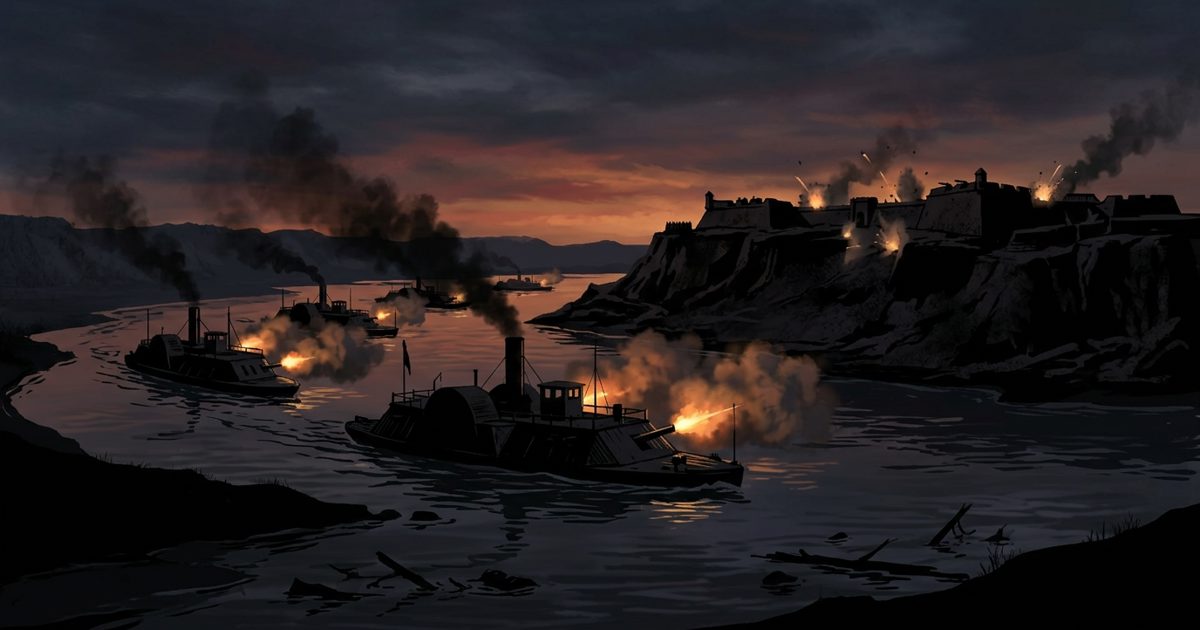
Gunboats Essex and St. Louis Clash at Lucas Bend
Commander William D. Porter steered the ironclad gunboats USS Essex and USS St. Louis down the Mississippi River near Lucas Bend, Kentucky. Federal gunners engaged Confederate river gunboats in a running artillery duel that forced the southern vessels to retreat beneath defensive shore batteries at Columbus, Kentucky. The action protected Union river patrols securing positions above Island Number Ten.
1863
U.S. Navy
Landmark Event
• Civil War
Confederate Raider Alabama Sinks USS Hatteras
Captain Homer C. Blake commanded the iron-hulled steamer USS Hatteras on blockade duty when Confederate commerce raider CSS Alabama lured the vessel off Galveston Lighthouse. Captain Raphael Semmes opened broadside fire at close range, crippling Hatteras and igniting fatal engine room flooding within thirteen minutes. Union sailors surrendered their sinking ship, and Alabama boats rescued one hundred eighteen crewmen before Hatteras sank.
1886
U.S. Army
• American Indian Wars
Lieutenant Marion Perry Maus Fights at Rio Aros
Lieutenant Marion Perry Maus led a detachment of Apache scouts deep into the rugged Sierra Madre Mountains of Sonora, Mexico. Hostile Chiricahua Apache fighters ambushed the expedition along the Rio Aros, sparking a fierce daylong firefight across rocky ridges. Maus maintained defensive positions, repelled multiple assaults, and preserved his command, earning the Medal of Honor for his leadership.
1900
U.S. Navy
• Philippine-American War
Gunboat Princeton Takes Possession of Batan Islands
Commander Harry Knox anchored the composite gunboat USS Princeton off Santo Domingo del Basco in the northern Luzon Strait. Sailors and Marines went ashore without armed resistance to raise the American flag and formally establish United States military governance over the remote Batanes archipelago. The landing closed a northern maritime corridor previously utilized by Filipino revolutionary forces for supply transport.
1928
U.S. Navy
• Interwar Era
Commander Marc Mitscher Lands Aboard USS Saratoga
Commander Marc A. Mitscher piloted a Vought UO-1 biplane onto the newly commissioned aircraft carrier USS Saratoga off the coast of Rhode Island. Mitscher caught the arresting gear cables and subsequently launched from the flight deck, completing the first official carrier landing and takeoff in the ship operational history. The successful evolution initiated extensive carrier aviation trials for the fleet.
1942
U.S. Navy
Landmark Event
• World War II
Japanese Submarine Torpedoes USS Saratoga near Oahu
Submarine I-6 of the Imperial Japanese Navy struck the aircraft carrier USS Saratoga with a single torpedo roughly four hundred miles southwest of Oahu. Blast damage flooded three boiler rooms, killed six sailors, and reduced the carrier cruising speed to sixteen knots. Saratoga reached Pearl Harbor under her own power for emergency patching before sailing to Puget Sound for five months of yard repairs.
1944
U.S. Navy
Landmark Event
• World War II
Escort Carrier Aircraft Launch First Rocket Attack on U-Boat
Aviators flying a Grumman TBF-1C Avenger from the escort carrier USS Block Island spotted German submarine U-758 running on the surface in the North Atlantic. Lieutenant Junior Grade Willis D. Seeley launched forward-firing aircraft rockets against the U-boat, marking the first time American carrier aircraft employed rockets in combat against an enemy submarine. The rockets bracketed the conning tower and forced the damaged boat to crash-dive.
1945
U.S. Army
• World War II
Staff Sergeant Archer Gammon Charges Royal Tiger Tank
Staff Sergeant Archer T. Gammon advanced alone through deep snow near Bastogne, Belgium, after German fire pinned down his platoon from the 9th Armored Infantry Battalion. Gammon knocked out an enemy machine gun with hand grenades, killed nine hostile soldiers, and forced a heavy Tiger Royal tank to withdraw. A direct tank shell killed him instantly, earning him a posthumous Medal of Honor.
1947
U.S. Navy
• Cold War
McDonnell XF2H-1 Banshee Makes Maiden Test Flight
Test pilot Robert M. Edholm took off from Lambert Field in St. Louis, Missouri, flying the prototype McDonnell XF2H-1 Banshee for the first time. The twin-engine jet fighter completed its initial flight handling evaluations smoothly, reaching an altitude of ten thousand feet. Production models of the carrier-capable Banshee subsequently served as primary strike and photoreconnaissance aircraft during the Korean War.
1962
U.S. Air Force
Landmark Event
• Cold War
B-52H Stratofortress Sets Unrefueled World Distance Record
Major Clyde P. Evely touched down in his Boeing B-52H Stratofortress at Torrejon Air Base near Madrid, Spain, concluding Operation Persian Rug. The Strategic Air Command bomber flew 12,532 miles nonstop from Kadena Air Base, Okinawa, in twenty-one hours and fifty-two minutes without inflight refueling. The record flight proved the extreme global range of turbofan-powered American strategic bombers.