Armada Firestorm and Amphibious Assault at Fort Fisher
Rear Admiral David Dixon Porter and Major General Alfred Terry unleash a coordinated naval bombardment and troop landing against the Confederate stronghold guarding Wilmington.
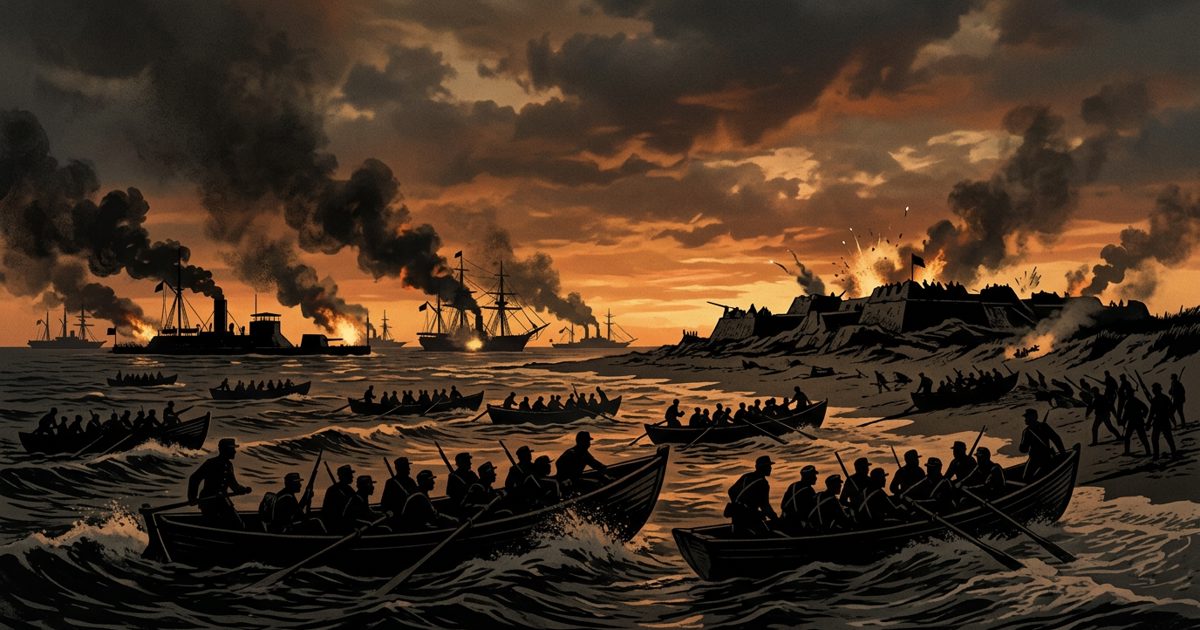
Warships under Rear Admiral David Dixon Porter anchored off the North Carolina coast at daybreak on January 13, 1865. Fifty-eight naval vessels formed parallel battle lines opposite Fort Fisher, the massive Confederate bastion guarding Wilmington and the Cape Fear River. Steam frigates and heavy monitors opened rapid broadsides against the northern land face to demolish artillery traverses. Exploding shells severed the garrison telegraph lines and prevented Confederate artillerymen from manning exterior positions. Porter maintained this continuous offshore cannonade to secure the sandy beaches for an imminent troop landing.
Major General Alfred Terry exploited the naval barrages by dispatching hundreds of surfboats toward Federal Point, four miles north of the fortress. Nearly ten thousand Union soldiers belonging to the Army of the James plunged into the cold Atlantic surf and waded ashore without opposition. Brigadier General Charles J. Paine deployed his division of United States Colored Troops across the narrow peninsula to construct defensive breastworks. Paine positioned these regiments to block any counterattack from Confederate Major General Robert Hoke, whose six thousand infantry occupied camps further up the road toward Wilmington. Terry established his command post on the sand ridges and organized his remaining divisions for a ground offensive.
Union infantrymen under Brigadier General Adelbert Ames entrenched along the southern approach while naval guns continued firing throughout the night. Spotters aboard the offshore fleet illuminated target coordinates with signal lanterns, striking rebel gun pits every few minutes to exhaust the defenders. Garrison commander Colonel William Lamb watched his heavy coastal guns break apart under the accurate naval shells without receiving field support from General Braxton Bragg. Terry and Porter finalized plans for a coordinated two-front breach scheduled for the following afternoon. Federal forces retained complete tactical control of the landing corridor and isolated the fort from outside resupply.