Full Calendar
THIS DAY IN U.S. MILITARY HISTORY • JANUARY 12 1962 U.S. Army Vietnam War

Operation Chopper Launches America Into Air Mobility Combat

Army aviators fly thirty-two twin-rotor helicopters west of Saigon to deploy South Vietnamese troops into combat for the first time.
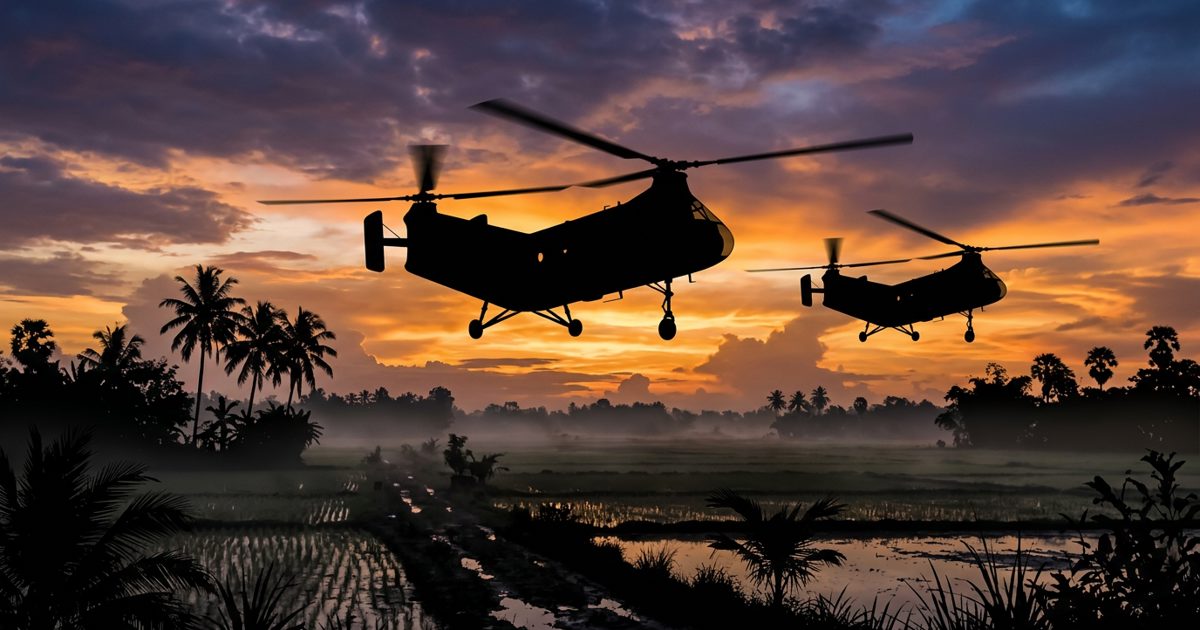
Operation Chopper Launches America Into Air Mobility Combat

Army aviators took flight from Tan Son Nhut Air Base on January 12, 1962, piloting thirty-two Piasecki H-21C Shawnee twin-rotor helicopters into enemy territory. Company members from the 8th and 57th Transportation Companies carried more than one thousand South Vietnamese airborne troops toward a suspected Viet Cong stronghold ten miles west of Saigon. Low cloud cover shielded the flight formation as the transports crossed marshland and canals toward the designated drop fields. Flight commanders executed the mission under the operational codename Operation Chopper, inaugurating the first major combat mission conducted by American forces in the Vietnam War.

Troops leaped from the hovering helicopters directly into muddy rice paddies, catching local guerrilla defenders entirely unprepared. Guerrillas fled their defensive perimeter under the sudden shock of vertical envelopment, abandoning heavy weapons and fortified bunkers in the surrounding village. South Vietnamese soldiers secured the perimeter within two hours, seizing a primary insurgent radio transmitter along with stockpiles of small arms. American crew chiefs fired mounted door machine guns to suppress sniper positions along the woodline during the extraction phases.

Helicopter units completed the tactical airlift without losing an aircraft, validating airmobile assault doctrine for battlefield deployment. Pentagon planners used the operational data from this mission to expand American rotary-wing aviation units across South Vietnam over the subsequent three years. Mechanized sky cavalry concepts replaced traditional overland truck movements for counterinsurgency sweeps throughout the region. Tactical commanders established permanent helicopter bases across the Mekong Delta and Central Highlands to support rapid-reaction forces.

CHRONOLOGICAL RECORD

January 12 Across U.S. Military History

8 Verified Events
1861 U.S. Navy • Civil War Era

Union Forces Surrender Pensacola Navy Yard

Captain James Armstrong surrendered the Pensacola Navy Yard in Florida to advancing state militia forces on January 12, 1861. Lieutenant Adam J. Slemmer rejected surrender demands at nearby Fort Barrancas and withdrew his small garrison across Pensacola Bay. Slemmer occupied Fort Pickens on Santa Rosa Island, preserving critical deep-water Federal harbor access throughout the Civil War.

1942 U.S. Army Landmark Event • World War II

Alexander Nininger Earns World War II Valor Honor

Lieutenant Alexander R. Nininger charged Japanese foxholes near Abucay on the Bataan peninsula on January 12, 1942. Nininger threw grenades into camouflaged sniper positions and engaged enemy squads in close-quarters hand-to-hand fighting despite suffering three gunshot wounds. Posthumous presentation of the Medal of Honor made him the first American service member so recognized during World War II.

1943 Joint • World War II

American Forces Land on Amchitka Island

Soldiers from the Alaska Defense Command landed on Amchitka Island in the Aleutians on January 12, 1943. Naval transports escorted by the destroyer USS Worden placed troops ashore at Constantine Harbor under severe arctic conditions to build an air base fifty miles from Japanese-held Kiska. Treacherous currents threw Worden onto coastal rocks during the operation, sinking the warship and claiming fourteen crewmen.

1945 U.S. Navy Landmark Event • World War II

Task Force 38 Strikes Indochina Coast

Aircraft from Task Force 38 swept down upon Japanese naval convoys along the French Indochina coast on January 12, 1945. Naval aviators sank forty-four enemy vessels, including the training cruiser Kashii and twelve oil tankers caught off Qui Nhon and Saigon. Destruction of convoy HI-86 effectively severed maritime oil shipments from the East Indies to the Japanese homeland.

1952 U.S. Army • Korean War

Ronald Rosser Clears Bunkers Near Ponggilli

Corporal Ronald E. Rosser assaulted entrenched Chinese positions on a heavily defended hill near Ponggilli, Korea, on January 12, 1952. Rosser charged through hostile fire three separate times with a carbine and grenades, killing thirteen enemy soldiers and evacuating wounded comrades. President Harry S. Truman later presented Rosser with the Medal of Honor for his valor.

1961 U.S. Air Force • Cold War

B-58 Hustler Sets Supersonic World Speed Records

Major Henry J. Deutschendorf piloted a Convair B-58A Hustler supersonic jet bomber over a closed California course on January 12, 1961. Aircrew members carried a two-thousand-kilogram payload at an average speed of 1,061.8 miles per hour, securing three world aviation records. Strategic Air Command demonstrated deep-penetration bomber capabilities through this milestone flight test at Edwards Air Force Base.

1973 U.S. Navy • Vietnam War

Navy Phantoms Down Final Vietnam MiG

Lieutenants Victor T. Kovaleski and James A. Wise launched an F-4B Phantom II from USS Midway on January 12, 1973. Aviators patrolling over the Gulf of Tonkin intercepted and destroyed a North Vietnamese MiG-17 fighter with an AIM-9 Sidewinder missile. Combat records confirmed this engagement as the final air-to-air victory credited to the U.S. Navy during the war.

1991 Joint Landmark Event • Persian Gulf War

Congress Authorizes Military Force Against Iraq

Lawmakers approved the Authorization for Use of Military Force Against Iraq Resolution on January 12, 1991. President George H.W. Bush received statutory congressional power under Public Law 102-1 to enforce United Nations Security Council resolutions expelling Iraqi occupation forces from Kuwait. Operation Desert Storm commenced combat air strikes five days after the passage of this joint resolution.

NAVAL AVIATION 1953

USS Antietam Tests First Angled Flight Deck

Aviators aboard USS Antietam initiated operational trials for the world's first angled flight deck off the coast of New York on January 12, 1953. Captain Samuel G. Mitchell, commanding officer of the carrier, piloted a North American SNJ Texan trainer toward the flight deck for the maiden arrested landing. Shipbuilders at the New York Naval Shipyard had modified the Essex-class aircraft carrier with an experimental eight-degree angled deck extension along the port side. Mitchell touched down along the canted landing area, snagged an arresting cable cleanly, and demonstrated that an aircraft executing a missed approach could climb away safely without colliding with planes parked forward.

Technicians recorded hundreds of trouble-free landings over the following weeks, convincing the Bureau of Ships to incorporate angled flight decks into all forthcoming supercarrier designs. Navy leaders immediately revised structural blueprints for the under-construction USS Forrestal and ordered angled-deck modernizations across sixteen existing fleet carriers. Naval pilots experienced an immediate reduction in deck-landing accidents as heavier jet aircraft entered frontline service during the Cold War. Antietam finished its comprehensive flight trials later that spring, cementing an architectural standard that remains in operational use aboard all modern American fleet carriers.

DAILY EMAIL BRIEFING

Get This Briefing Every Morning

Start each day with verified U.S. military history delivered to your inbox. Straightforward historical reporting covering major battles and lesser-known tactical operations.

Subscribe Below