Continental Forces Decisively Defeat British Regulars at Cowpens
Brigadier General Daniel Morgan deployed Continental infantry and militia at Hannah's Cowpens in 1781 to eliminate Lieutenant Colonel Banastre Tarleton's British strikeforce in South Carolina.
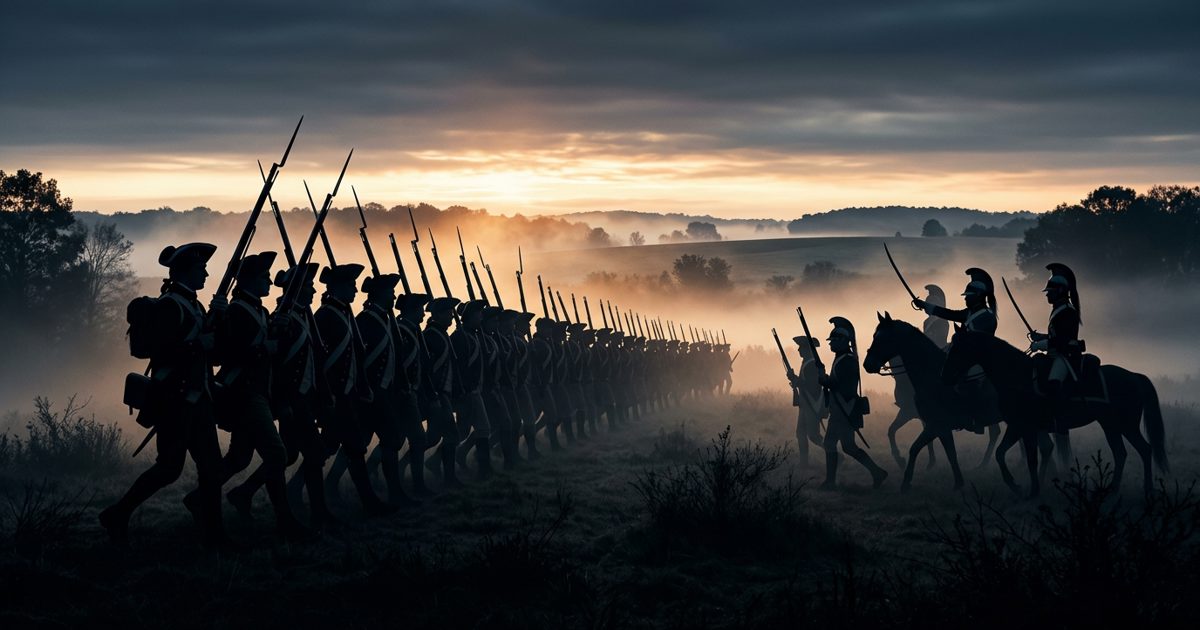
Brigadier General Daniel Morgan positioned his mixed force of Continental regulars, Virginia riflemen, and southern militia in three defensive lines across an open rolling pasture called Hannah's Cowpens. Morgan recognized the aggressive temperament of his opponent, British cavalry leader Lieutenant Colonel Banastre Tarleton, and tailored his tactical dispositions to exploit Tarleton's habit of reckless frontal charges. Skirmishers in the forward line received orders to fire two aimed volleys at the advancing redcoats before falling back to the militia line under Andrew Pickens. Pickens' men likewise fired disciplined volleys at close range into the British infantry ranks before conducting an orderly withdrawal behind veteran Maryland and Delaware Continentals commanded by Lieutenant Colonel John Eager Howard.
Howard absorbed the main British charge along the third defensive ridge, where the Continentals traded heavy musket volleys with the 7th Royal Fusiliers and Tarleton's British Legion infantry. Confusion arose when Howard ordered his right flank company to refuse its line, causing the entire Continental line to face about and march rearward in good order. Tarleton mistook this disciplined realignment for an American retreat and spurred his soldiers into a disordered rush forward. Howard immediately halted his infantry, turned them face to face with the disorganized pursuers, and unleashed a devastating point-blank volley into the British vanguard.
Continentals mounted fierce bayonet charges into the reeling British center while Lieutenant Colonel William Washington swung his cavalry squadron around the British right flank. Andrew Pickens rallied the reformed militia to envelop Tarleton's left flank, completing a double envelopment that trapped the majority of the British column in open fields. British resistance collapsed within sixty minutes as more than eight hundred crown soldiers were killed, wounded, or captured alongside two three-pounder artillery pieces. Morgan marched north immediately after securing the prisoners, depriving British commander Lord Cornwallis of his elite light reconnaissance troops before the campaign in North Carolina.