Full Calendar
THIS DAY IN U.S. MILITARY HISTORY • JANUARY 21 1968 U.S. Marine Corps Vietnam War

North Vietnamese Artillery Opens the Siege of Khe Sanh

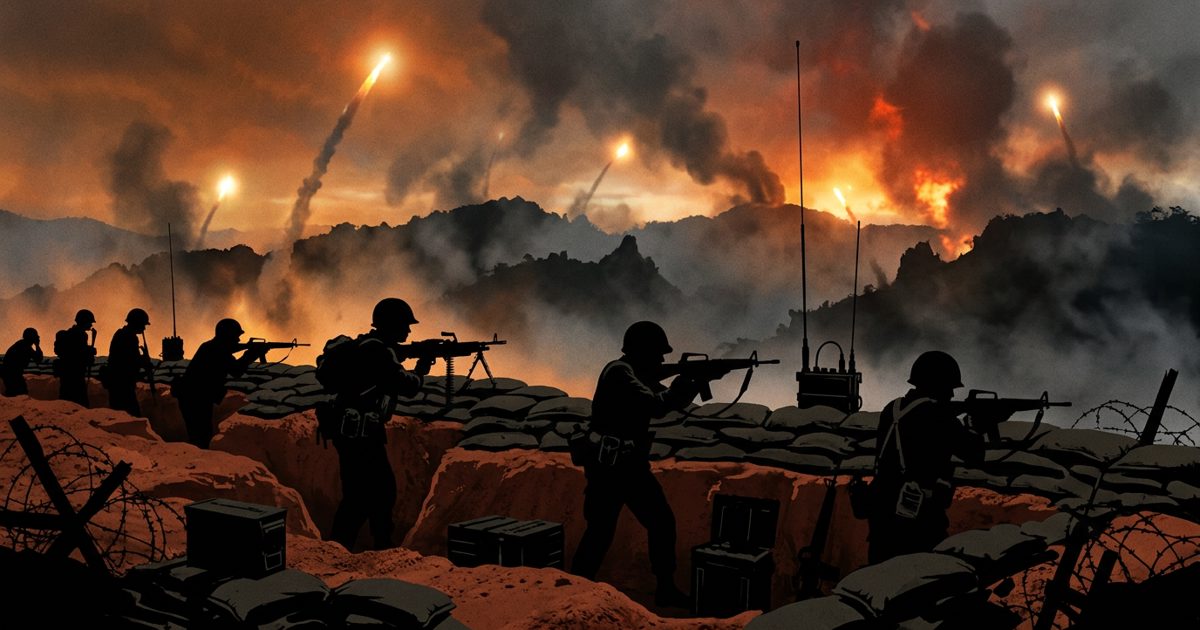
Marines of the 26th Marine Regiment withstand a devastating bombardment as communist forces surround their remote combat base in South Vietnam in 1968.
North Vietnamese Artillery Opens the Siege of Khe Sanh

North Vietnamese artillery batteries unleashed a massive bombardment against Khe Sanh Combat Base before dawn. High-explosive shells struck the main ammunition dump near the runway, detonating fifteen hundred tons of munitions in a blast that hurled unexploded ordnance across the compound. Colonel David E. Lownds directed defenders from the 26th Marine Regiment into fortified bunkers as shrapnel tore through revetments and command posts. Marines simultaneously repelled a ground assault on nearby Hill 861, fighting in dense fog with rifles and grenades. The barrage shattered communication lines, cratered the airfield, and initiated a seventy-seven-day siege.

Enemy infantry from two North Vietnamese Army divisions dug approach trenches through the ravines toward the defensive perimeter. Lownds directed intense counterbattery fire using Marine and Army howitzers stationed at the combat base and surrounding hills. Marine and Air Force attack aircraft dove through low cloud cover to drop napalm and high explosives onto hostile rocket positions. Cargo aircraft braved direct fire to land on the damaged airstrip, delivering blood plasma and evacuating badly wounded troops. This concentrated defensive firepower blunted the opening ground thrust, forcing enemy commanders into a prolonged standoff.

General William Westmoreland initiated Operation Niagara, deploying B-52 Stratofortress bombers and tactical aircraft to strike enemy concentrations around the valley. Air Force transport crews sustained the defenders by dropping pallets of ammunition and rations by parachute when landing became impossible. Marines held their muddy red-clay trenches and outpost hills despite absorbing thousands of artillery rounds. Relief forces from the 1st Cavalry Division broke through along Route 9 in early April, relieving the garrison after months of intense combat.

CHRONOLOGICAL RECORD

January 21 Across U.S. Military History

8 Verified Events
1785 U.S. Army Landmark Event • Post-Revolutionary Frontier

Treaty of Fort McIntosh Secures Frontier Lands

Commissioners George Rogers Clark, Richard Butler, and Arthur Lee concluded the Treaty of Fort McIntosh with tribal leaders from the Wyandot, Delaware, Chippewa, and Ottawa nations. The pact established federal sovereignty over two-thirds of the Ohio Country and defined a military boundary for frontier settlements. This agreement laid the groundwork for future American military outposts across the Northwest Territory.

1863 U.S. Navy • Civil War

Confederate Cottonclads Capture Blockaders off Sabine Pass

Gunboats CSS Josiah A. Bell and CSS Uncle Ben steamed out of Sabine Pass to attack Union blockading vessels off the Texas coast. Confederate sharpshooters and heavy guns forced the sailing sloop USS Morning Light and schooner USS Velocity to strike their colors after a running gun battle. The loss temporarily disrupted federal blockade operations along the western Gulf of Mexico.

1918 U.S. Marine Corps • World War I

Marine Aviators Deploy to the Azores for Patrols

Marines assigned to the 1st Marine Aeronautic Company arrived at Ponta Delgada in the Azores to conduct anti-submarine patrols across critical Atlantic shipping lanes. Captain Francis T. Evans led the contingent, operating Curtiss R-6 and N-9 seaplanes to scout for German U-boats. The deployment marked the first fully equipped American aviation unit to reach an overseas combat zone during the war.

1945 U.S. Navy • World War II

Kamikazes Strike Carrier USS Ticonderoga off Formosa

Japanese kamikaze aircraft plunged into the flight deck and island superstructure of the aircraft carrier USS Ticonderoga while operating with Task Force 38 off Formosa. Captain Dixie Kiefer suffered severe shrapnel wounds but remained on the bridge to direct damage control parties. Kiefer ordered compartments flooded on the port side, inducing a deliberate list that washed burning aviation gasoline into the sea.

1951 U.S. Air Force • Korean War

Thunderjet Scores First Air Victory over MiG-15

Lieutenant Colonel William E. Bertram of the 27th Fighter-Escort Group shot down a Soviet-built MiG-15 jet fighter over North Korea. Bertram engaged the hostile aircraft while flying an F-84E Thunderjet on an armed escort mission, scoring the first aerial victory for the aircraft type. The success demonstrated that straight-wing American fighter-bombers could defend themselves against swept-wing enemy interceptors.

1954 U.S. Navy Landmark Event • Cold War

First Nuclear Submarine USS Nautilus Launches at Groton

Shipbuilders launched the submarine USS Nautilus at the Electric Boat shipyard in Groton, Connecticut, marking the birth of naval nuclear propulsion. First Lady Mamie Eisenhower christened the vessel with champagne before it slid into the Thames River. Built under the direction of Captain Hyman G. Rickover, the submarine eliminated the traditional requirement for surface ventilation during long-distance underwater patrols.

1968 U.S. Air Force Landmark Event • Cold War

Stratofortress Crashes with Nuclear Payload near Thule

Fire broke out in the cabin of an airborne alert B-52G Stratofortress, forcing the crew to abandon the bomber over North Star Bay near Thule Air Base, Greenland. The pilotless aircraft crashed onto sea ice, causing the conventional explosives in four thermonuclear weapons to detonate and scatter radioactive material. Military response teams launched Project Crested Ice to recover contaminated ice and debris in subzero conditions.

1991 U.S. Air Force Landmark Event • Gulf War

Air Force Team Rescues Downed Tomcat Pilot

Captain Paul Johnson piloted his A-10A Thunderbolt II deep into central Iraq to locate Navy Lieutenant Devon Jones after an Iraqi missile downed his F-14 Tomcat. Johnson destroyed an approaching enemy truck with 30mm cannon fire while guiding an Air Force MH-53J Pave Low helicopter directly to the survivor. The mission marked the first successful combat search and rescue of the Persian Gulf War.

MEDAL OF HONOR ACTION 1915

Valor in the Firerooms of USS San Diego

Boiler tubes ruptured aboard the armored cruiser USS San Diego during an endurance speed run in the Gulf of California. Superheated steam filled fireroom number two, blinding sailors and threatening catastrophic hull damage. Ensign Robert Webster Cary held open the electrically closing watertight doors, shouting for trapped crewmen to escape. Fireman Second Class Telesforo Trinidad was blown through the hatch by the blast but re-entered the scalding compartment immediately. Trinidad located injured Fireman Second Class R. W. Daly and hoisted him onto his shoulders to carry him toward the exit.

Explosions ripped through adjacent fireroom number three as Trinidad carried his shipmate through the smoke, scorching Trinidad's face with burning steam. Trinidad passed Daly to safety, ignored his wounds, and plunged back into the debris to rescue another trapped sailor. Cary managed the damage control effort and secured the surviving boilers before further detonations occurred. The Navy awarded both Trinidad and Cary the Medal of Honor in April 1915 for their actions during the disaster. Trinidad remains the only Filipino-American sailor to receive the Medal of Honor.