Allied Landing Forces Storm Ashore at Anzio During Operation Shingle
Major General John P. Lucas lands the United States VI Corps behind German lines to bypass the fortified Gustav Line in central Italy.
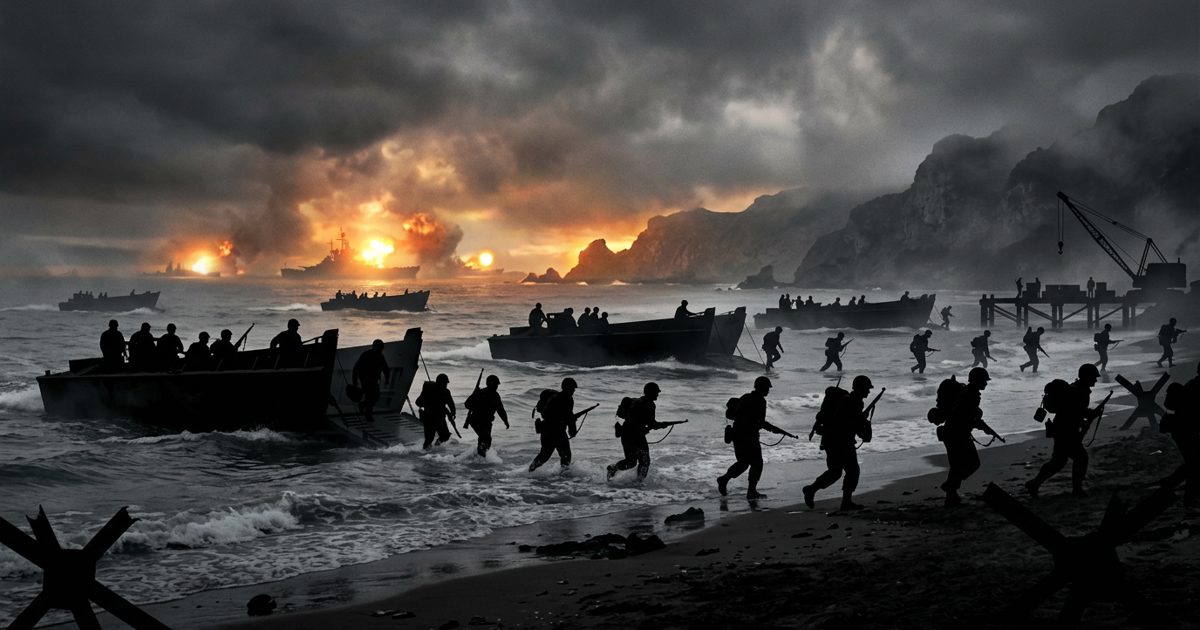
Soldiers of the United States VI Corps stepped onto the sandy beaches near Anzio and Nettuno shortly after two in the morning. Rear Admiral Frank J. Lowry directed Task Force 81 as naval guns bombarded shore targets and landing craft churned through gentle Mediterranean swells. Assault troops from Major General Lucian Truscott's 3rd Infantry Division secured X-Ray Beach east of Nettuno against scattered German coastal watch detachments. Colonel William O. Darby led three battalions of United States Army Rangers directly into the port of Anzio, capturing the harbor facilities and clearing defensive pillboxes before sunrise. Over thirty-six thousand Allied soldiers and three thousand vehicles reached shore by nightfall with fewer than one hundred and fifty casualties.
General Lucas halted his forward regiments only a few miles inland to dig extensive defensive perimeters around the beachhead. Reconnaissance patrols probed toward the Alban Hills without finding heavy German resistance along Highway 7, confirming that the initial landing had caught the enemy off balance. Prime Minister Winston Churchill had urged a rapid thrust toward the Alban Hills to sever German supply arteries feeding the Gustav Line. Major General Lucas hesitated to advance without heavy armor, fearing a rapid Axis counterattack against his exposed flanks. This deliberate delay gave German Field Marshal Albert Kesselring valuable hours to react.
Kesselring deployed elements of eight German divisions from northern Italy, France, and Yugoslavia to encircle the Allied lodgment. Generaloberst Eberhard von Mackensen established the Fourteenth Army headquarters to coordinate intense artillery bombardments and counteroffensives against the flat coastal pocket. Allied infantrymen endured four months of static trench warfare under constant long-range shellfire and air attacks. Major General Lucian Truscott ultimately assumed command of VI Corps in late February to reorganize the perimeter defenses. Allied forces finally broke out in late May 1944, linking with the advancing Fifth Army and liberating Rome on June 4.