Full Calendar
THIS DAY IN U.S. MILITARY HISTORY • JANUARY 26 1945 U.S. Army World War II

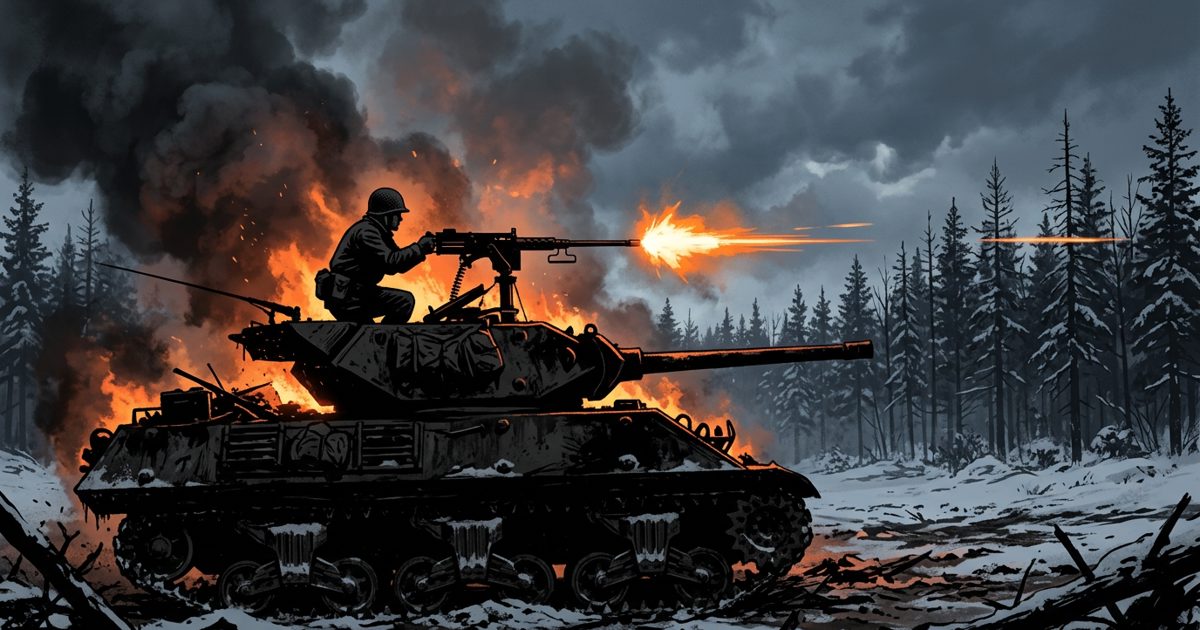
Audie Murphy Defends Holtzwihr Atop a Burning Tank Destroyer

Second Lieutenant Audie Murphy holds off six German tanks and infantry waves in the Colmar Pocket to save Company B.
Audie Murphy Defends Holtzwihr Atop a Burning Tank Destroyer

Second Lieutenant Audie Murphy took command of Company B of the 15th Infantry Regiment near the French village of Holtzwihr as German artillery shells pulverized the snow around his defensive perimeter. His company numbered only nineteen riflemen following weeks of brutal attrition across the Colmar Pocket. German commanders launched an armored counterattack out of the Riedwihr woods at two in the afternoon, sending six tanks and approximately two hundred fifty infantrymen directly toward the American tree line. Murphy ordered his surviving men to withdraw into the deep forest while he remained at his forward command post to direct artillery fire by field telephone.

German high-explosive tank shells struck an American M10 tank destroyer positioned twenty yards to his right, setting its fuel tanks ablaze and driving its crew into the woods. Murphy climbed onto the smoking rear deck of the burning vehicle despite the immediate danger of an internal ammunition explosion. He grasped the pintle-mounted .50-caliber machine gun and opened fire into the advancing waves of white-suited German foot soldiers. Incoming enemy small-arms rounds and tank fragments struck the turret armor, wounding him in the right leg as he held off squads attempting to flank his position from ten yards away.

Artillery strikes adjusted by Murphy shattered the enemy formations while his machine-gun bursts exhausted the final belts of ammunition. German tanks withdrew after losing their infantry escort, leaving dozens of dead and wounded across the frozen pasture. Murphy dismounted from the burning wreck, refused medical evacuation, and led his reorganized company in an immediate counterattack that swept the surviving enemy out of the woods. Army headquarters awarded him the Medal of Honor for his one-hour defense that preserved the 3rd Infantry Division's bridgehead west of the Rhine River.

CHRONOLOGICAL RECORD

January 26 Across U.S. Military History

8 Verified Events
1856 U.S. Navy Landmark Event • Puget Sound War

Sloop Decatur Drives Off Attackers at Seattle

Sailors and Marines from the sloop-of-war USS Decatur defended the settlement of Seattle against an all-day assault by several hundred Native American warriors. Commander Guert Gansevoort directed his ship's 32-pounder naval guns into the tree lines along Elliott Bay, breaking up coordinated rushes. Naval gunfire and settler militia fire secured the perimeter by nightfall.

1862 U.S. Navy • American Civil War

Union Gunboats Probe Wassaw Sound in Georgia

Union gunboats USS Ottawa and USS Seneca entered Wassaw Sound carrying troops commanded by Brigadier General Horatio G. Wright to scout Confederate defenses near Savannah. Naval crews engaged armed Confederate vessels attempting to resupply Fort Pulaski. Wright gathered critical intelligence on Wilmington River waterways that aided the eventual siege and reduction of Fort Pulaski.

1863 U.S. Army Landmark Event • American Civil War

Lincoln Replaces Burnside with Hooker in Virginia

President Abraham Lincoln signed General Orders Number 20 relieving Major General Ambrose Burnside from command of the Army of the Potomac. Burnside lost the confidence of the administration following the bloody defeat at Fredericksburg and the aborted Mud March. Major General Joseph Hooker assumed command, immediately reorganizing the army's cavalry corps and medical supply systems.

1863 U.S. Army Landmark Event • American Civil War

War Department Authorizes Black Regiments from Massachusetts

Secretary of War Edwin M. Stanton issued an official order authorizing Massachusetts Governor John A. Andrew to recruit volunteer infantry units that included men of African descent. Governor Andrew utilized this federal authority to organize the 54th Massachusetts Volunteer Infantry. Recruitment drew free Black volunteers from across northern states to form one of the war's premier fighting units.

1942 U.S. Army Landmark Event • World War II

First American Troops Land in Northern Ireland

Troopships carrying 4,058 soldiers of the 34th Infantry Division docked at Dufferin Quay in Belfast, Northern Ireland, establishing the first American military presence in Europe during World War II. Major General Russell P. Hartle led the contingent from Convoy AT-10 to relieve British garrison battalions for overseas deployment. Private Milburn Henke became the first soldier photographed stepping ashore.

1943 U.S. Army Air Forces • World War II

Seventh Air Force Bombers Strike Tarawa Atoll

Consolidated B-24 Liberator bombers of the Seventh Air Force flew a 704-nautical-mile strike from Funafuti to attack Japanese installations on Tarawa Atoll. Flight crews delivered bombs onto shore defenses and secured high-resolution aerial photographs. Reconnaissance imagery confirmed for the first time that Japanese engineers were constructing a major military airfield on Betio Island.

1945 U.S. Army • World War II

Fortieth Infantry Division Captures Mabalacat Airfields

Soldiers of the 160th Infantry Regiment, 40th Infantry Division, attacked Japanese defensive positions across the Bamban Hills on the Philippine island of Luzon. American battalions overcame entrenched machine-gun bunkers and secured the Mabalacat airfields west of Clark Field. General Douglas MacArthur inspected captured Japanese aircraft wrecks along the frontline later that afternoon.

1991 U.S. Air Force • Persian Gulf War

Air Force Eagles Destroy Iraqi Fighter Jets

Pilots flying four F-15C Eagles from the 33rd Tactical Fighter Wing intercepted four Iraqi MiG-23 fighters attempting to escape from H-2 Air Base toward Iran. Captain Rory Draeger, Captain Tony Schiavi, and Captain Cesar Rodriguez launched radar-guided AIM-7 Sparrow missiles in a synchronized beyond-visual-range engagement. Missiles detonated against three MiG-23s within seconds, completely destroying all three target aircraft.

MILITARY AVIATION 1911

Glenn Curtiss Launches the First American Seaplane from San Diego Bay

Aviation pioneer Glenn Curtiss rolled his modified pusher biplane into the waters off North Island in San Diego, California, to attempt the first successful seaplane flight in the United States. Curtiss fitted a single central pontoon beneath the airframe and stabilizing floats beneath the lower wings. United States Navy observers watched from the shoreline, including Lieutenant Theodore G. Ellyson, who had arrived to receive flight instruction. Curtiss throttled up across the bay, lifted off cleanly from the surface, and circled overhead before touching down on the water.

Naval officers recognized that floatplanes could operate alongside fleet cruisers without relying on prepared airfields ashore. Curtiss conducted multiple flights that afternoon, demonstrating that aircraft could operate reliably from harbor currents. Development of the float design led directly to the Curtiss A-1 Triad, which the Navy bought in July 1911 as its first military airplane. Ellyson qualified as Naval Aviator Number One under Curtiss, cementing North Island as the foundational training base for naval flight.