Full Calendar
THIS DAY IN U.S. MILITARY HISTORY • JANUARY 29 1991 U.S. Marine Corps Gulf War

Marines and Coalition Armor Repel Iraqi Assault at Khafji

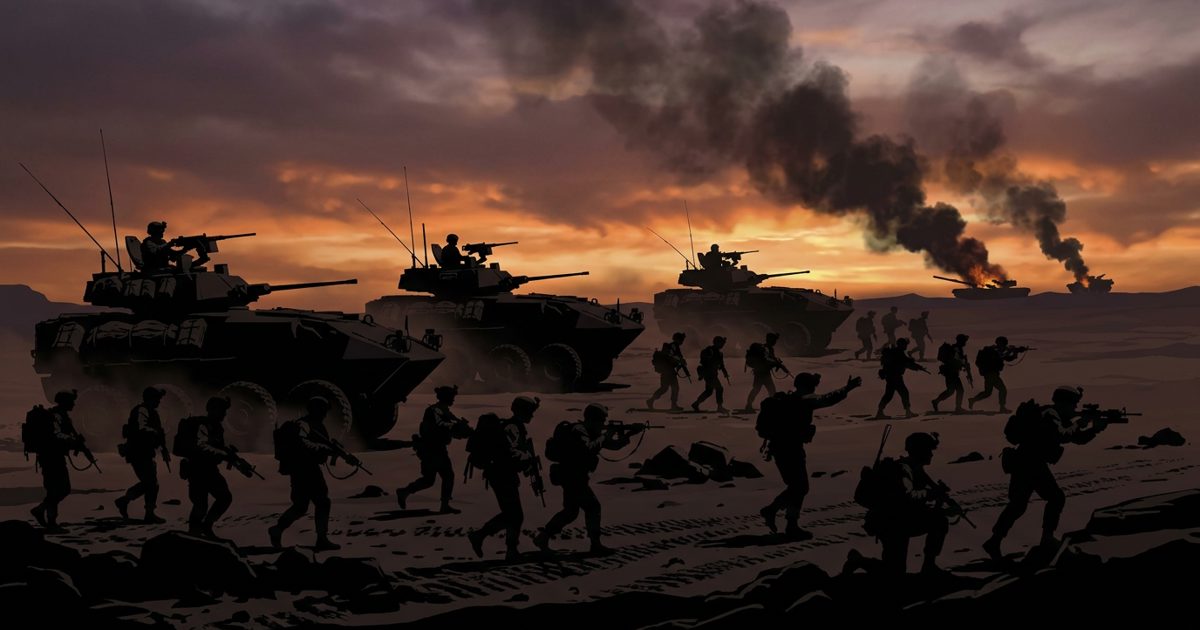
Elements of the 1st Marine Division and coalition allies clashed with Iraqi armored columns near the Saudi border in January 1991 to halt Saddam Hussein's cross-border offensive.
Marines and Coalition Armor Repel Iraqi Assault at Khafji

Tanks from two Iraqi armored divisions crossed the Kuwaiti border into northeastern Saudi Arabia under cover of night on January 29, 1991, launching Saddam Hussein's sole major ground offensive of the Gulf War. Soviet-built T-55 and T-62 tanks moved south along three separate axes, driving directly toward the coastal town of Ras al-Khafji. Forward observation posts manned by light armored infantry and reconnaissance elements from the 1st Marine Division spotted the advancing columns and opened fire with antitank missiles. Heavy mechanized clashes erupted around Observation Posts 4 and 7 as Marine light armored vehicles engaged Iraqi armor in close skirmishes to delay the hostile thrust.

Marines executed organized fighting withdrawals south of the border while calling down devastating artillery barrages and coalition air support against the massed columns. Forward air controllers directed strikes from Air Force A-10 Thunderbolt II attack aircraft and Marine AV-8B Harriers against the exposed Iraqi armor in the open desert. Two six-man reconnaissance teams from the 1st and 3rd Reconnaissance Battalions remained hidden inside Khafji itself after Iraqi troops breached the city limits. Reconnaissance Marines occupied rooftop positions above the hostile occupation forces, relaying coordinates that guided precision bombs and naval gunfire onto enemy command posts without alerting local garrisons.

Coalition commanders assembled Saudi Arabian National Guard battalions and Qatari armored units to counterattack the occupied settlement under continuous American aerial coverage. Heavy air bombardment shattered Iraqi supply lines north of the border, destroying dozens of armored fighting vehicles and starving the occupying force of fuel and ammunition. Ground units liberated Khafji following thirty-six hours of house-to-house combat, capturing hundreds of Iraqi prisoners and restoring the international boundary. American combat casualties during the engagement included eleven Marines and fourteen airmen, while the defeat of three Iraqi divisions eliminated Baghdad's capability to mount further ground incursions into Saudi territory.

CHRONOLOGICAL RECORD

January 29 Across U.S. Military History

8 Verified Events
1813 U.S. Army • War of 1812

Congress Authorizes Twenty New Regular Infantry Regiments

Congress enacted legislation on January 29, 1813, expanding the Regular Army by authorizing twenty new regiments of infantry for one year of service. Colonel John Williams recruited the 39th United States Infantry under this statute, providing the disciplined core that later reinforced Major General Andrew Jackson during the Creek War.

1847 U.S. Army Landmark Event • Mexican-American War

Dragoons and Volunteers Dislodge Insurgents at Embudo Pass

Captain John H. K. Burgwin led a force of First U.S. Dragoons and Missouri mounted volunteers into the gorge of Embudo Pass on January 29, 1847. American troops dismounted and scaled the steep canyon walls under fire, dislodging entrenched Mexican and Pueblo insurgents during the Taos Revolt and clearing the mountain approach toward Taos.

1863 U.S. Army Landmark Event • Civil War

California Volunteers Attack Shoshone Encampment at Bear River

Colonel Patrick Edward Connor led approximately two hundred California Volunteers across the frozen Bear River near Preston, Idaho, on January 29, 1863. Troops assaulted Chief Bear Hunter's winter encampment, flanking the ravine after an initial repulse and killing over two hundred Shoshone warriors in brutal sub-zero fighting.

1943 U.S. Navy Landmark Event • World War II

Japanese Torpedo Bombers Attack Task Force Eighteen

Bombers of the Japanese naval air corps ambushed Rear Admiral Robert C. Giffen's Task Force 18 south of Guadalcanal on January 29, 1943. Two aerial torpedoes crippled the heavy cruiser USS Chicago, halting the American force's advance to cover an incoming troop convoy and triggering the naval battle of Rennell Island.

1944 U.S. Navy Landmark Event • World War II

Task Force Fifty-Eight Pummels Japanese Airfields on Kwajalein

Task Force 58 launched hundreds of combat sorties under Rear Admiral Marc A. Mitscher against Japanese positions across Kwajalein, Roi-Namur, and Maloelap on January 29, 1944. Naval aviators eliminated enemy aircraft and pulverized defensive works, securing total air supremacy across the atolls before amphibious forces landed two days later.

1944 U.S. Navy Landmark Event • World War II

Battleship USS Missouri Launches at Brooklyn Navy Yard

Shipbuilders launched the Iowa-class battleship USS Missouri at the New York Navy Yard on January 29, 1944. Margaret Truman, daughter of Senator Harry S. Truman, christened the 45,000-ton dreadnought, which became the final battleship completed by the United States Navy and the historic venue for Imperial Japan's surrender in 1945.

1945 U.S. Coast Guard Landmark Event • World War II

Cargo Ship USS Serpens Explodes Off Guadalcanal

Ammunition ship USS Serpens exploded while loading depth charges off Lunga Beach, Guadalcanal, on January 29, 1945. The blast obliterated the vessel and killed 250 men, including 197 Coast Guard crewmen and 51 Army stevedores, marking the single greatest loss of life in United States Coast Guard history.

1947 U.S. Navy • Post-World War II

Transport Planes Launch from Carrier Deck to Antarctica

Pilots flying six ski-equipped R4D-5 Skytrain transport planes launched from the carrier USS Philippine Sea on January 29, 1947, en route to Little America, Antarctica. Commanded by Rear Admiral Richard E. Byrd during Operation Highjump, these naval crews conducted extensive aerial mapping flights across 150,000 square miles of uncharted polar ice cap.

MEDAL OF HONOR ACTION 1945

First Sergeant Leonard Funk Subdues Eighty German Captors at Holzheim

Sergeant Leonard A. Funk Jr. led an improvised detachment of company headquarters clerks and wiremen into the snow-covered village of Holzheim, Belgium, on January 29, 1945. Serving as first sergeant with Company C, 508th Parachute Infantry Regiment, 82nd Airborne Division, Funk assumed executive officer duties after his lieutenant fell during a fifteen-mile march through blizzard drifts. Paratroopers under his direction assaulted fifteen buildings and captured eighty German soldiers, securing the captives in an assembly area under a small guard while Company C mopped up peripheral resistance.

Soldiers from German relief units slipped into the village during the mop-up operation, overwhelming the American guards and re-arming the captive troops. An enemy officer leveled a submachine gun against Funk's ribs when the first sergeant walked around the corner of a stone barn into the hostile group. Funk pretended to unshoulder his submachine gun in compliance before whipping the barrel up and emptying the magazine into the enemy officer. Shouting for his recovered guards to seize discarded rifles, Funk killed twenty-one hostile soldiers in seconds, recapturing the entire German force and earning the Medal of Honor for preserving the regimental flank.