Full Calendar
THIS DAY IN U.S. MILITARY HISTORY • JANUARY 6 1945 U.S. Navy World War II

Kamikaze Strikes Hammer American Bombardment Warships at Lingayen Gulf

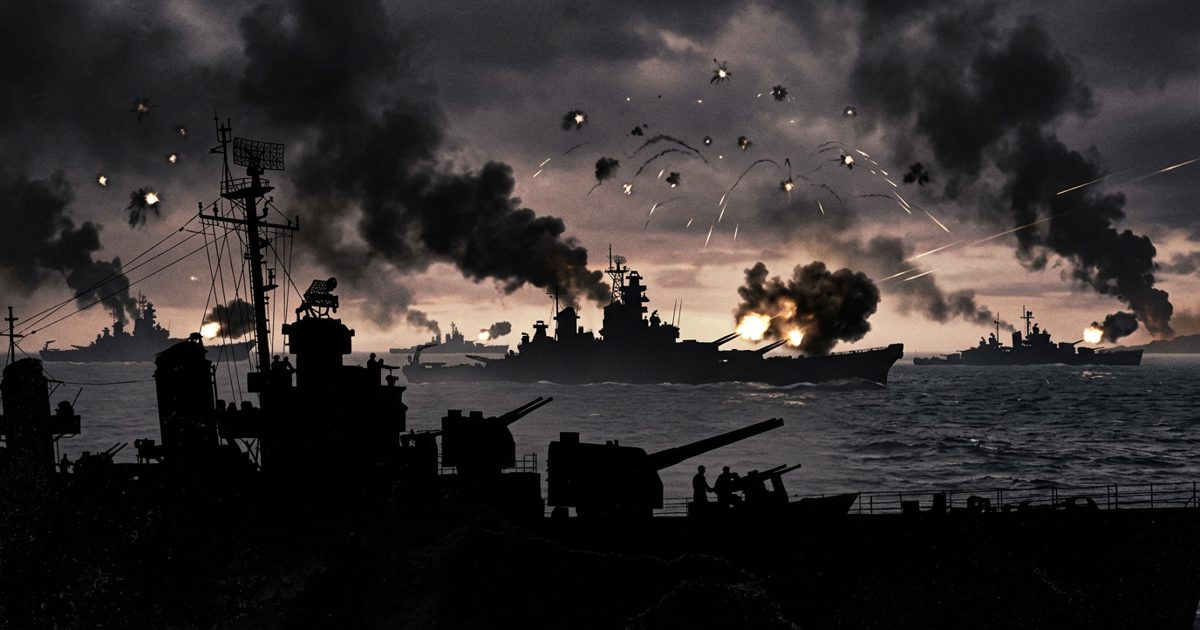
Task Group 77.2 entered Philippine waters off Luzon in 1945 to soften Japanese coastal defenses despite sustaining severe suicide aircraft strikes.
Kamikaze Strikes Hammer American Bombardment Warships at Lingayen Gulf

Warships of Task Group 77.2 steamed into Lingayen Gulf under Vice Admiral Jesse B. Oldendorf to open pre-invasion bombardments against Japanese fortifications on western Luzon. Minesweepers cleared navigation channels under overcast skies while American dreadnoughts and cruisers moved into firing positions along the coast. Japanese commanders dispatched waves of Special Attack suicide aircraft from regional airfields to contest the naval approach. Combat air patrols and shipboard gunners threw up dense barrages, yet several enemy pilots evaded the perimeter and dove straight toward the fleet.

Japanese suicide aircraft plunged into several major American warships across the afternoon assault. A bomb-laden plane smashed into the port bridge wing of the battleship USS New Mexico, killing Captain Robert Walton Fleming and visiting British observer Lieutenant General Herbert Lumsden. Another suicide pilot crashed the signal bridge of the heavy cruiser USS Louisville, spraying burning gasoline across the command deck and mortally wounding Rear Admiral Theodore E. Chandler. Fires erupted aboard the light cruiser USS Columbia and the destroyer USS Allen M. Sumner as additional impacts severed communications and disabled weapons mounts.

Sailors extinguished the blazes and manned auxiliary steering systems while medical personnel treated dozens of burned and wounded crewmen below decks. Rear Admiral Chandler helped drag fire hoses across Louisville before succumbing to severely scorched lungs the following day. Admiral Oldendorf kept his battered formation inside the gulf and ordered the undamaged main batteries to resume their bombardment schedule against shore positions. Naval gunfire pounded Japanese artillery emplacements throughout the next two days, ensuring secure beachheads for the Sixth Army landings on January 9.

CHRONOLOGICAL RECORD

January 6 Across U.S. Military History

8 Verified Events
1776 Continental Navy Landmark Event • American Revolutionary War

Continental Congress Authorizes Establishment of Naval Medicine

Delegates of the Continental Congress passed a resolution directing the recruitment of surgeons and surgeon mates for all commissioned colonial warships. Naval vessels preparing for sea required dedicated medical personnel to treat gunshot wounds, amputations, and epidemic disease among sailors. The measure created the administrative foundation for American naval medicine.

1777 Continental Army Landmark Event • American Revolutionary War

George Washington Establishes Winter Quarters at Morristown

General George Washington marched the exhausted Continental Army into Morristown, New Jersey, following victories at Trenton and Princeton. Rugged ridges of the Watchung Mountains shielded the camp from British forces occupying New York City. Continental troops spent the winter constructing defensive redoubts, procuring rations, and inoculating thousands of soldiers against smallpox.

1862 U.S. Army • Civil War

Union Forces Repel Confederate Guns at Hancock

Brigadier General Frederick W. Lander deployed Union artillery batteries on the Maryland bluffs overlooking the Potomac River to exchange heavy fire with Confederate forces under Major General Thomas Stonewall Jackson. Federal gunners prevented Confederate infantry from crossing the icy river and attacking Hancock. Jackson broke off the bombardment the following morning and withdrew.

1916 U.S. Navy • World War I Era

First Enlisted Sailors Begin Flight Training at Pensacola

Instructors at Naval Air Station Pensacola launched the first formal aviation training course for enlisted sailors in Florida. Student sailors studied aerodynamic theory, engine maintenance, and flight controls to qualify as aircraft pilots alongside commissioned officers. The initiative produced the service branch's first certified enlisted naval aviators, expanding aircrew capacity before World War I.

1928 U.S. Marine Corps • Interwar Period

Lieutenant Christian Schilt Flies Daring Relief Missions into Quilali

Lieutenant Christian F. Schilt landed an O2U-1 Corsair biplane on a cratered dirt street in Quilali, Nicaragua, to evacuate wounded Marines surrounded by guerrilla forces. Schilt lacked wheel brakes and relied on infantrymen to grab his wingtips to stop the plane under hostile fire. His ten flights evacuated eighteen wounded Marines and earned the Medal of Honor.

1941 Joint Landmark Event • World War II

President Roosevelt Proclaims the Four Freedoms

President Franklin D. Roosevelt delivered his State of the Union address to Congress, presenting the Four Freedoms and calling for emergency industrial mobilization. Roosevelt urged immediate expansion of American factories to manufacture thousands of munitions, ships, and aircraft for Allied democracies. The address laid the defense foundation for the Lend-Lease program and global military commitments.

1943 U.S. Navy • World War II

Navy Flying Boat Sinks German Submarine Off Brazil

Lieutenant William R. Ford piloted a PBY-5A Catalina of Patrol Squadron 83 on convoy escort duty off the coast of Brazil when he spotted German submarine U-164 running on the surface. Ford glided through cloud cover, throttled forward at low altitude, and dropped four depth bombs directly alongside the hull. Detonations split the U-boat and sank it within minutes.

1967 U.S. Marine Corps Landmark Event • Vietnam War

Marines Launch Operation Deckhouse Five in Mekong Delta

Marines of Battalion Landing Team 1st Battalion, 9th Marines and South Vietnamese Marine forces stormed beaches in Kien Hoa Province during Operation Deckhouse Five. Seventh Fleet amphibious transports deployed landing craft and helicopters to insert troops into the Thanh Phu Secret Zone. The assault marked the first employment of American combat troops in the Mekong River delta.

MEDAL OF HONOR ACTION 1968

Major Patrick Henry Brady Flies Dustoff Rescues Through Fog and Minefields

Major Patrick Henry Brady commanded a UH-1H Iroquois medical evacuation helicopter with the 54th Medical Detachment near Chu Lai, Republic of Vietnam. Fog blanketed the rugged valleys, trapping wounded South Vietnamese soldiers under intense enemy fire after earlier rescue flights aborted. Brady descended through dense cloud cover, using the backwash of his rotor blades to part the mist and reach the isolated casualties. Hostile machine-gun fire damaged his controls during subsequent sorties, but he delivered the wounded to field hospitals and immediately secured replacement aircraft to continue flying.

Radio transmissions summoned Brady to an active minefield where a trapped American infantry platoon had sustained severe casualties. Brady touched down on a narrow dirt patch, loaded six critically injured soldiers, and held the aircraft steady even after a detonating mine punctured the fuselage and wounded two crew members. Maintenance crews later counted over four hundred bullet holes across the three helicopters Brady piloted throughout the day. His four combat missions evacuated fifty-one wounded soldiers, leading to his award of the Medal of Honor.