Full Calendar
THIS DAY IN U.S. MILITARY HISTORY • MARCH 17 1776 Continental Army American Revolutionary War

Continental Army Forces British Evacuation of Boston

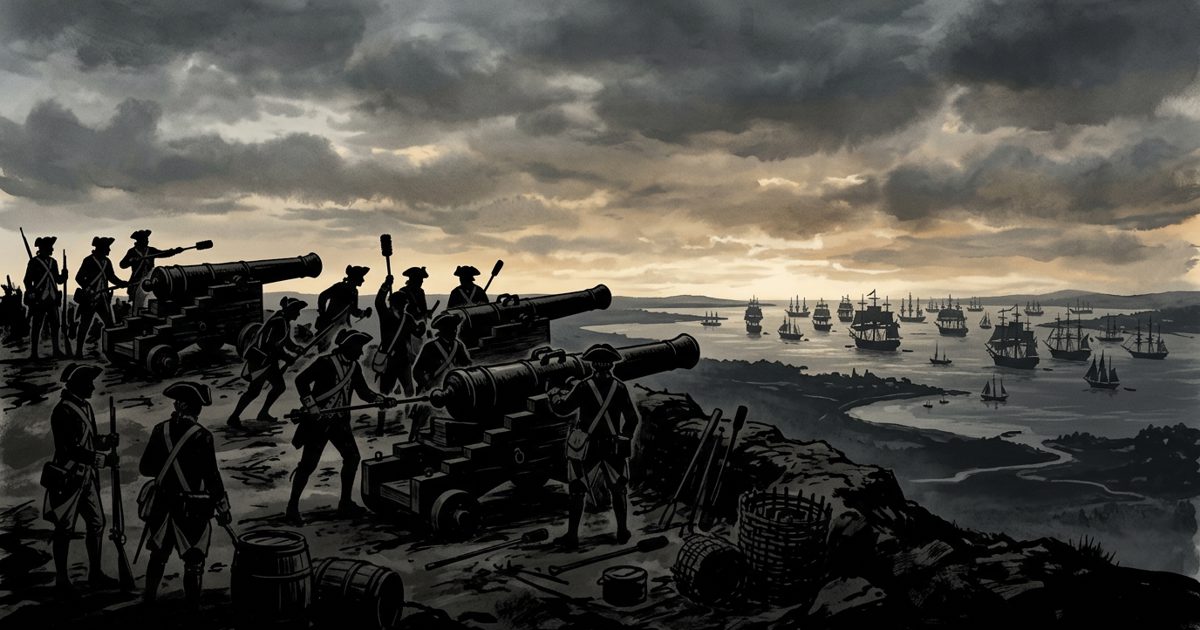
General George Washington deployed heavy siege artillery onto Dorchester Heights in 1776, compelling royal commanders to abandon the city.
Continental Army Forces British Evacuation of Boston

General George Washington watched British troop transports haul up their anchors across Boston Harbor on March 17, 1776, concluding an eleven-month siege. Royal Navy warships and commercial vessels carried more than nine thousand soldiers under General William Howe along with over one thousand Loyalist refugees. British regiments abandoned Massachusetts after Continental gunners fortified Dorchester Heights, a dominant promontory south of the city. Colonel Henry Knox had delivered more than fifty heavy cannons and mortars from captured Fort Ticonderoga through snow and frozen terrain over the winter. Those weapons gave colonial forces the tactical high ground and brought the entire harbor within range of lethal bombardment.

Knox positioned these heavy guns during a single night under cover of a diversionary artillery duel on March 4. Continental soldiers dug fortifications into the frozen turf and raised wooden barricades called fascines to shield the gun emplacements. General Howe recognized that his garrison and supply ships faced immediate destruction from plunging artillery fire. Bad weather initially prevented a British amphibious counterattack against the colonial positions on the heights. Howe soon chose retreat over an assault that would mirror the severe casualties his forces suffered at Bunker Hill.

Troops under General Artemas Ward marched into Boston shortly after the last royal transports cleared the harbor. Continental soldiers secured the town, seized abandoned military stores, and neutralized remaining British fortifications. Washington celebrated the liberation of the colonial capital and promptly redirected his regiments south toward New York to counter anticipated amphibious landings. This strategic withdrawal stripped the British Crown of its primary base in New England and proved that volunteer colonial forces could prevail in a conventional siege. Suffolk County in Massachusetts officially observes March 17 as Evacuation Day to mark the historic achievement.

CHRONOLOGICAL RECORD

March 17 Across U.S. Military History

9 Verified Events
1863 U.S. Army • Civil War

Union Cavalry Fights at Kellys Ford

Brigadier General William W. Averell led 2,100 Federal cavalrymen across the Rappahannock River on March 17, 1863, attacking Confederate horsemen under Fitzhugh Lee. Union troopers held their ground through multiple mounted countercharges, proving their growing tactical parity before withdrawing across the river.

1865 U.S. Navy • Civil War

Sailors Earn Medals at Mattox Creek

Landsman Aaron Anderson and Boatswain Mate Patrick Mullen manned an armed cutter from the Potomac Flotilla on March 17, 1865, navigating upstream through heavy Confederate fire. Their courageous actions clearing enemy supply boats in Mattox Creek earned both men the Medal of Honor, with Mullen firing the howitzer while Anderson rowed through intense gunfire.

1917 U.S. Navy Landmark Event • World War I

Navy Enlists First Female Yeoman

Loretta Perfectus Walsh enlisted in the Naval Reserve Force in Philadelphia on March 17, 1917, becoming the first woman to officially enlist in the American armed forces in a non-nursing capacity. Her enlistment as a yeoman paved the way for more than eleven thousand female sailors who served the Navy during World War I.

1942 U.S. Army Landmark Event • World War II

MacArthur Reaches Australia from Corregidor

General Douglas MacArthur arrived at Batchelor Field south of Darwin on March 17, 1942, completing his escape from the besieged Philippine island of Corregidor. MacArthur traveled by patrol torpedo boat and B-17 bomber to take command of Allied forces in the Southwest Pacific Area.

1944 U.S. Navy • World War II

Task Group Sinks German Submarine

Aircraft from escort carrier USS Block Island joined the destroyer USS Corry and destroyer escort USS Bronstein on March 17, 1944, to sink German submarine U-801 near the Cape Verde Islands. Depth charges and aerial rocket attacks forced the U-boat to surface before naval gunfire destroyed the vessel.

1945 U.S. Army Landmark Event • World War II

Ludendorff Bridge Collapses at Remagen

Engineers from the 276th Engineer Combat Battalion were repairing the captured Ludendorff Railroad Bridge when the weakened steel span collapsed into the Rhine River on March 17, 1945. The disaster killed twenty-eight soldiers, but five American divisions had already crossed the river and firmly established the bridgehead.

1958 U.S. Navy Landmark Event • Cold War

Vanguard Satellite Achieves Stable Orbit

Scientists at the Naval Research Laboratory successfully launched Vanguard 1 into Earth orbit from Cape Canaveral on March 17, 1958. The small three-pound sphere served as the first satellite powered by solar cells and remains the oldest human-made object still orbiting the planet.

1968 U.S. Army • Vietnam War

Machine Gunner Sacrifices to Save Squad

Specialist Fourth Class Edward A. DeVore Jr. assaulted fortified enemy bunkers near Saigon on March 17, 1968, after an ambush pinned down his platoon. DeVore drew intense hostile fire with his machine gun until he fell mortally wounded, allowing trapped comrades to escape and earning a posthumous Medal of Honor.

1973 U.S. Air Force Landmark Event • Vietnam War

Returned Aviator Reunited with Family

Lieutenant Colonel Robert L. Stirm arrived at Travis Air Force Base on March 17, 1973, after enduring more than five years of captivity in North Vietnam. Photographer Sal Veder captured the emotional reunion with Stirm sprinting children in the Pulitzer Prize-winning photograph Burst of Joy.

WEAPONS AND TECHNOLOGY 1966

Navy Submersible Alvin Locates Missing Thermonuclear Bomb

Submersible Alvin made naval history on March 17, 1966, by locating a lost B-28 thermonuclear bomb on the Mediterranean seabed off Palomares, Spain. The weapon had vanished two months earlier when a Strategic Air Command B-52 bomber collided with a KC-135 refueling tanker during high-altitude operations. Three weapons crashed onto coastal land, while the fourth bomb plummeted into deep water with its parachute partially deployed. Operating under United States Navy Task Force 65, the crew directed the small research craft across jagged undersea canyons. Pilot Valentine Wilson and oceanographer William Rainnie spotted the parachute draped over the casing on a steep incline at a depth of 2,550 feet.

Recovery teams aboard surface support vessels immediately prepared specialized salvage equipment to secure the intact hydrogen bomb. Navy engineers deployed the Cable-Controlled Undersea Recovery Vehicle, an unmanned robotic platform, to attach lifting lines to the weapon. Crewmen raised the bomb to the surface on April 7, ending weeks of international diplomatic tension and radioactive contamination fears. This breakthrough operation proved the military value of deep-submergence submersibles for deep-ocean salvage and classified naval recovery missions.