Full Calendar
THIS DAY IN U.S. MILITARY HISTORY • MARCH 2 1965 U.S. Air Force Vietnam War

Operation Rolling Thunder Launches American Air Campaign Over North Vietnam

American strike packages hit North Vietnamese ammunition depots at Xom Bang in 1965 to open a three-year strategic bombing offensive.
Operation Rolling Thunder Launches American Air Campaign Over North Vietnam

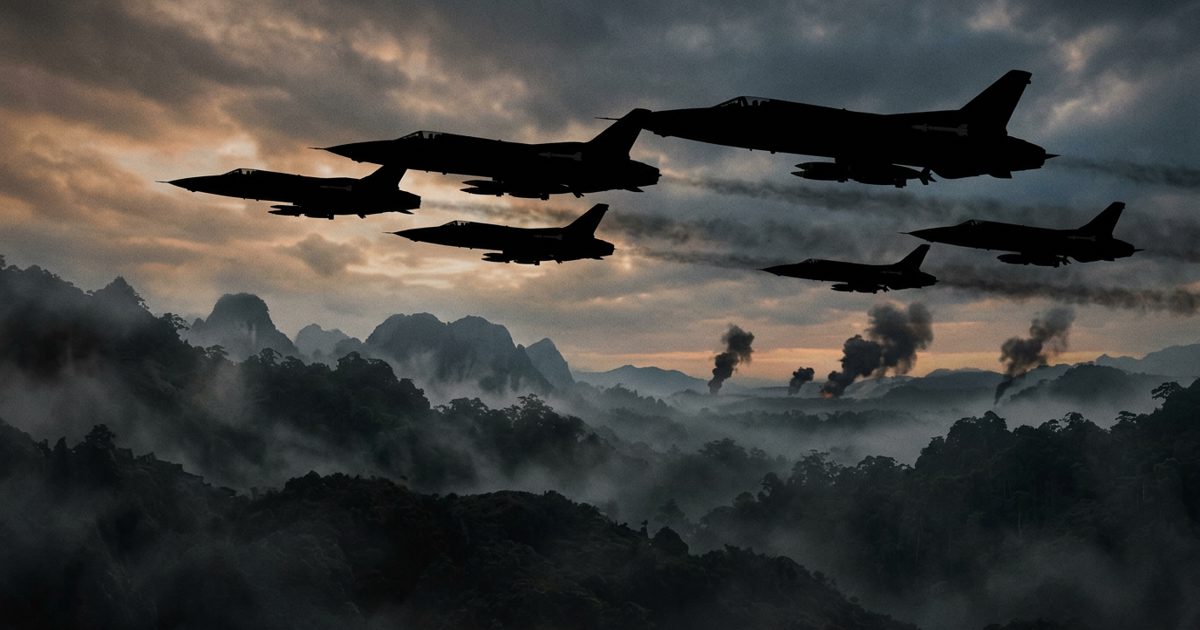
Fighter-bombers from the Second Air Division roared across the seventeenth parallel into North Vietnam to open Operation Rolling Thunder. More than one hundred United States Air Force strike aircraft converged on the fortified ammunition depot at Xom Bang just north of the Demilitarized Zone. Republic F-105 Thunderchiefs and North American F-100 Super Sabres spearheaded the flight packages alongside Martin B-57 Canberras flying from bases in Thailand and South Vietnam. Pilots delivered ordnance directly onto designated weapons bunkers and ammunition magazines while enemy gunners threw up intense antiaircraft barrages. Heavy flak met the incoming formations, signaling an unexpectedly dense network of ground defenses.

Antiaircraft fire damaged multiple American airframes and claimed five aircraft during the strike against the ammunition complex. United States Air Force rescue forces scrambled amphibious Grumman HU-16 Albatross amphibians and helicopters to recover downed aviators under intense pressure. Aerial reconnaissance photographs revealed that the strike force demolished three-quarters of the forty-nine military structures within the Xom Bang depot. South Vietnamese Douglas A-1 Skyraiders conducted a coordinated secondary raid against the naval facilities at Quang Khe further up the coast. These opening strikes delivered tons of high explosives but exposed serious tactical hazards for allied pilots operating in heavily defended airspace.

President Lyndon B. Johnson established strict operational rules that tightly regulated target selection and mission frequency from Washington. Military planners initially restricted flight paths to southern sectors to avoid provoking direct Chinese or Soviet intervention in the conflict. Strategic planners anticipated that gradual bombing pressure would compel North Vietnamese leaders to abandon support for southern insurgents. Sustained aerial operations continued across North Vietnam until late 1968, resulting in the delivery of over six hundred thousand tons of ordnance across thousands of combat sorties.

CHRONOLOGICAL RECORD

March 2 Across U.S. Military History

9 Verified Events
1776 Continental Army Landmark Event • American Revolutionary War

Continental Forces Contest Royal Navy Rice Raids

Soldiers under Colonel Lachlan McIntosh clashed with British landing parties on Hutchinson Island along the Savannah River. Royal Navy sailors sought to seize merchant vessels laden with rice to provision crown forces in Boston. Georgia militia and Continental artillery subsequently engaged the enemy squadron and forced the ships downriver.

1864 U.S. Navy • Civil War

Gunboat USS Fort Hindman Fights River Ambush

Confederate artillery batteries ambushed the tinclad gunboat USS Fort Hindman along the Ouachita River near Harrisonburg, Louisiana. Incoming shells raked the exposed casemate, severely wounding Landsman William P. Johnston in the hand. Johnston refused medical evacuation and manned the naval guns throughout the engagement, earning the Medal of Honor for his tenacity under fire.

1865 U.S. Army Landmark Event • Civil War

Custer Overruns Early at Waynesboro

Brigadier General George Armstrong Custer led the Third Cavalry Division in a decisive assault against Lieutenant General Jubal Early at Waynesboro, Virginia. Union troopers exploited an open gap on the Confederate left flank to surround the entrenched defenders against the swollen South River. Federal forces captured over fifteen hundred prisoners, seventeen battle flags, and all Confederate artillery pieces.

1901 Joint Service Landmark Event • Imperial Era

Congress Enacts the Strategic Platt Amendment

President William McKinley signed the Army Appropriations Act of 1901, incorporating the Platt Amendment into federal law. Legislative provisions established strict conditions for the withdrawal of United States military forces from Cuba following the Spanish-American War. Provisions granted the United States long-term lease rights to establish a permanent naval station at Guantanamo Bay.

1940 U.S. Navy • Interwar Era

Destroyer USS O'Brien Enters Active Service

Shipbuilders delivered the Sims-class destroyer USS O'Brien to the United States Navy at the Boston Navy Yard. Lieutenant Commander Carl F. Espe assumed command as the warship hoisted its commissioning pennant. O'Brien subsequently joined the Atlantic Fleet to conduct neutrality patrols and protect convoys before deploying to the Pacific theater of World War II.

1943 U.S. Army Air Forces Landmark Event • World War II

Fifth Air Force Bombers Strike Japanese Convoy

Boeing B-17 Flying Fortresses of the Fifth Air Force located and attacked a sixteen-ship Japanese reinforcement convoy in the Bismarck Sea. Heavy bombers flying from Papua New Guinea sank the transport Kyokusei Maru and damaged two destroyers. Allied aviators initiated four days of relentless air strikes that ultimately destroyed the entire troop convoy bound for Lae.

1944 U.S. Army • World War II

Cavalry Troopers Consolidate Hold on Momote Airfield

Reinforcements from the 5th Cavalry Regiment landed at Hyane Harbor on Los Negros Island to expand the newly established Allied perimeter. Troopers of the 1st Cavalry Division secured Momote Airdrome while naval gunfire from offshore destroyers broke up gathering Japanese counterattacks. Engineering units immediately began repairing the coral airstrip to provide forward fighter cover for future advances.

1991 U.S. Army Landmark Event • Gulf War

Armored Task Forces Smash Republican Guard Column

Elements of the 24th Infantry Division Mechanized clashed with an armored column of the Iraqi Republican Guard Hammurabi Division near the Rumaila oil field. Major General Barry McCaffrey directed tanks, Bradley fighting vehicles, and AH-64 Apache helicopters in a crushing counterstroke. American forces destroyed hundreds of Iraqi tanks, artillery pieces, and supply vehicles while capturing thousands of prisoners.

2002 Joint Service Landmark Event • War in Afghanistan

Coalition Assault Forces Enter the Shah-i-Kot

Helicopters inserted soldiers of Task Force Mountain into the rugged Shah-i-Kot Valley of eastern Afghanistan to initiate Operation Anaconda. Ground troops from the 10th Mountain Division and 101st Airborne Division immediately encountered fierce machine-gun and mortar barrages from entrenched al-Qaeda fighters. Coalition forces held defensive perimeters against intense enemy resistance while coordinating close air support across high mountain ridges.

MEDAL OF HONOR ACTION 1968

Specialist Nicholas Cutinha Sacrifices Position at Gia Dinh

Specialist Fourth Class Nicholas J. Cutinha moved with Company C of the 4th Battalion, 9th Infantry Regiment, 25th Infantry Division, during a combat sweep near Gia Dinh, Republic of Vietnam. Hostile fire erupted from concealed battalion-size enemy fortifications, killing the company commander and severing radio communications with headquarters. Cutinha immediately unlimbered his machine gun and laid down heavy suppressive fire to stall the advancing assault. Shrapnel struck him in the leg and enemy rounds destroyed his machine gun, but the young gunner continued crawling through the mud toward a secondary weapon.

Bullets struck Cutinha a second time as he reached the operable machine gun and provided continuous cover for wounded comrades. Medical personnel evacuated nine injured soldiers to safety behind his defensive position while Cutinha maintained accurate fire and eliminated fifteen enemy riflemen. Mortally wounded before reinforcements arrived, Cutinha refused to yield his isolated fighting post. President Richard Nixon posthumously awarded Specialist Cutinha the Medal of Honor for his actions in saving his fellow soldiers.