Full Calendar
THIS DAY IN U.S. MILITARY HISTORY • MARCH 22 1945 U.S. Army World War II

Third Army Breaches the Rhine River in Daring Midnight Assault

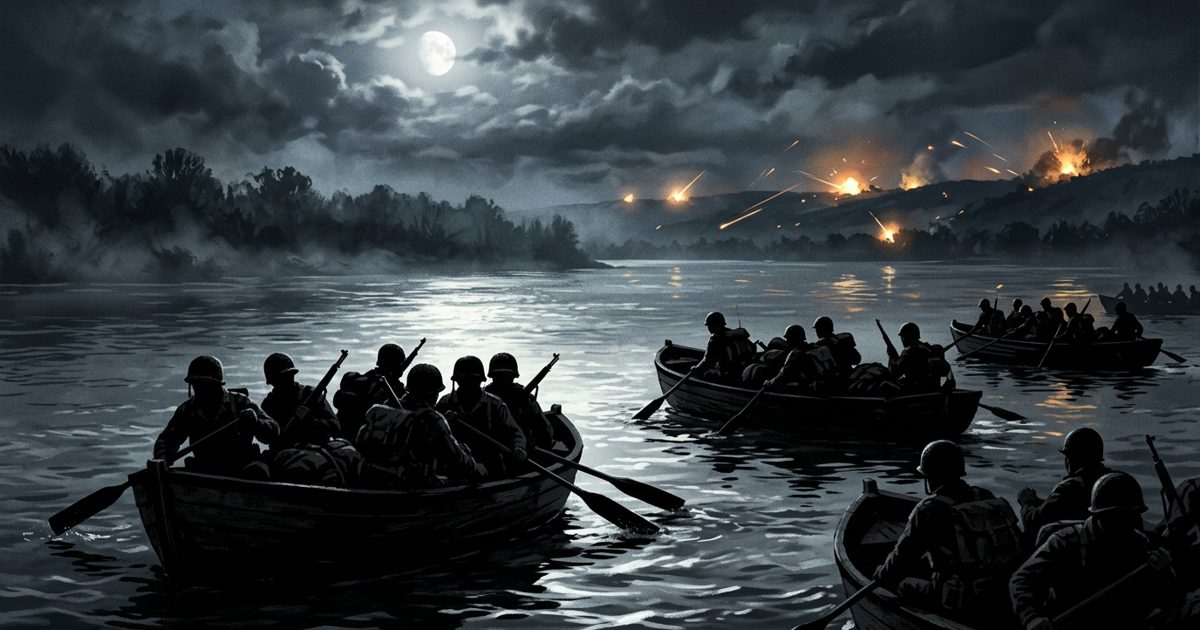
Major General Manton Eddy XII Corps slipped assault boats across the Rhine at Oppenheim in 1945, collapsing Germany final western river defenses.
Third Army Breaches the Rhine River in Daring Midnight Assault

General George S. Patton Jr. ordered his Third Army spearheads to force an immediate crossing of the Rhine River on the night of March 22, 1945. Major General Manton S. Eddy assigned the mission to the 5th Infantry Division, directing the 11th Infantry Regiment to lead the secret amphibious assault near Oppenheim. Patton wanted to establish a firm foothold east of Germany natural obstacle before British Field Marshal Bernard Montgomery launched his prepared offensive farther north. Third Army artillery batteries remained deliberately silent, and no tactical bombers patrolled overhead to preserve absolute surprise.

Infantrymen loaded into lightweight plywood assault boats along the western riverbank at ten o'clock sharp and pushed out into the fast-flowing water. German defenders on the opposite bank did not expect an assault and offered only sporadic small-arms fire. Company K secured the eastern shoreline within twenty minutes, sending riflemen into the treeline to establish defensive perimeters and eliminate machine-gun nests. Combat engineers followed directly behind the infantry, deploying powerboats and amphibious craft to shuttle entire battalions across the river throughout the night.

Combat engineers from the 249th Engineer Combat Battalion immediately assembled heavy treadway pontoon sections under morning fog while enemy artillery fire began targeting the river corridor. American fighter-bombers from XIX Tactical Air Command swept in at dawn to suppress German artillery positions and disperse counterattacking armor. Soldiers expanded the bridgehead to a depth of several miles before dusk, allowing armored columns to roll into the German interior. Patton notified Allied headquarters that his Third Army had breached the Rhine on the run, permanently wrecking the German defense of the western frontier.

CHRONOLOGICAL RECORD

March 22 Across U.S. Military History

8 Verified Events
1820 U.S. Navy • Early Republic

Commodore Stephen Decatur Wounded in Bladensburg Duel

Commodore Stephen Decatur suffered mortal wounds during a pistol duel with Commodore James Barron on the dueling grounds at Bladensburg, Maryland. The dispute stemmed from Barron resentment over Decatur participation in his court-martial after the 1807 Chesapeake-Leopard affair. Decatur succumbed to his abdominal wound twelve hours later at his Washington home.

1838 U.S. Army • Second Seminole War

Army Forces Penetrate the Florida Everglades

Lieutenant Colonel James Bankhead led an amphibious expedition of regular soldiers and naval personnel into the Florida Everglades against a Seminole band at Pine Island Ridge. Troops pushed small boats through sawgrass marshes and exchanged gunfire before securing the remote hammock island. The engagement marked the first recorded deep penetration of the Everglades interior by American armed forces.

1865 U.S. Army Landmark Event • Civil War

Wilson Launches Cavalry Raid Through Alabama

General James H. Wilson led more than thirteen thousand Union cavalrymen out of Gravelly Springs, Alabama, initiating Wilson Raid. The heavily armed horsemen carried Spencer repeating carbines on a sweeping campaign targeting the Confederate industrial heartland. Their push destroyed key arsenals, ironworks, and supply depots throughout Selma and Columbus over the following month.

1915 U.S. Navy Landmark Event • World War I Era

Navy Formally Adopts Naval Aviator Designation

Navy officials officially replaced the older rating of Navy Air Pilot with the formal title of Naval Aviator. The Bureau of Navigation established standardized flight pay qualifications and issued sequential designations, retroactively numbering Lieutenant Theodore G. Ellyson as Naval Aviator Number One. The administrative reform cemented formal qualifications for all future maritime military fliers.

1917 U.S. Coast Guard Landmark Event • World War I Era

Elmer Stone Becomes First Coast Guard Aviator

Lieutenant Elmer F. Stone graduated from flight training at the Naval Aeronautic Station in Pensacola, Florida. Stone earned designation as Naval Aviator Number 38 and became Coast Guard Aviator Number One. His graduation founded Coast Guard aviation, and Stone later served as pilot on the historic 1919 transatlantic flight of the NC-4 flying boat.

1955 U.S. Navy • Cold War

Navy Liftmaster Crashes into Oahu Mountains

Navy pilots operating a Douglas R6D-1 Liftmaster transport encountered heavy rain and navigational difficulties while descending toward Hickam Air Force Base in Hawaii. The transport crashed into Pali Kea Peak in the Waianae Range, killing all sixty-six service members and crew aboard. The collision stands as the deadliest air disaster in the history of naval aviation.

1957 U.S. Air Force • Cold War

Air Force Stratofreighter Disappears Over Pacific

Air Force flight crews lost contact with a Boeing C-97 Stratofreighter transport two hundred miles east of Tokyo over stormy ocean waters. The transport had departed Wake Island bound for Yokota Air Base carrying sixty-seven personnel. Extensive aerial search operations by dozens of military aircraft found no wreckage or survivors, making it the deadliest incident in C-97 history.

2017 U.S. Air Force Landmark Event • Operation Inherent Resolve

American Heliborne Assault Opens Tabqa Campaign

Coalition helicopters ferried hundreds of Syrian Democratic Forces soldiers behind Islamic State positions south of the Euphrates River near Lake Assad. American airmen, Marine artillerymen, and special operations advisors coordinated the night air assault to sever highway routes west of Raqqa. The flanking maneuver isolated the extremist stronghold and opened the successful siege of Tabqa Dam.

MEDAL OF HONOR ACTION 1967

First Sergeant David McNerney Rallies Company A at Polei Doc

First Sergeant David H. McNerney took command of Company A, 1st Battalion, 8th Infantry, 4th Infantry Division when his unit was ambushed near Polei Doc, South Vietnam. A reinforced North Vietnamese Army battalion enveloped the American positions and killed the company commander along with the artillery forward observer. McNerney dashed through intense enemy fire, engaged hostile soldiers at point-blank range, and destroyed a machine-gun bunker with grenades despite suffering painful shrapnel wounds. He assumed tactical command of the surviving riflemen and rallied them into a tight defensive perimeter.

Artillery fire directed by McNerney crashed within twenty meters of the perimeter trenches to break persistent North Vietnamese charges. McNerney climbed a tall tree under heavy machine-gun fire to secure an orange marker panel for supporting gunships and later used explosives to clear a landing zone for medevac helicopters. He refused medical evacuation for his own wounds and held the battered company together until relief forces arrived the following afternoon. President Lyndon B. Johnson presented McNerney with the Medal of Honor in 1968 for his actions during the battle.