Armor and Artillery Repel Human Wave Assault at Suoi Tre
Soldiers of the 4th Infantry Division defended Fire Support Base Gold against overwhelming Viet Cong forces in Tay Ninh Province in 1967.
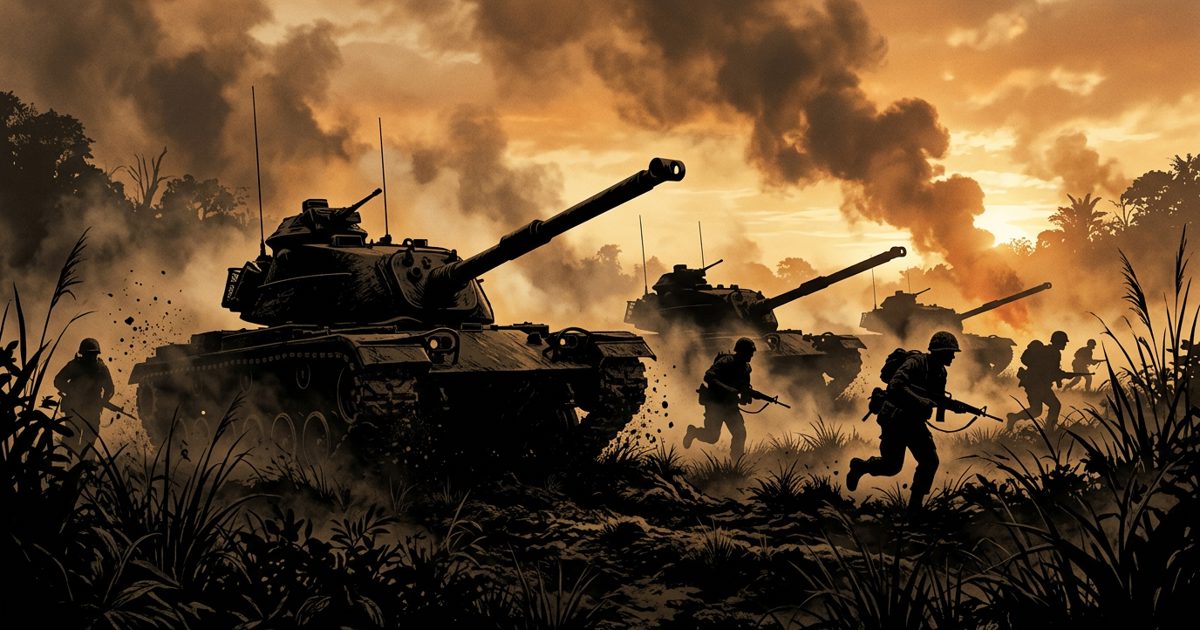
Mortar rounds and recoilless rifle shells slammed into Fire Support Base Gold at dawn on March 21, 1967, shattering the quiet perimeter near Suoi Tre in Tay Ninh Province. Approximately four hundred fifty American soldiers from the 3rd Battalion, 22nd Infantry and the 2nd Battalion, 77th Artillery suddenly faced a ferocious ground assault by more than two thousand five hundred combatants of the Viet Cong 272nd Regiment. Enemy infantry surged across the cleared perimeter from three directions under heavy machine gun fire, attempting to overrun the artillery pits and annihilate the isolated outpost during Operation Junction City. American artillerymen lowered the barrels of their 105mm howitzers to point-blank elevation and fired beehive antipersonnel rounds packed with thousands of steel flechettes directly into the charging ranks. The blast waves checked the initial wave of attackers just yards outside the bunker line, but mounting enemy pressure threatened to breach the perimeter as ammunition supplies dwindled.
Relief columns from the 2nd Battalion, 34th Armor and the 2nd Battalion, 22nd Infantry fought their way across thick jungle underbrush and the muddy banks of the Suoi Samat River to rescue the garrison. Captain Richard Trimble directed his M48 Patton tanks and armored personnel carriers through dense tropical tree lines, crashing into the eastern flank of the attacking enemy regiment at top speed. Tank crews fired 90mm canister rounds while vehicle commanders swept the tree line with heavy machine guns, ripping through enemy infantry fighting positions. The sudden shock of heavy armor threw the Viet Cong assault formations into complete disarray as United States Air Force fighter-bombers dropped napalm along the perimeter tree line. Enemy commanders lost battlefield coordination, forcing surviving fighters to break contact and withdraw into the surrounding jungle.
Infantrymen swept the surrounding terrain immediately following the four-hour engagement, securing the battered defensive perimeter and collecting abandoned weapons. Soldiers discovered six hundred forty-seven enemy bodies left on the battlefield, along with ninety-four individual rifles and sixty-five crew-served heavy weapons. American casualties totaled thirty-one soldiers killed in action and one hundred nine wounded during the intense fighting. President Lyndon B. Johnson later awarded the Presidential Unit Citation to the participating units of the 3rd Brigade, 4th Infantry Division for their defensive stand at Fire Support Base Gold.