Full Calendar
THIS DAY IN U.S. MILITARY HISTORY • MARCH 31 1992 U.S. Navy Post-Cold War

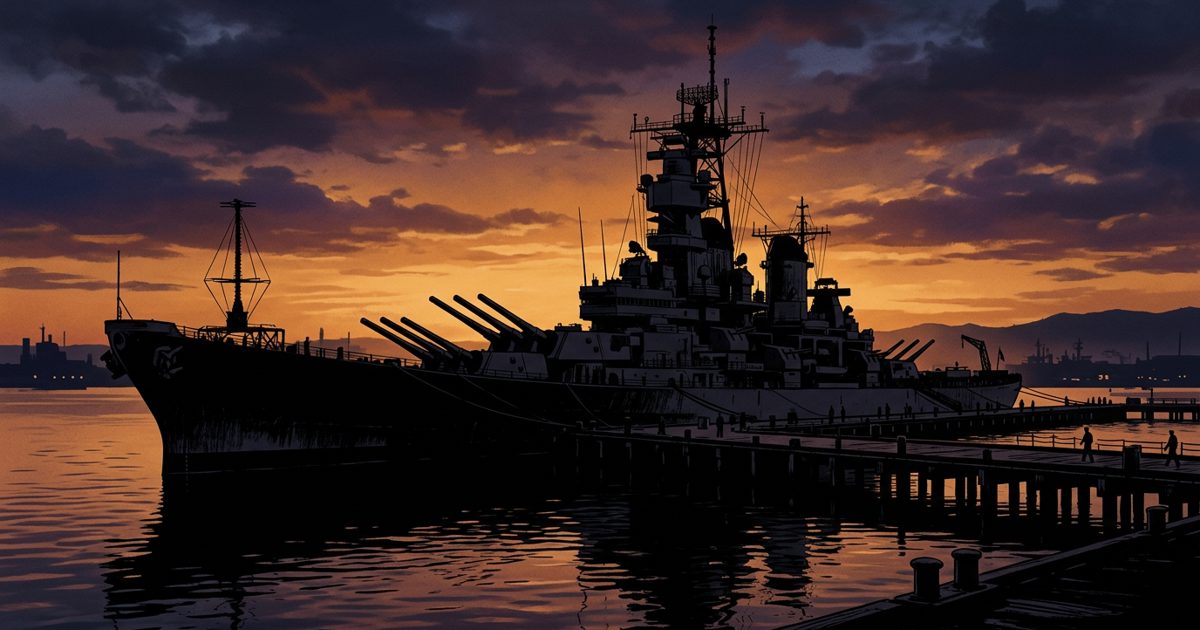
Battleship USS Missouri Lowers Colors in Long Beach Ending an Era

Captain Albert Lee Kaiss orders the final crew ashore as the last active battleship in the United States Navy transitions into retirement.
Battleship USS Missouri Lowers Colors in Long Beach Ending an Era

Crewmen stood in precise ranks along the teak decks of USS Missouri on March 31, 1992, at Naval Station Long Beach in California. Captain Albert Lee Kaiss addressed the assembled sailors and guests, delivering his final orders before the dreadnought ceased active operations. Missouri had served across five decades, providing 16-inch gunfire support from Iwo Jima and Okinawa to the Korean Peninsula and the Persian Gulf. Her combat deployment during Operation Desert Storm had demonstrated her upgraded offensive reach through the launch of 28 Tomahawk cruise missiles and hundreds of heavy artillery shells. This final gathering at the Long Beach pier brought an official close to forty-eight years of fleet assignments.

Sailors executed the formal decommissioning routine by securing the boilers and preparing to haul down the national colors. Deck officers escorted honored veterans across the gangway while the executive officer processed the final logbook entries of the morning watch. The retirement reflected sweeping defense reorganizations following the dissolution of the Soviet Union, as the Navy phased out high-maintenance surface combatants in favor of guided-missile cruisers and destroyers. Bureau officials struck the warship from active duty rolls, initiating preservation protocols to safeguard her armor plating and machinery. These maintenance procedures ensured the vessel remained intact while civilian custodians prepared a permanent maritime museum site.

Tugboats eventually moved the silent dreadnought to Puget Sound for temporary storage before her final transfer to Hawaii in 1998. Missouri now rests along Battleship Row at Ford Island in Pearl Harbor, positioned bow-to-bow with the sunken wreck of USS Arizona. Visitors walk the surrender deck where Supreme Allied Commander Douglas MacArthur accepted the formal capitulation of the Japanese Empire on September 2, 1945. Her departure from active duty on March 31, 1992, remains the definitive moment when global naval doctrines permanently abandoned the big-gun dreadnought concept.

CHRONOLOGICAL RECORD

March 31 Across U.S. Military History

8 Verified Events
1854 U.S. Navy Landmark Event • Antebellum Era

Commodore Perry Secures the Convention of Kanagawa

Commodore Matthew Perry concluded negotiations with representatives of the Tokugawa Shogunate in Kanagawa, Japan, signing the treaty on March 31, 1854. Perry deployed his squadron of steam-powered warships to ensure the protection of shipwrecked American whalers and secure access to coal depots. The agreement opened the ports of Shimoda and Hakodate to American merchant ships, establishing formal bilateral ties.

1865 U.S. Army Landmark Event • Civil War

Union Infantry Drives Confederates Along White Oak Road

Major General Gouverneur K. Warren led the Union V Corps against Confederate defensive works along White Oak Road, Virginia, on March 31, 1865. Warren halted a fierce counterattack by General Bushrod Johnson before countercharging with infantry brigades to seize the roadway. The tactical advance severed direct communications between General Robert E. Lee and Confederate positions at Five Forks.

1899 U.S. Army Landmark Event • Philippine-American War

American Troops Capture Insurgent Capital of Malolos

Major General Arthur MacArthur Jr. directed the 2nd Division of the Eighth Army Corps into Malolos, Bulacan, on March 31, 1899. American infantry regiments pushed through burning barricades after an intense morning artillery preparation cleared the insurgent outskirts. The seizure deprived the revolutionary government of its administrative capital, forcing Emilio Aguinaldo to shift his forces northward.

1917 U.S. Navy • World War I

Navy Assumes Formal Control of the Virgin Islands

Commander Edwin Taylor Pollock represented the United States Navy during formal transfer ceremonies on Saint Thomas on March 31, 1917. American sailors lowered the Danish flag and raised the Stars and Stripes after the United States purchased the islands for twenty-five million dollars. Pollock served as the initial naval governor, securing vital Caribbean shipping routes and protecting the approaches to the Panama Canal.

1944 U.S. Navy • World War II

Task Force 58 Devastates Japanese Shipping in Palau

Vice Admiral Marc A. Mitscher concluded Operation Desecrate One on March 31, 1944, recovering his carrier strike groups after sweeping the Palau Islands. Navy aircraft dropped aerial mines into channel chokepoints and sank thirty-six Japanese vessels across the lagoons. The two-day strike neutralized enemy fleet anchorages and shielded General Douglas MacArthur's advancing Allied forces in New Guinea.

1945 U.S. Navy • World War II

Kamikaze Attack Damages Flagship USS Indianapolis off Okinawa

Gunners aboard the heavy cruiser USS Indianapolis engaged an incoming Japanese dive bomber off the beaches of Okinawa on March 31, 1945. The aircraft dropped an armor-piercing bomb that penetrated the hull and exploded beneath the keel, killing nine crewmen and flooding multiple compartments. Crew members stabilized the ship, enabling her to return to California for repairs that positioned her for her subsequent atomic transport run.

1968 Joint Service Landmark Event • Vietnam War

President Johnson Restricts Air Strikes Over North Vietnam

President Lyndon B. Johnson announced a unilateral halt to aerial bombardment across North Vietnam north of the twentieth parallel during an address on March 31, 1968. Johnson sought to open peace talks in Paris while reducing the scale of combat operations following the Tet Offensive. The televised address concluded with his decision not to seek reelection as commander in chief.

2004 U.S. Marine Corps Landmark Event • War in Iraq

Fallujah Convoy Ambush Triggers Marine Corps Offensive Plans

Insurgents ambushed two commercial security vehicles in Fallujah, Iraq, killing four American contractors on March 31, 2004. Regimental Combat Team 1 of the 1st Marine Division, having just assumed responsibility for security in al-Anbar Province, received orders to cordon the city. The deadly assault prompted senior commanders to launch Operation Vigilant Resolve, initiating the First Battle of Fallujah.

MILITARY AVIATION 1945

Defecting Pilot Delivers Operational Jet Fighter to American Forces

Hans Fay landed an intact Messerschmitt Me 262A-1 jet fighter at the American-occupied Rhein-Main Airfield near Frankfurt, Germany, on March 31, 1945. Fay had received orders to ferry the factory-fresh aircraft east to avoid approaching Allied forces, but he deliberately altered course to defect to the United States Army Air Forces. American ground troops secured the twin-engine jet immediately upon its arrival on the runway. The defection provided the Allies with their first fully operational German jet interceptor without requiring combat recovery from contested territory.

Intelligence officers from the Air Technical Intelligence teams rapidly documented the aircraft's Junkers Jumo 004 axial-flow turbojet engines and swept-wing aerodynamic surfaces. Mechanics partially disassembled the jet and loaded it onto cargo transports for shipment to Wright Field in Ohio under the umbrella of Operation LUSTY. American test pilots and aeronautical engineers conducted extensive flight trials and wind tunnel analyses to extract critical performance data. The captured hardware accelerated American post-war jet development programs, directly shaping early swept-wing fighter designs including the North American F-86 Sabre.