Full Calendar
THIS DAY IN U.S. MILITARY HISTORY • APRIL 1 1945 Joint (U.S. Army, U.S. Marine Corps, U.S. Navy) World War II

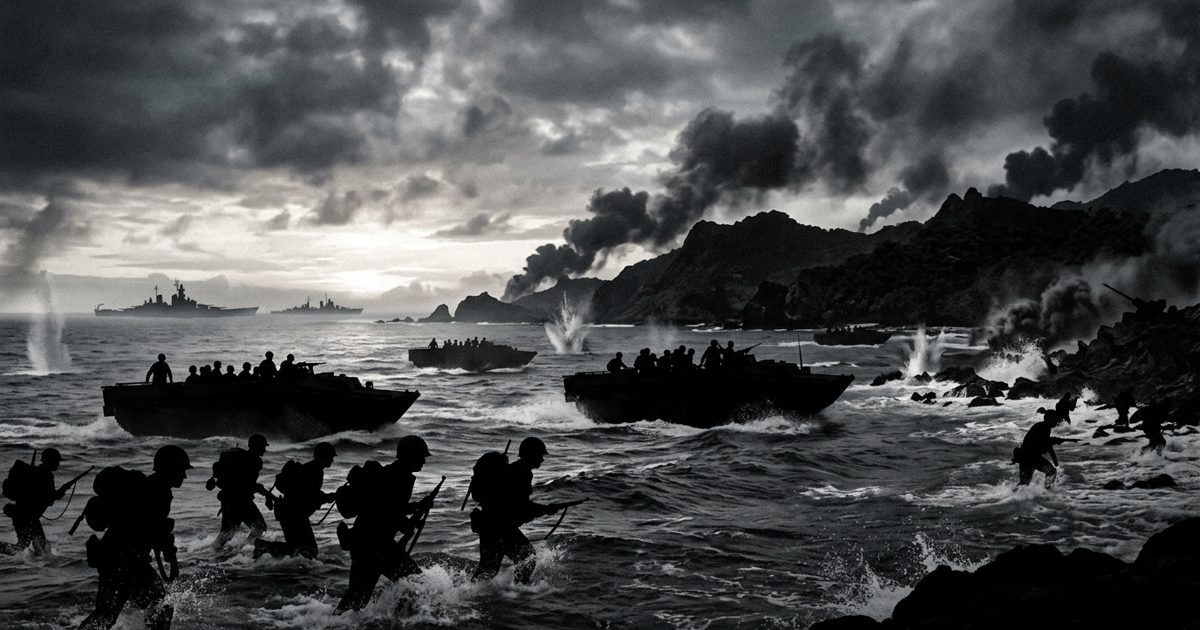
Tenth Army Launches Operation Iceberg Against Japanese Forces on Okinawa

Lieutenant General Simon Bolivar Buckner Jr. directs the largest amphibious assault of the Pacific War across the beaches of Okinawa in 1945.
Tenth Army Launches Operation Iceberg Against Japanese Forces on Okinawa

Soldiers of the United States Tenth Army hit the Hagushi beaches on the western shore of Okinawa under the command of Lieutenant General Simon Bolivar Buckner Jr. Supported by naval gunfire from Task Force 54 battleships and carrier air strikes from Task Force 58, assault waves from the 7th and 96th Infantry Divisions alongside the 1st and 6th Marine Divisions pressed inland. Planners anticipated heavy casualties during the initial surf crossing, but Japanese forces offered almost no defensive fire along the shoreline. Troops quickly secured both the Kadena and Yontan airfields before nightfall without meeting serious opposition.

Japanese commander Lieutenant General Mitsuru Ushijima deliberately avoided contested beach defenses to conserve his Thirty-Second Army inside fortified subterranean networks across southern Okinawa. Hidden artillery batteries, interconnected cave complexes, and machine-gun bunkers honeycombed the coral ridges surrounding Shuri Castle, awaiting the American advance. Tenth Army units pivoted southward into these pre-sighted kill zones over subsequent days, running directly into interlocking fields of fire that brought mechanized columns to a halt. Marine and Army riflemen relied on flamethrowing tanks and satchel charges to blast through each cave entrance in grinding, yard-by-yard combat.

Combat raged across the island for eighty-two days, generating the costliest engagement of the Pacific Theater. Fleet operations offshore endured relentless waves of kamikaze attacks that damaged or sank dozens of naval support vessels. Ground fighting officially ceased on July 2 after Ushijima took his own life, while Buckner was killed in action by enemy artillery shrapnel on June 18. American forces secured Okinawa to establish anchorages, air staging bases, and logistics depots positioned only 350 miles from the Japanese home islands.

CHRONOLOGICAL RECORD

April 1 Across U.S. Military History

8 Verified Events
1865 U.S. Army Landmark Event • American Civil War

Union Forces Smash Pickett at Five Forks

Major General Philip Sheridan launched a combined assault using dismounted cavalry and the infantry of Major General Gouverneur K. Warren's V Corps against entrenched Confederate lines at Five Forks, Virginia. Union troops collapsed the Confederate left flank and captured over 4,000 prisoners, severing the Southside Railroad. General Robert E. Lee abandoned Petersburg and Richmond the following morning.

1893 U.S. Navy Landmark Event • Modernizing Fleet Era

Navy General Order Establishes Chief Petty Officers

Navy General Order 409 officially took effect across the fleet, creating the rank of Chief Petty Officer to establish permanent senior enlisted deckplate leadership. The new classification unified nine specialized naval occupations, including boatswain's mates, gunner's mates, and machinists, under a single supervisory grade. Chiefs assumed direct operational responsibility for sailor mentorship, shipboard technical expertise, and crew discipline.

1899 U.S. Navy and U.S. Marine Corps • Second Samoan Civil War

Naval Expeditionary Force Repels Ambush at Vailele

Marines and bluejackets from the protected cruiser USS Philadelphia marched into an ambush set by 800 Samoan warriors near Vailele on Upolu. Marine Private Henry L. Hulbert and Gunner's Mate Frederick T. Fisher maintained defensive fire while evacuating casualties under heavy fire. Four American participants received the Medal of Honor for valor.

1944 U.S. Army Air Forces • World War II

Eighth Air Force Bombers Accidentally Strike Schaffhausen

Liberator bombers of the Eighth Air Force's 392nd Bombardment Group dropped sixty tons of bombs on the neutral Swiss city of Schaffhausen after onboard radar systems failed in dense overcast. Navigators mistook the border municipality for their primary target at Ludwigshafen, Germany, 120 miles away. Diplomatic apologies and financial reparations resolved the international border incident with Switzerland.

1945 U.S. Army Landmark Event • World War II

American Pincers Close the Trapped Ruhr Pocket

Tanks of the U.S. First Army and U.S. Ninth Army linked up at Lippstadt, Germany, encircling Field Marshal Walter Model's Army Group B. The maneuver trapped more than 300,000 Wehrmacht troops inside the industrial heartland of the Ruhr Valley. American divisions began systematic clearing operations that eliminated the pocket and produced over 317,000 prisoners.

1945 U.S. Navy • World War II

Submarine Queenfish Torpedoes Safe Conduct Ship Awa Maru

Commander Charles E. Loughlin of the submarine USS Queenfish fired four torpedoes into the Japanese liner Awa Maru in heavy fog within the Taiwan Strait. The vessel carried guaranteed safe-conduct protections from the Allies to transport Red Cross relief packages to Allied prisoners of war. Over two thousand Japanese passengers perished in the sinking, resulting in a general court-martial for the submarine captain.

1954 U.S. Air Force Landmark Event • Cold War

President Eisenhower Signs Air Force Academy Act

President Dwight D. Eisenhower signed Public Law 83-325, creating the United States Air Force Academy to train commissioned officers on equal footing with West Point and Annapolis. Secretary of the Air Force Harold E. Talbott formed a site-selection commission that soon chose Colorado Springs, Colorado, as the permanent campus. Cadets entered the inaugural class the following year at temporary quarters at Lowry Air Force Base.

2001 U.S. Navy Landmark Event • Post-Cold War

Navy Surveillance Crew Survives Midair Hainan Collision

Lieutenant Shane Osborn wrestled a crippled EP-3E Aries II surveillance turboprop out of an inverted dive after a Chinese J-8II fighter jet collided with his aircraft over the South China Sea. The flight crew executed classified destruction procedures before making an uninvited emergency landing on Hainan Island. Chinese authorities detained the twenty-four crew members for eleven days of diplomatic negotiations before granting their release.

MEDAL OF HONOR ACTION 1970

Special Forces Medic Gary Beikirch Defends Dak Seang Under Fire

Sergeant Gary B. Beikirch served as the medical aidman for Detachment B-24, Company B, 5th Special Forces Group at Camp Dak Seang in Kontum Province, South Vietnam. Hostile North Vietnamese infantry surrounded the remote firebase before dawn, launching an intense barrage of mortar shells, rockets, and machine-gun fire. Beikirch sprinted across open terrain to reach wounded Montagnard defenders and American soldiers, treating trauma injuries under continuous incoming fire. Shell fragments peppered his back and concussion waves damaged his spine while he carried an injured officer toward the safety of the medical bunker.

Beikirch refused evacuation and ordered indigenous Montagnard scouts to carry him on a stretcher so he could continue treating casualties across the perimeter. Hostile rifle fire struck him in the stomach and collapsed one of his lungs as he administered mouth-to-mouth resuscitation to a mortally wounded soldier. Shrapnel killed his primary stretcher-bearer during a subsequent rocket explosion, leaving Beikirch to continue directing defensive fire from the ground until he lost consciousness. President Richard Nixon presented Beikirch with the Medal of Honor in 1973 for his actions during the battle.