Full Calendar
THIS DAY IN U.S. MILITARY HISTORY • APRIL 2 1865 U.S. Army Civil War

Assault at Dawn Smashes Confederate Lines at Petersburg

Major General Horatio Wright leads the Union Sixth Corps in a decisive breach of Confederate fortifications outside Petersburg, forcing the evacuation of Richmond.
Assault at Dawn Smashes Confederate Lines at Petersburg

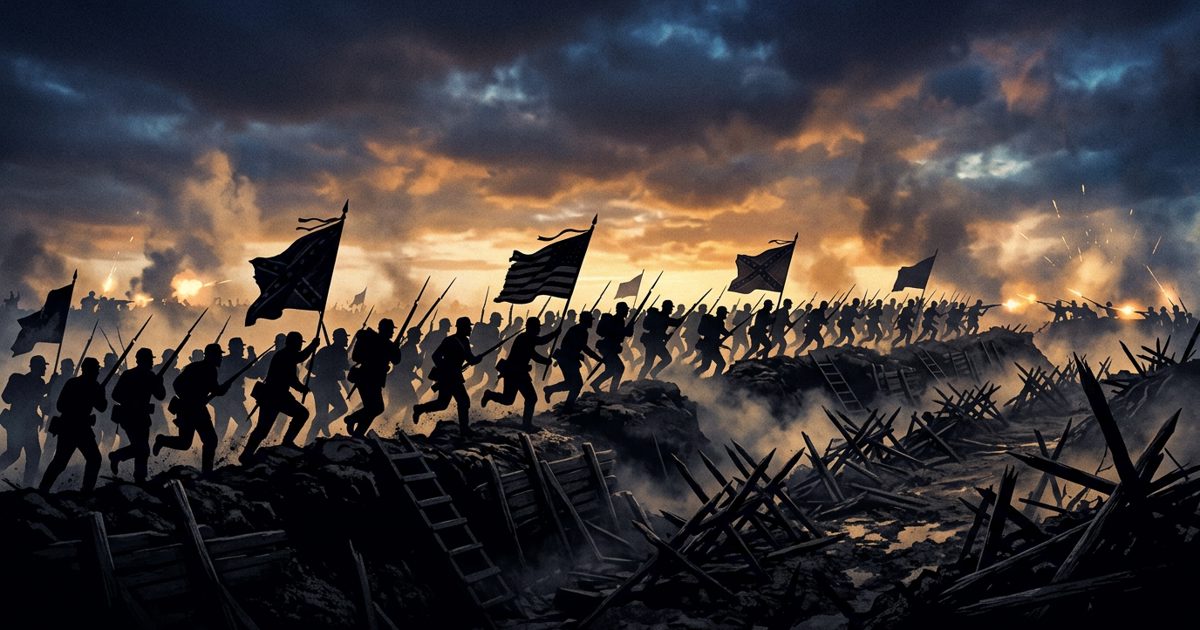
Soldiers of the Union Army of the Potomac formed into massed assault wedges under cover of pitch darkness outside the earthworks of Petersburg, Virginia. Lieutenant General Ulysses S. Grant ordered a general attack along the entrenched lines following his cavalry victory at Five Forks. Major General Horatio G. Wright positioned fourteen thousand infantrymen of the VI Corps opposite a vulnerable salient along the Boydton Plank Road defenses. Signal guns roared from Fort Fisher at four in the morning to unleash the waiting infantry into no-man's-land.

Troops rushed forward across the muddy, obstacle-strewn terrain while under heavy musketry and artillery fire. Infantrymen cleared five lines of abatis with axes and bare hands before swarming into the rifle pits. Captain Charles G. Gould of the 5th Vermont climbed the parapet first, taking severe saber and bayonet wounds while opening an entryway for his regiment. Union soldiers flooded the breaches within twenty minutes, shattering the Confederate defensive line commanded by Lieutenant General A. P. Hill.

General Robert E. Lee realized his fortified perimeter had collapsed after receiving reports of the disaster and the death of Hill in the early fighting. Messengers carried urgent warnings to Richmond, prompting Confederate president Jefferson Davis and his cabinet to abandon the Confederate capital by rail before dusk. Federal divisions severed the South Side Railroad, cutting off the last direct supply connection into Petersburg. Evacuation orders sent thirty thousand southern soldiers into a westward retreat toward Appomattox Court House.

CHRONOLOGICAL RECORD

April 2 Across U.S. Military History

8 Verified Events
1781 Continental Navy • American Revolutionary War

Frigate Alliance Captures Two British Privateers

Captain John Barry led the Continental frigate Alliance into combat against the armed British privateers Mars and Minerva in the Bay of Biscay. Continental gunners unleashed coordinated broadsides that crippled both British vessels, forcing their captains to surrender after a brief naval duel. The victory yielded two valuable merchant prizes and scores of captured crewmen for the Continental cause.

1827 U.S. Navy • Early Republic

Cornerstone Laid for Portsmouth Naval Hospital

Workers laid the official cornerstone for Building One of the naval medical facility at Portsmouth, Virginia, establishing the first permanent hospital in United States Navy history. Architect John Haviland incorporated hundreds of thousands of recycled bricks from dismantled Fort Nelson into the neoclassical structure. The hospital opened for patient admissions six years later, providing specialized medical support to thousands of sailors and Marines.

1917 Joint Service Landmark Event • World War I

Woodrow Wilson Asks Congress to Enter World War I

President Woodrow Wilson addressed a joint session of the United States Congress at eight-thirty in the evening to request a formal declaration of war against Imperial Germany. Wilson cited unrestricted German submarine warfare against American merchant shipping and the intercepted Zimmermann Telegram as unprovoked acts of aggression. Congress debated the request and approved the war resolution four days later, formally deploying American military power overseas.

1942 U.S. Navy Landmark Event • World War II

Carrier USS Hornet Sails for Tokyo Raid

Captain Marc Mitscher navigated the aircraft carrier USS Hornet out of San Francisco Bay carrying sixteen Army Air Forces B-25 Mitchell bombers lashed to its flight deck. Lieutenant Colonel James Doolittle directed eighty airmen on the covert mission, designated Special Aviation Project Number One, bound for the Japanese homeland. The secret voyage marked the first time army bombers deployed operationally from a naval carrier deck.

1945 U.S. Army Landmark Event • World War II

American Forces Cut Across Central Okinawa

Soldiers of the XXIV Army Corps drove eastward across central Okinawa, reaching the shoreline at Tobara to split the island into two distinct combat sectors. Marines of the III Amphibious Corps expanded the northern beachhead, while engineering battalions opened captured Yontan and Kadena airfields for immediate observation flights. Rapid territorial gains trapped Japanese forces within their heavily fortified southern mountain defense networks.

1951 U.S. Navy • Korean War

Navy Jet Panthers Execute First Carrier Bombing Mission

Pilots from Fighter Squadron 191 launched two Grumman F9F-2 Panther jets from the aircraft carrier USS Princeton to strike a North Korean railroad bridge near Songjin. Lieutenant Commander Ben Riley and Lieutenant Ray Hawkins flew the aircraft, each carrying one thousand pounds of bombs. The strike damaged rail spans, logging the first operational carrier-launched jet bombing sortie in naval aviation history.

1972 U.S. Air Force • Vietnam War

Air Force Electronic Warfare Aircraft Downed in Vietnam

Missile operators from the North Vietnamese Army launched an SA-2 surface-to-air missile that downed an Air Force EB-66C electronic warfare aircraft near the Demilitarized Zone. Lieutenant Colonel Iceal Hambleton ejected safely behind enemy lines, becoming the sole survivor among the six aircrew members. Hambleton evaded capture for twelve days, sparking the largest combat search-and-rescue operation of the war.

2003 U.S. Army • War in Iraq

Coalition Forces Destroy Baghdad Republican Guard Division

Bombers and ground artillery units decimated the Iraqi Republican Guard Baghdad Division south of the capital, collapsing organized resistance along the primary advance route. Army V Corps armor units pushed within fifteen miles of suburban Baghdad while securing critical highway crossings along the Tigris River. Combat operations dismantled the final organized defense ring guarding the southern approaches into the city.

NAVY CROSS ACTION 1972

Captain John Ripley Halts an Armored Assault at Dong Ha

Captain John W. Ripley faced a massive armored column of the North Vietnamese Army advancing south toward the Cua Viet River in Quang Tri Province. Intelligence reported more than twenty thousand enemy soldiers and two hundred tanks threatening to overrun friendly positions along Route 1. Captain Ripley, serving as the senior American advisor to the 3rd Vietnamese Marine Corps Infantry Battalion, recognized that the bridge at Dong Ha formed the only crossing point capable of bearing enemy armor. Pre-positioned crates holding five hundred pounds of high explosives sat near the bridge, but a security fence prevented combat engineers from reaching them.

Ripley climbed beneath the bridge girders to move the explosives into position by hand. The Marine officer swung hand-over-hand along the steel beams for three continuous hours while dodging intense enemy small-arms fire and mortar shrapnel. He crimped detonation caps with his teeth, activated the timed fuses, and dropped onto the riverbank moments before the massive detonation destroyed the central spans. The blast halted the North Vietnamese mechanized advance across the northern front, buying critical days for allied defenses to reassemble.

DAILY EMAIL BRIEFING

Get This Briefing Every Morning

Start each day with verified U.S. military history delivered to your inbox. Straightforward historical reporting covering major battles and lesser-known tactical operations.

Subscribe Below