Full Calendar
THIS DAY IN U.S. MILITARY HISTORY • APRIL 15 1986 Joint Service Cold War

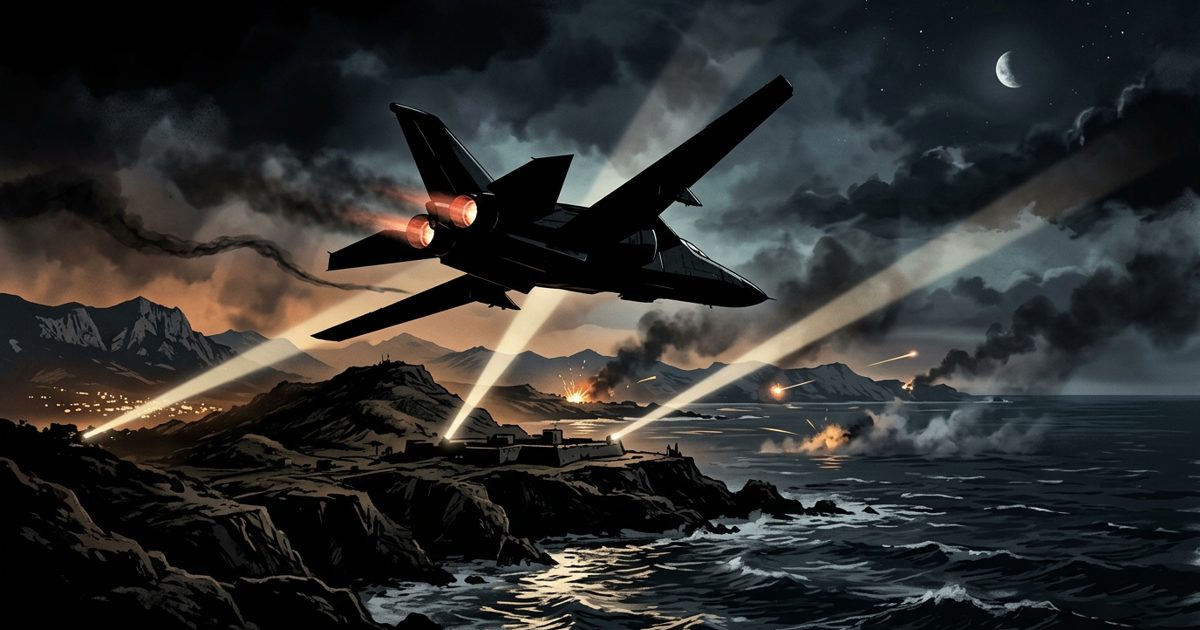
Operation El Dorado Canyon Strikes Libyan Command Targets

American strike aircraft execute a coordinated joint bombing campaign against state-sponsored terrorist targets in Tripoli and Benghazi.
Operation El Dorado Canyon Strikes Libyan Command Targets

President Ronald Reagan ordered Operation El Dorado Canyon after intelligence confirmed Libyan involvement in the West Berlin discotheque bombing that killed two American servicemen. Planners structured a joint assault combining Air Force bombers in England with carrier strike wings in the Mediterranean. Diplomatic refusals from France and Spain barred American aircraft from European airspace, forcing a six-thousand-mile detour around the Iberian Peninsula. Pilots of the 48th Tactical Fighter Wing departed RAF Lakenheath aboard twenty-four F-111F Aardvarks, relying on silent aerial refuelings to reach North Africa.

Navy EA-6B Prowlers and Air Force EF-111A Ravens jammed Libyan air defense radars across Tripoli and Benghazi at two o'clock in the morning on April 15. Carrier jets from USS America and USS Coral Sea launched anti-radiation missiles, clearing corridors for A-6E Intruders to bomb Benina Airfield. Air Force F-111Fs swept low over Tripoli, dropping laser-guided munitions onto the Bab al-Azizia military barracks and naval commando facilities. Heavy anti-aircraft fire brought down one F-111F over the Gulf of Sidra, killing Captain Fernando Ribas-Dominicci and Captain Paul Lorence.

Crews of the returning strike aircraft egressed over the Mediterranean, leaving burning facilities and damaged runways across five major Libyan bases. Reconnaissance photographs verified the destruction of five radar sites, military barracks, and seventeen Libyan combat aircraft. Air Force pilots completed their return flight around Spain, touching down at RAF Lakenheath after fourteen continuous hours aloft. Pentagon planners utilized operational data from the raid to refine joint air defense suppression tactics and long-range bomber operations.

CHRONOLOGICAL RECORD

April 15 Across U.S. Military History

8 Verified Events
1783 Continental Army Landmark Event • American Revolutionary War

Continental Congress Ratifies Preliminary Revolutionary War Peace Articles

Delegates assembled in Philadelphia voted unanimously to ratify the provisional peace treaty negotiated with Great Britain. The congressional resolution formally sanctioned the cessation of hostilities across all theaters of the American Revolution. General George Washington subsequently published orders announcing the formal armistice to the Continental Army at Newburgh, New York.

1861 U.S. Army Landmark Event • Civil War

President Lincoln Mobilizes Seventy-Five Thousand Militiamen

President Abraham Lincoln issued a presidential proclamation calling forth seventy-five thousand state militiamen for three months of federal service following the surrender of Fort Sumter. The directive mobilized Northern states to reclaim federal forts and suppress the rebellion. Several Upper South states refused the troop levy and subsequently passed ordinances of secession.

1862 U.S. Army • Civil War

Union Cavalry Clashes at Picacho Pass in Arizona

Lieutenant James Barrett led a detachment of the 1st California Cavalry into an engagement against Confederate pickets near Picacho Peak, Arizona Territory. The skirmish marked the westernmost fatal clash of the American Civil War. Union troops pushed past the defensive position and secured the overland route to Tucson.

1900 U.S. Army • Philippine-American War

Filipino Guerrillas Besiege American Infantry at Catubig

Colonel Enrique Daguhob led hundreds of Filipino fighters in a coordinated dawn attack against Company H of the 43rd Infantry Regiment at Catubig on Samar. American soldiers retreated into the town church and held off continuous assaults for four days. Relief forces aboard an armed river steamer eventually extracted the surviving defenders.

1918 U.S. Marine Corps • World War I

Marine Corps Establishes First Marine Aviation Force

Captain Alfred A. Cunningham organized the First Marine Aviation Force at Marine Flying Field in Miami, Florida. The newly formed air wing assembled four tactical squadrons to support allied ground operations in Europe. Aviators trained intensively in coastal patrol and bombing tactics before deploying to northern France later that summer.

1943 U.S. Navy • World War II

Navy Formalizes Sino-American Cooperative Organization in China

Commander Milton E. Miles signed an operational treaty establishing the Sino-American Cooperative Organization to direct unconventional warfare across Japanese-occupied China. Navy intelligence officers trained guerrilla fighters, established remote weather stations, and set up coastal surveillance networks. The joint organization supplied vital meteorological intelligence for Allied naval operations throughout the Pacific.

1945 U.S. Marine Corps • World War II

Marine Private First Class Sacrifices Life on Okinawa

Private First Class Harold Gonsalves directed artillery fire with the 15th Marines during an assault on Mount Yaetake in Okinawa. An enemy grenade landed between Gonsalves and his forward observer team as they pulled back from an exposed ridge. Gonsalves threw himself onto the explosive, absorbing the blast and earning a posthumous Medal of Honor.

1969 U.S. Navy Landmark Event • Cold War

North Korean Fighters Down Navy Reconnaissance Aircraft

North Korean MiG-21 fighters shot down an unarmed United States Navy EC-121M Warning Star over international waters in the Sea of Japan. All thirty-one crew members from Fleet Air Reconnaissance Squadron One were killed in the incident. The loss prompted the United States military to deploy carrier Task Force 71 and mandate armed fighter escorts.

MILITARY AVIATION 1952

Boeing YB-52 Stratofortress Completes Maiden Flight

Boeing test pilot Alvin Tex Johnston and Air Force Lieutenant Colonel Guy M. Townsend lifted the Boeing YB-52 prototype into the sky above Boeing Field in Seattle on April 15, 1952. Engineers had readied the second prototype ahead of the original XB-52 airframe after pneumatic ground-testing accidents damaged the first model. Eight Pratt and Whitney J57 turbojet engines mounted in paired wing pods powered the swept-wing bomber through its initial handling evaluations. Johnston kept the massive two-hundred-ton aircraft airborne for two hours and twenty-one minutes before touching down smoothly at Larson Air Force Base in central Washington.

Engineers at Larson examined the flight data recorders and confirmed that the high-altitude airframe met all essential aerodynamic stability requirements. Strategic Air Command commanders immediately accelerated procurement plans, ordering hundreds of production models to replace the aging propeller-driven Convair B-36 Peacemaker. Boeing refined the production tooling to manufacture seven hundred forty-four Stratofortress bombers across eight distinct variants over the next decade. Modernized B-52H models remain active in United States Air Force inventory more than seven decades after that initial flight.