Full Calendar
THIS DAY IN U.S. MILITARY HISTORY • APRIL 20 1945 U.S. Army World War II

American Troops Secure Leipzig and Breach Last Fortress

Soldiers of the 2nd and 69th Infantry Divisions crush the final German stronghold at the Battle of the Nations Monument in Saxony.
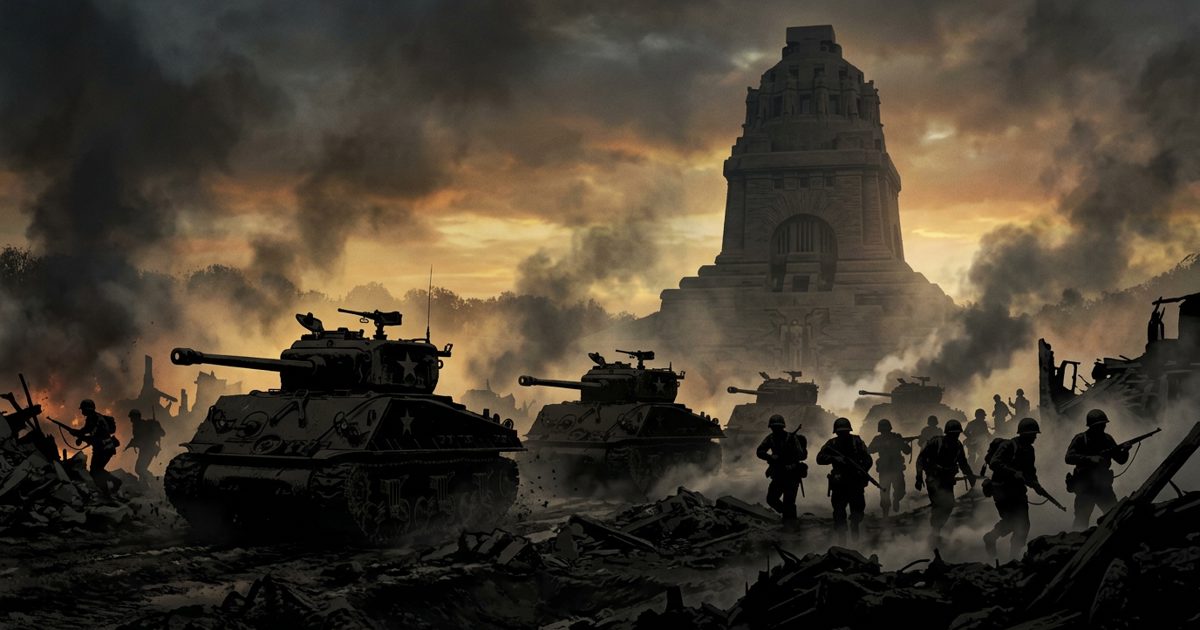
American Troops Secure Leipzig and Breach Last Fortress

Infantrymen of the U.S. Army V Corps completed the encirclement and capture of Leipzig, Germany, concluding three days of intense street fighting across the nation's fifth-largest city. Major General Clarence R. Huebner directed the assault using the 2nd Infantry Division advancing from the northwest and the 69th Infantry Division driving from the southwest. Combat teams cleared barricaded avenues, neutralized entrenched sniper nests, and bypassed demolished bridges over the Elster and Pleisse rivers. German garrison forces disintegrated as city police president Wilhelm von Grolman sought surrender terms, while diehard Nazi officials committed suicide inside the New Town Hall.

Colonel Hans von Poncet refused the municipal surrender and withdrew roughly one hundred fifty German troops into the massive Völkerschlachtdenkmal monument. This granite memorial, commemorating Napoleon's defeat in 1813, featured thick stone walls that resisted direct artillery fire and tank shells. German riflemen poured machine-gun fire through narrow architectural slits, pinning down assault companies from the 272nd Infantry Regiment and holding American captives inside the crypt. Negotiators from the 69th Infantry Division arranged a local truce to secure the release of the prisoners and prevent further casualties.

Surrender agreements took full effect at two o'clock in the morning when Colonel von Poncet marched his remaining troops out of the stone fortress. American soldiers immediately secured the monument, disarmed the garrison, and confirmed the total elimination of organized resistance across the city. Patrols subsequently established defensive sectors along the Mulde River to await the impending junction with the Soviet Red Army. General Dwight D. Eisenhower later transferred administrative control of Leipzig to Soviet occupation forces in July in accordance with Allied partition agreements established at the Yalta Conference.

CHRONOLOGICAL RECORD

April 20 Across U.S. Military History

8 Verified Events
1796 U.S. Navy Landmark Event • Early Republic

Congress Authorizes Completion of First Navy Frigates

Lawmakers approved the Naval Act of 1796, amending the original 1794 authorization to ensure the completion of three heavy frigates. Construction continued on USS Constitution, USS United States, and USS Constellation while work on three other hulls halted following a peace treaty with Algiers. These three vessels formed the permanent core of the newly established United States Navy.

1861 U.S. Navy Landmark Event • Civil War

Union Forces Burn and Evacuate Gosport Navy Yard

Sailors under Flag Officer Charles S. McCauley evacuated the federal Gosport Navy Yard in Portsmouth, Virginia, setting fire to docks and storehouses to prevent Confederate capture. Union crews scuttled multiple warships, including the steam frigate USS Merrimack. Confederate salvagers subsequently raised the sunken hull of Merrimack and rebuilt the vessel as the ironclad ram CSS Virginia.

1861 U.S. Army Landmark Event • Civil War

Robert E. Lee Resigns United States Army Commission

Colonel Robert E. Lee submitted his written resignation from the United States Army to Secretary of War Simon Cameron at Arlington House, Virginia. Lee took this step after declining an offer from Major General Winfield Scott to command the field forces of the Union Army. Virginia authorities appointed Lee commander of state military and naval forces three days later.

1898 Joint Landmark Event • Spanish-American War

McKinley Signs Joint Resolution Demanding Spanish Withdrawal

President William McKinley signed a joint congressional resolution demanding that Spain relinquish authority over Cuba and withdraw all military forces from the island. The resolution authorized the president to employ land and naval forces to enforce the decree and incorporated the Teller Amendment disclaiming American intent to annex Cuba. Spain severed diplomatic ties the following day, opening the Spanish-American War.

1942 U.S. Navy • World War II

Aircraft Carrier Wasp Ferries Spitfires to Malta

Flight crews aboard the aircraft carrier USS Wasp launched forty-seven British Supermarine Spitfire fighters off the coast of Algeria during Operation Calendar. Prime Minister Winston Churchill had requested American carrier assistance to reinforce the heavily bombed island of Malta. American sailors positioned the fighters on the flight deck and coordinated with Royal Air Force pilots to ensure forty-six aircraft arrived safely.

1944 U.S. Navy • World War II

German Torpedo Bombers Sink Destroyer Lansdale Off Algiers

Junkers Ju-88 torpedo bombers from the German Luftwaffe attacked Allied convoy UGS 38 thirty miles off Cape Bengut, Algeria, in the Mediterranean Sea. Aerial torpedoes struck the destroyer USS Lansdale on the starboard side, splitting the warship in half and sinking it. Crew members from nearby destroyer escorts USS Menges and USS Newell rescued two hundred thirty-four survivors from the water.

1945 U.S. Marine Corps • World War II

Sixth Marine Division Secures Northern Okinawa

Marines of the 6th Marine Division concluded major combat operations on the rugged Motobu Peninsula, securing the northern half of Okinawa twenty days after landing. Major General Lemuel C. Shepherd Jr. reported over two thousand two hundred enemy dead following the reduction of mountain strongholds on Mount Yae-Take. Marine units subsequently redeployed south to reinforce the Tenth Army along the Shuri Line.

1953 Joint Landmark Event • Korean War

Operation Little Switch Initiates Korean Prisoner Exchange

Ambulances carrying sick and wounded prisoners of war arrived at Panmunjom as United Nations Command and Communist forces opened Operation Little Switch. Medical personnel processed repatriated Allied soldiers on the first day, including American and British troops. This initial exchange operated for thirteen days and established the direct diplomatic path toward the signing of the Korean Armistice Agreement in July.

MEDAL OF HONOR ACTION 1967

Navy Aviator Strikes Surface-to-Air Missile Sites Over Haiphong

Lieutenant Commander Michael J. Estocin led a three-plane flight of A-4E Skyhawk attack jets from Attack Squadron 192 aboard USS Ticonderoga. Mission planners tasked Estocin with missile suppression ahead of a strike against two thermal power plants in Haiphong, North Vietnam. Hostile radar batteries locked onto the formation, prompting Estocin to warn the main strike force while diving directly into enemy air defenses. Exploding fragments from an SA-2 missile damaged his aircraft, yet he remained in the target area and neutralized three missile sites using AGM-45 Shrike missiles.

Fuel streamed from his damaged fuselage, leaving Estocin with less than five minutes of reserves as he turned toward open water. Estocin linked with an airborne tanker and took on fuel until three miles behind the carrier. Landing on his first attempt with his fuel tanks nearly exhausted, he brought the crippled jet safely onto the flight deck. President Jimmy Carter presented the Medal of Honor to Estocin's family in 1978 in recognition of his actions over Haiphong.