Full Calendar
THIS DAY IN U.S. MILITARY HISTORY • APRIL 21 1914 U.S. Navy Mexican Revolution

Bluejackets and Marines Storm Ashore at Veracruz

Rear Admiral Frank Friday Fletcher orders naval landing parties to seize Mexican port facilities and intercept a German munitions shipment.
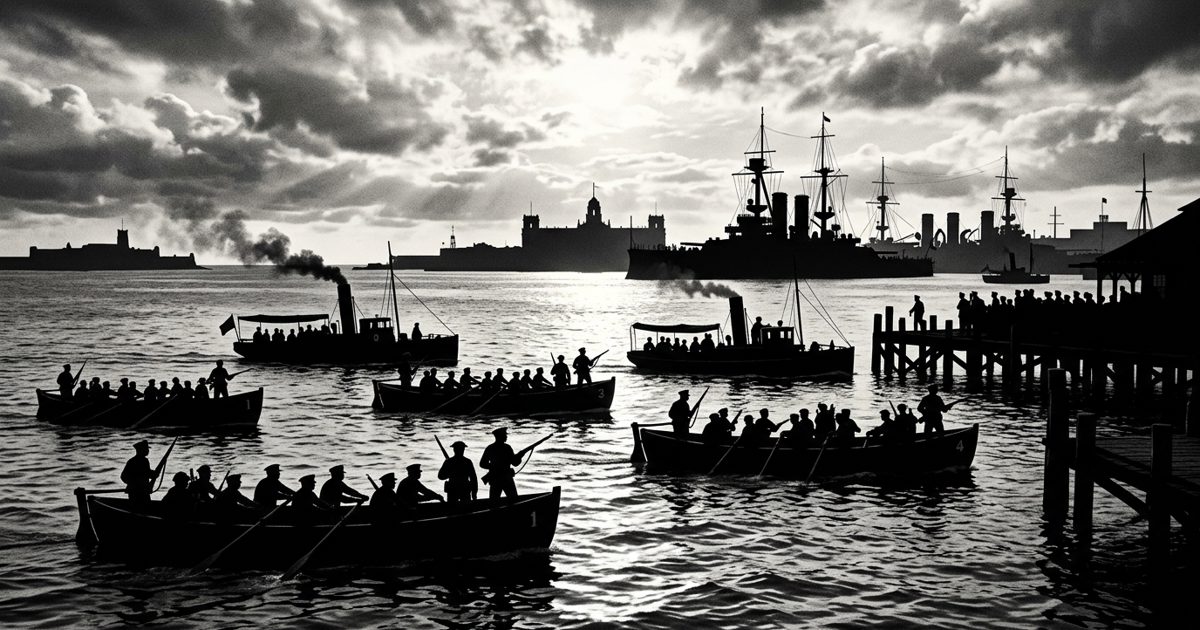
Bluejackets and Marines Storm Ashore at Veracruz

Rear Admiral Frank Friday Fletcher received urgent orders from Secretary of the Navy Josephus Daniels before dawn instructing him to seize the customs house at Veracruz, Mexico. Intelligence confirmed that the German merchant steamer Ypiranga was steaming toward the harbor carrying thousands of Mauser rifles and millions of rounds of ammunition destined for Mexican General Victoriano Huerta. Fletcher assembled a landing brigade composed of five hundred Marines from the transport Prairie and nearly three hundred naval bluejackets from the battleship Florida under Captain William Rees Rush. Whaleboats towed by steam launches ferried the American assault elements across the harbor to Pier Four shortly after eleven o'clock in the morning.

Bluejackets and Marines stepped onto the waterfront wharves and immediately advanced into the city center toward the customs house, post office, and telegraph terminal. Snipers from local militia units and cadets from the Mexican Naval Academy opened fire from rooftops and fortified upper windows of the Terminal Hotel. Sailors deployed machine guns along the docks while Marines formed skirmish lines to suppress the hostile positions. Ensign Edward Orrick McDonnell established a signal station on the exposed roof of the Terminal Hotel, directing naval gunfire support and ship-to-shore communications while absorbing continuous rifle fire.

Gunfire subsided as American detachments cleared the customs warehouse and severed rail links leading inland toward Mexico City. Navy crews aboard the auxiliary cruiser Prairie and approaching battleships dispatched reinforcements ashore to secure the waterfront perimeter before nightfall. Dockworkers and federal officials found their ammunition transport blocked when Navy boarding parties prevented the Ypiranga from offloading her European cargo. American forces held the harbor at a cost of four sailors killed and twenty wounded during the opening day, initiating an occupation that lasted seven months.

CHRONOLOGICAL RECORD

April 21 Across U.S. Military History

9 Verified Events
1862 U.S. Navy • Civil War

Ironclad Gunboat USS Galena Enters Service

Commander Alfred Taylor placed the experimental ironclad steamer USS Galena into commission at Mystic, Connecticut. Built with interlocking iron rail armor over an oak hull, the warship departed for the James River to support Union Army operations on the Virginia Peninsula. The vessel joined the North Atlantic Blockading Squadron to challenge Confederate fortifications protecting Richmond.

1898 U.S. Navy Landmark Event • Spanish-American War

Navy Begins Blockade of Cuban Ports

President William McKinley ordered Rear Admiral William T. Sampson to deploy the North Atlantic Fleet to establish a naval blockade around western Cuba. Warships steamed out of Key West to intercept Spanish supply vessels and isolate colonial garrisons. Congress subsequently declared that a state of war had officially existed between the United States and Spain from this date.

1918 U.S. Army • World War I

Yankee Division Reoccupies Seicheprey Trenches

Soldiers of the 102nd Infantry Regiment, 26th Division, launched counterattacks to recapture devastated trench positions around the French village of Seicheprey. German assault troops had bombarded the American sector with twenty thousand gas shells the previous morning before seizing forward redoubts. Heavy American artillery barrages forced the raiding German stormtroopers to withdraw back to their jump-off lines.

1944 U.S. Navy Landmark Event • World War II

Task Force Fifty-Eight Strikes Hollandia Airfields

Admiral Marc A. Mitscher directed carrier task groups to bomb Japanese airstrips and gun emplacements across northern New Guinea. Navy dive-bombers and fighter sweeps neutralized enemy air facilities at Hollandia, Wakde, and Sarmi. These strikes eliminated Japanese aerial resistance immediately prior to the amphibious landings of Operation Reckless.

1945 U.S. Army Landmark Event • World War II

Soldiers Secure Iegusuku Peak on Ie Shima

Infantrymen of the 77th Infantry Division raised the American flag over the summit of Iegusuku Peak after five days of relentless mountain fighting. Soldiers assaulted fortified Japanese caves and concrete pillboxes across the rocky slopes using satchel charges and flamethrowers. Securing the island provided Allied forces with vital runways to support the ongoing Okinawa campaign.

1950 U.S. Navy • Cold War

Navy Launches Atomic Bomber from Coral Sea

Captain John T. Hayward completed the first carrier takeoff of a North American AJ-1 Savage from the flight deck of USS Coral Sea. Weighing over seventeen tons, the twin-piston, single-turbojet aircraft represented the Navy's first carrier-capable heavy attack bomber engineered to deliver nuclear weapons. The successful launch validated carrier-based strategic nuclear strike capability.

1951 U.S. Marine Corps • Korean War

Marine Corsairs Down Three North Korean Fighters

Pilots of Marine Fighter Squadron 312 flying Vought F4U-4 Corsairs scored their service's first carrier-based aerial victories over Korea. Captain Philip C. DeLong destroyed two North Korean Yak-9 fighters, while his wingman First Lieutenant Harold D. Daigh destroyed a third near Chinnampo. The Marine aviators operated from the light carrier USS Bataan while escorting reconnaissance flights.

1967 U.S. Marine Corps • Vietnam War

Gary Wayne Martini Earns Medal of Honor

Private First Class Gary Wayne Martini assaulted an entrenched enemy trench line across an open rice paddy near Binh Son during Operation Union. After hurling grenades to silence hostile automatic weapons, Martini crawled through heavy fire to drag two wounded Marines to safety. Mortally wounded during the second rescue, he held his position until his comrades reached cover.

1975 U.S. Air Force Landmark Event • Vietnam War

Air Force Transports Begin Emergency Saigon Airlift

Lockheed C-130 Hercules crews accelerated emergency evacuation flights from Tan Son Nhut Air Base as North Vietnamese divisions surrounded Saigon. Airmen flew nearly six hundred American citizens and endangered South Vietnamese personnel out of the capital following the collapse of the defensive perimeter at Xuan Loc. These transport missions preceded the final helicopter evacuation of Operation Frequent Wind.

MEDAL OF HONOR ACTION 1945

Second Lieutenant Daniel Inouye Attacks Colle Musatello

Lieutenant Daniel K. Inouye led his infantry platoon of Company E, 442nd Regimental Combat Team, in a frontal assault against a fortified ridge near San Terenzo, Italy. German defenders held Colle Musatello with three entrenched machine-gun bunkers guarding a vital road junction. Inouye crawled up the steep slope through interlocking fields of fire and tossed two grenades within five yards of the first bunker, destroying its crew. Fire from a second position erupted immediately, and Inouye neutralized it with his submachine gun before organizing his riflemen to clear the surrounding trenches.

Enemy snipers concentrated their fire on Inouye as he advanced against the final bunker, striking him in the abdomen and shattering his right arm with a rifle grenade. Inouye transferred his live grenade into his left hand, threw it into the remaining hostile slit trench, and continued directing his men until the ridge was secured. Medical corpsmen evacuated the lieutenant only after the defensive junction fell, resulting in the amputation of his right arm. President Bill Clinton formally presented Inouye with the Medal of Honor in June 2000 following an extensive military review of Asian American valor records.

DAILY EMAIL BRIEFING

Get This Briefing Every Morning

Start each day with verified U.S. military history delivered to your inbox. Straightforward historical reporting covering major battles and lesser-known tactical operations.

Subscribe Below