Full Calendar
THIS DAY IN U.S. MILITARY HISTORY • APRIL 26 1865 U.S. Army Civil War

Sherman Receives the Largest Confederate Surrender at Bennett Place

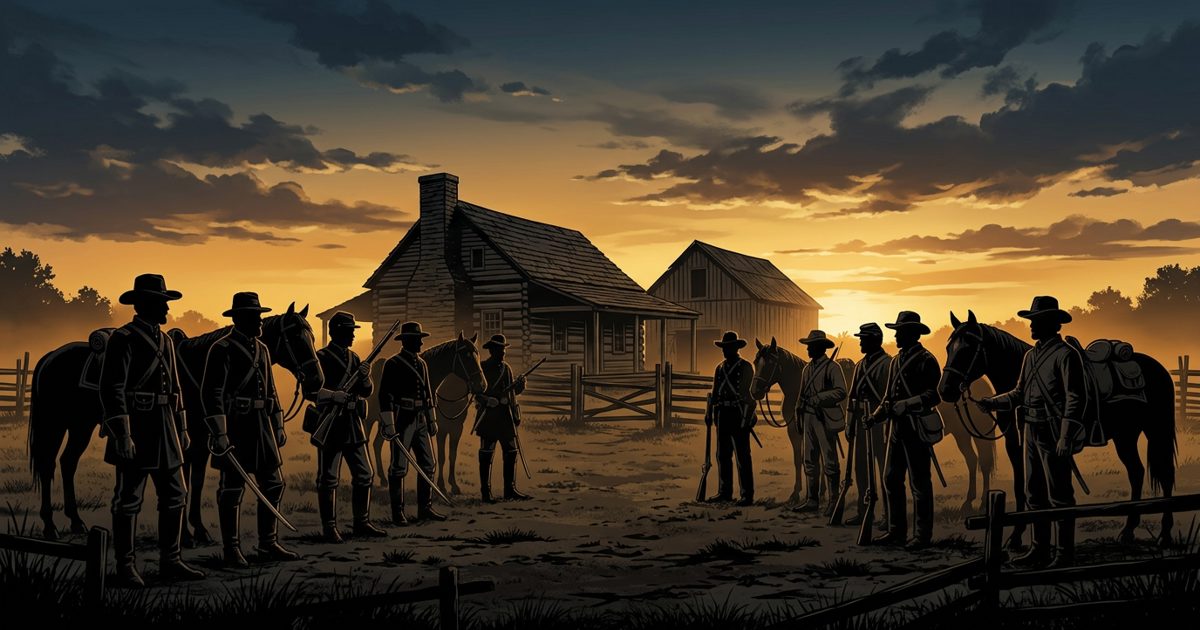
Major General William Tecumseh Sherman accepts the capitulation of General Joseph E. Johnston and eighty-nine thousand Confederate soldiers near Durham Station in 1865.
Sherman Receives the Largest Confederate Surrender at Bennett Place

General William Tecumseh Sherman rode out from Raleigh toward the modest wooden farmhouse of James Bennitt on April 26, 1865, to settle the military fate of the remaining Confederate forces in the East. Nine days earlier, the two commanders had drafted a broad political agreement, but federal authorities in Washington promptly rejected those terms following the assassination of President Abraham Lincoln. Secretary of War Edwin Stanton directed Sherman to demand immediate military capitulation on the identical terms granted to the Army of Northern Virginia at Appomattox. General Joseph E. Johnston, having defied orders from Confederate President Jefferson Davis to scatter his infantry into guerrilla bands, returned to the bargaining table to prevent further bloodshed across the South.

Negotiations resumed inside the small sitting room as both commanders recognized that continued resistance offered no strategic advantage to the dying rebellion. General John M. Schofield drafted the operational articles of convention, granting paroled soldiers safe passage home and permitting officers to retain their sidearms and personal horses. Sherman approved Schofield's terms and authorized the distribution of two hundred and fifty thousand field rations to feed Johnston's starving ranks. Johnston affixed his signature to the military convention, formally yielding command of all Confederate forces stationed across North Carolina, South Carolina, Georgia, and Florida.

Signatures on the agreement completed the largest troop surrender of the American Civil War, disbanding eighty-nine thousand two hundred and seventy Confederate soldiers. Union quartermasters established central parole stations at Greensboro to process the surrendering units and issue travel passes. Field artillery batteries and thousands of muskets were turned over to Federal ordnance officers while artillery horses were distributed to rural veterans for spring plowing. Johnston issued his farewell order to his soldiers six days later, closing organized military combat across the eastern theater.

CHRONOLOGICAL RECORD

April 26 Across U.S. Military History

9 Verified Events
1777 Continental Army • American Revolutionary War

British Forces Sack Continental Depots in Danbury

Continental Army supply storehouses in Danbury burned on April 26, 1777, after eighteen hundred British and Loyalist troops marched inland under Major General William Tryon. Outnumbered militia detachments withdrew to safeguard transportable munitions while invading forces destroyed fifteen hundred tents, flour reserves, and ordnance. American couriers rode through the night to alert regional militia units, setting up the sharp confrontation at Ridgefield the following day.

1805 U.S. Marine Corps Landmark Event • First Barbary War

Marines Deliver Surrender Demands at Derna

Lieutenant Presley O'Bannon and diplomatic envoy William Eaton completed a five-hundred-mile desert march, halting outside the fortified port of Derna on April 26, 1805. Eaton delivered a formal summons demanding immediate capitulation, which Governor Mustafa Bey rejected outright. Three American warships anchored in the harbor to coordinate land and naval bombardments scheduled for the following morning.

1862 U.S. Army • Civil War

Union Forces Secure Fort Macon Harbor Defenses

Brigadier General John G. Parke formally received the surrender of Fort Macon on April 26, 1862, following an eleven-hour artillery barrage that breached the brick masonry bastion. Four hundred Confederate defenders capitulated after Union Parrott rifled guns shattered their powder magazines. Possession of the stronghold secured Beaufort Harbor as a permanent coaling station for Union blockading squadrons.

1865 U.S. Army Landmark Event • Civil War

Union Cavalry Corners Presidential Assassin John Wilkes Booth

Troopers from the 16th New York Cavalry surrounded a tobacco barn near Port Royal, Virginia, trapping fugitive John Wilkes Booth in the early morning darkness of April 26, 1865. Sergeant Boston Corbett fired his revolver through an opening between the wooden slats, fatally wounding the assassin. Federal soldiers carried Booth onto the farm porch where he died hours later.

1872 U.S. Army • Indian Wars

Buffalo Bill Leads Cavalry Action at Loup Fork

Scout William F. Cody guided Company B of the 3rd U.S. Cavalry during a pursuit of hostile Miniconjou Lakota raiders across Nebraska on April 26, 1872. Cody located the encampment along the Loup River and led cavalry troopers in an aggressive morning attack. Soldiers secured stolen livestock while Cody earned the Medal of Honor for conspicuous field gallantry.

1944 U.S. Navy • World War II

USS Jack Devastates Imperial Army Troop Convoy

Commander Thomas Dykers guided the submarine USS Jack into firing position off northwestern Luzon, attacking the heavily guarded Japanese Take Ichi troop convoy on April 26, 1944. Torpedoes detonated against the freighter Yoshida Maru No. 1, sinking the vessel in minutes and killing over twenty-six hundred enemy reinforcements. Escorting destroyers counterattacked with depth charges but failed to locate the American submarine.

1945 U.S. Army Landmark Event • World War II

Allied Formations Liberate Mountain Bastion of Baguio

Soldiers of the 33rd and 37th Infantry Divisions joined Filipino guerrillas to capture the northern mountain city of Baguio on April 26, 1945. Allied infantry battered through fortified roadblocks and ridgelines to seize General Tomoyuki Yamashita's former Luzon headquarters. Surviving Japanese defenders retreated farther into the rugged Sierra Madre mountains to make an isolated last stand.

1952 U.S. Navy Landmark Event • Cold War

Night Flight Collision Sinks Destroyer USS Hobson

Aircraft carrier USS Wasp sliced through the destroyer-minesweeper USS Hobson during night flight recovery operations in the North Atlantic on April 26, 1952. Hobson turned across the carrier's bow and broke in half within minutes, resulting in the deaths of one hundred and seventy-six sailors. Rescue crews from nearby escort ships managed to pull sixty-one survivors from icy waters.

1967 U.S. Navy • Vietnam War

Commander Michael Estocin Attacks Haiphong Surface Missiles

Lieutenant Commander Michael John Estocin piloted his A-4E Skyhawk against heavily defended surface-to-air missile installations near Haiphong on April 26, 1967. Shrapnel from an exploding missile set his aircraft ablaze, but he maintained control to launch anti-radiation missiles into the battery before his jet crashed. Naval authorities posthumously awarded Estocin the Medal of Honor for extraordinary courage under fire.

MILITARY AVIATION 1944

Lieutenant Carter Harman Flies the First Combat Helicopter Rescue

Harman piloted an experimental Sikorsky YR-4B helicopter across hundreds of miles of jungle to reach four stranded Allied servicemen behind Japanese lines in Burma. Technical Sergeant Ed Hladovcak had crash-landed an L-1 liaison plane while evacuating three wounded British soldiers from a remote combat zone. Harman staged through forward airstrips and touched down in a jungle clearing on April 25, 1944, shuttling the first two casualties to a river sandbar before extreme engine temperatures forced an overnight halt.

Harman restarted the engine at dawn on April 26, 1944, and flew back into the clearing to rescue the third British soldier. He returned immediately on a fourth sortie to extract Hladovcak just as Allied Chindit troops emerged from the jungle brush. Four separate flights completed the first rotary-wing combat rescue in military history, demonstrating that helicopters could extract wounded personnel from deep within hostile territory. Harman's successful sorties laid the operational foundation for modern military search and rescue aviation.