Full Calendar
THIS DAY IN U.S. MILITARY HISTORY • APRIL 27 1805 U.S. Marine Corps Early Republic

Marines Assault Fortified Derna on the Shores of Tripoli

Lieutenant Presley O'Bannon and William Eaton led a grueling desert march and amphibious assault to capture the Tripolitan stronghold.
Marines Assault Fortified Derna on the Shores of Tripoli

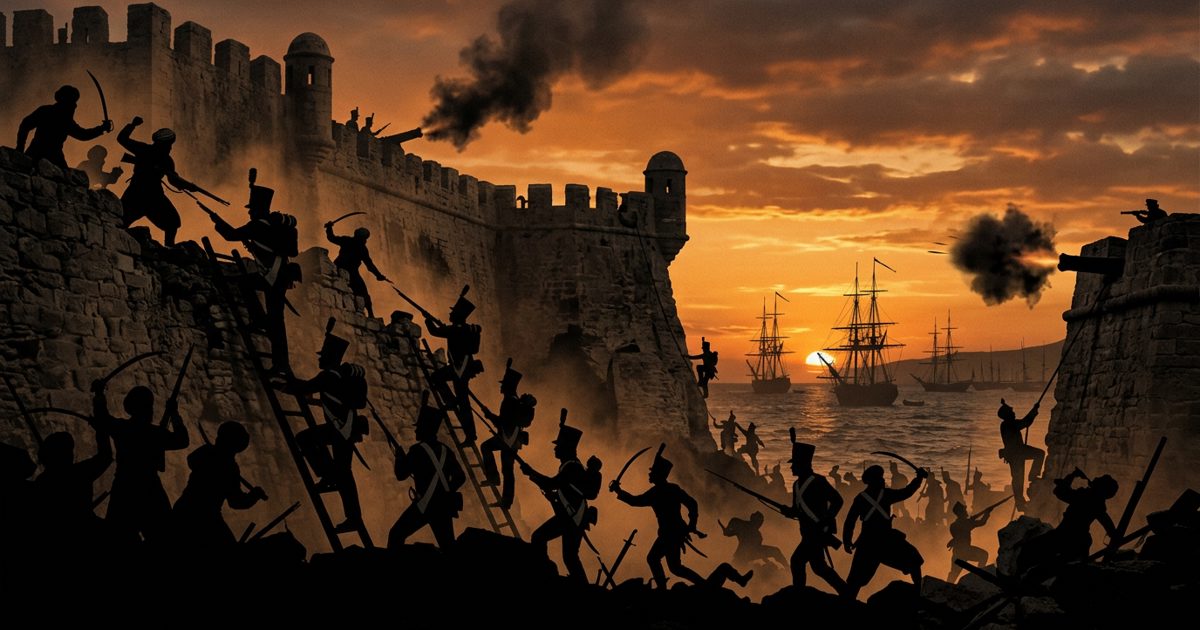
Lieutenant Presley O'Bannon led seven United States Marines and several hundred European and Arab mercenaries out of the Libyan desert toward the fortified port of Derna. Envoy William Eaton coordinated the overall expedition after marching over five hundred miles across North Africa to reinstall exiled Pasha Hamet Karamanli. Tripolitan defenders commanded by Mustafa Bey refused Eaton's summons to surrender, declaring that their heads would fall before the city opened its gates. American warships USS Argus, USS Hornet, and USS Nautilus anchored in harbor waters offshore and opened fire with heavy naval cannons against the city's coastal batteries.

Gunfire from the three vessels shattered the harbor batteries and cleared defensive strongpoints along the seaside ramparts. Eaton ordered his land forces forward under covering fire from the ships, sending Hamet's cavalry against the governor's palace while O'Bannon assaulted the main harbor fortification. Musket volleys struck the advancing Marine column as enemy riflemen fired from behind stone rooftops and courtyard parapets. O'Bannon charged through the breach alongside his squad of Marines and twenty-six Greek mercenaries, driving enemy fighters from their gun positions with fixed bayonets.

Marines quickly turned the captured cannons against the city center, breaking Tripolitan resistance across the harbor district. O'Bannon lowered the enemy banner and raised the American flag above the battery ramparts, marking the first time the United States flag flew in victory on foreign soil. Victory at Derna forced Yusuf Karamanli to enter peace negotiations and release three hundred American sailors held captive from the frigate USS Philadelphia. Eaton and his Marines held the captured fortress through several counterattacks until diplomats concluded a formal peace treaty in June.

CHRONOLOGICAL RECORD

April 27 Across U.S. Military History

8 Verified Events
1813 U.S. Army Landmark Event • War of 1812

American Forces Capture Fort York in Upper Canada

Brigadier General Zebulon Pike commanded American infantry during an amphibious assault on York, present-day Toronto. Landing troops drove back British regulars and Canadian militia before seizing the defensive fortifications. Pike died alongside dozens of soldiers when retreating British forces detonated their central gunpowder magazine.

1861 Joint Service Landmark Event • Civil War

Lincoln Authorizes Suspension of Habeas Corpus

President Abraham Lincoln directed General Winfield Scott to suspend the writ of habeas corpus along military transit corridors between Philadelphia and Washington. Troop movements faced severe disruptions from secessionist rioters in Maryland. Scott enforced military detentions to safeguard strategic rail routes and telegraph lines supplying the national capital.

1864 U.S. Navy • Civil War

Union Flotilla Runs Cane River Ambush

Admiral David Dixon Porter led gunboats through heavy Confederate shore fire near Deloach's Bluff at the junction of the Cane and Red rivers. Rebel batteries battered USS Cricket and disabled USS Juliet with direct artillery hits. Porter maneuvered his vessels past the ambush site, linking with downstream ironclads to secure the fleet's passage to Alexandria.

1865 U.S. Army Landmark Event • Civil War

Steamship Sultana Explodes on the Mississippi River

Boilers exploded aboard the paddle-wheeler Sultana north of Memphis while carrying thousands of newly released Union prisoners of war. Soldiers paroled from Andersonville and Cahaba prisons struggled in icy river currents amid severe overcrowding. Over eleven hundred soldiers perished, producing the deadliest maritime disaster in American history.

1899 U.S. Army • Philippine-American War

Kansas Volunteers Swim Calumpit River Under Fire

Privates Edward White and William Trembley swam across the Rio Grande de Pampanga under intense insurgent fire at Calumpit. Both soldiers carried a tow line to the fortified enemy bank and secured a ferry rope. Their action enabled American forces to raft across the river and capture insurgent entrenchments, earning both men the Medal of Honor.

1944 U.S. Navy • World War II

Allied Forces Launch Exercise Tiger Assault Rehearsals

Soldiers of the VII Corps initiated full-scale amphibious landing drills at Slapton Sands in Devon, England. Naval convoys carried thousands of troops across Lyme Bay to simulate Normandy beach assaults with live artillery support. Training maneuvers continued through the day, preceding a tragic German torpedo boat attack that struck follow-up convoys that night.

1945 U.S. Army Landmark Event • World War II

Seventh Army Liberates Kaufering Concentration Camps

Soldiers of the 12th Armored Division crossed the Lech River and entered the Kaufering concentration camp complex near Landsberg. American forces discovered thousands of emaciated prisoners and uncovered widespread Nazi atrocities across multiple subcamps. Army medical personnel immediately set up emergency triage stations to treat starving survivors.

1972 U.S. Air Force Landmark Event • Vietnam War

Air Force Phantoms Strike Thanh Hoa Bridge

Pilots of the 8th Tactical Fighter Wing flying F-4 Phantoms attacked the Dragon's Jaw bridge across the Song Ma River. Crews released Paveway laser-guided bombs, scoring direct hits that knocked the bridge's western span off its concrete abutment. Precision munitions accomplished severe structural damage that hundreds of unguided bombing sorties had failed to inflict.

INTELLIGENCE AND RECONNAISSANCE 1953

Operation Moolah Offers Bounties for Defecting Soviet Jets

General Mark Clark authorized Operation Moolah to secure an intact Soviet Mikoyan-Gurevich MiG-15 jet fighter through psychological warfare. Military radio transmitters in Japan and South Korea broadcast appeals across North Korea and China offering fifty thousand dollars to any pilot who delivered an undamaged jet. Broadcasters promised political asylum, personal protection, and an extra fifty thousand dollar bonus to the first pilot who surrendered an aircraft. American B-29 Superfortress bombers dropped over one million informational leaflets printed in Korean, Russian, and Chinese above communist airfields along the Yalu River.

Intelligence reports revealed that Soviet commanders temporarily grounded frontline squadrons to screen flight crews for ideological loyalty. North Korean pilot Lieutenant No Kum-Sok subsequently defected with his MiG-15 to Kimpo Air Base near Seoul following the armistice. Test pilots, including Major Chuck Yeager, evaluated the captured fighter at Kadena Air Base to assess enemy flight performance against American F-86 Sabres. Flight evaluations provided valuable aerodynamic data that confirmed American aircraft retained superior maneuverability at high altitudes.