Full Calendar
THIS DAY IN U.S. MILITARY HISTORY • DECEMBER 29 1812 U.S. Navy War of 1812

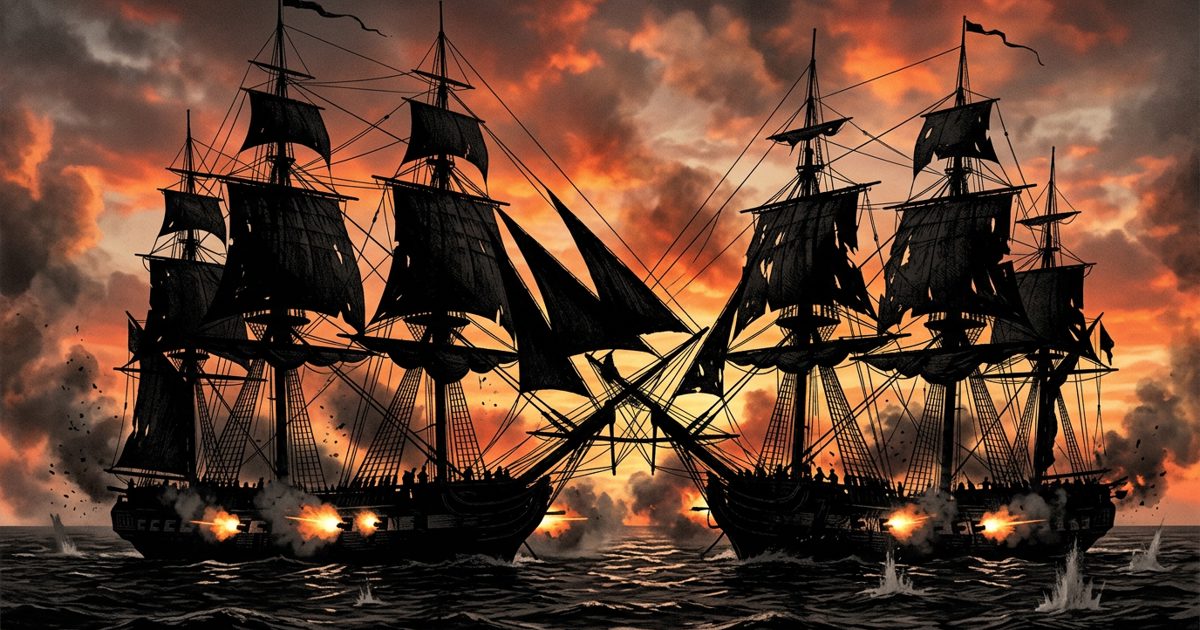
USS Constitution Defeats HMS Java off Brazil

Commodore William Bainbridge commands the American frigate through a fierce four-hour duel in the South Atlantic, dismantling a Royal Navy adversary and asserting American naval strength.
USS Constitution Defeats HMS Java off Brazil

Lookouts aboard USS Constitution sighted two sails off the coast of Salvador, Brazil, prompting Commodore William Bainbridge to alter course toward the larger vessel. Captain Henry Lambert commanded HMS Java, a captured French-built 38-gun British frigate carrying over four hundred men and dispatches for the East Indies. Java closed the distance and maneuvered aggressively to gain the weather gauge before unleashing heavy broadsides. British cannon shot shattered Constitution's wheel and mortally wounded four helmsmen, leaving Bainbridge struck in the thigh by copper shrapnel.

Bainbridge refused to leave the quarterdeck and directed crewmen down to the berth deck to steer the rudder directly using emergency block-and-tackle gear. American gun crews exploited the frigate's thick live-oak hull to absorb British cannonballs while delivering destructive 24-pounder solid shot into Java's spars and rigging. Lambert attempted to salvage the battle by ramming Constitution to send boarding parties onto the American deck. American musket and cannon fire dismasted Java's foremast during the approach and struck Lambert down with a fatal chest wound.

Lieutenant Henry Ducie Chads assumed command of the crippled British frigate but found every mast gone and dozens of guns disabled. Constitution drew off to repair severed rigging before sweeping back into a lethal raking position across Java's bow, compelling Chads to strike his colors. Bainbridge paroled the surviving British prisoners and ordered Java burned because the shattered hull could not survive the voyage to an American port. Java's magazine exploded two days later, and the British Admiralty responded to the defeat by ordering its frigate captains never to engage American heavy frigates in single-ship actions.

CHRONOLOGICAL RECORD

December 29 Across U.S. Military History

8 Verified Events
1778 Continental Army Landmark Event • American Revolutionary War

British Expeditionary Force Captures Savannah

Lieutenant Colonel Archibald Campbell landed British infantry at Girardeau's Plantation and outflanked Major General Robert Howe's Continental and militia defenders. Enslaved guide Quamino Dolly led British troops through an unguarded swamp trail, surprising the American rear. Howe lost over four hundred men captured and abandoned Savannah, initiating the British southern campaign.

1862 U.S. Army Landmark Event • American Civil War

Confederate Defenses Repulse Sherman at Chickasaw Bayou

Major General William T. Sherman launched frontal infantry assaults against Confederate positions entrenched along the bluffs north of Vicksburg, Mississippi. Confederate artillery and rifle fire under Lieutenant General John C. Pemberton devastated advancing Union brigades in the muddy bayous. Sherman suffered over seventeen hundred casualties, forcing Ulysses S. Grant to abandon his direct overland approach to Vicksburg.

1890 U.S. Army Landmark Event • Indian Wars

Seventh Cavalry Encircles Lakota at Wounded Knee

Troopers of the 7th U.S. Cavalry opened fire with carbines and Hotchkiss revolving cannons while attempting to disarm Miniconjou Lakota followers under Chief Spotted Elk along Wounded Knee Creek. Gunfire erupted during a scuffle, resulting in the deaths of more than two hundred Lakota men, women, and children alongside twenty-five soldiers. The engagement ended major armed conflict on the northern plains.

1940 U.S. Armed Forces Landmark Event • World War II Era

President Roosevelt Announces Arsenal of Democracy Policy

President Franklin D. Roosevelt delivered his national security radio address urging American industry to mobilize for defense production. Roosevelt warned that the United States faced grave peril from Axis expansion and pledged massive military manufacturing to supply allied democracies fighting overseas. The policy established the logistical foundation for equipping millions of American troops and global allies during World War II.

1941 U.S. Army Coast Artillery Corps • World War II

Japanese Bombers Strike Fort Mills on Corregidor

Bombers of the Japanese navy and army conducted their first major aerial raid against Fort Mills on Corregidor Island, dropping sixty tons of high explosives on harbor installations. Antiaircraft batteries of the 60th Coast Artillery Regiment engaged the incoming formations with three-inch guns, downing multiple enemy aircraft. Soldiers and Marines rapidly cleared burning wreckage and moved ammunition to deep tunnel networks.

1942 U.S. Navy • World War II

Submarine USS Thresher Attacks Enemy Freighter

Commander William J. Millican brought the submarine USS Thresher into action against the Japanese cargo ship Haichan Maru in the Java Sea. Thresher surfaced after midnight and scored eight consecutive hits with her five-inch deck gun, halting the vessel after an attempted ramming maneuver. A final torpedo sent the damaged merchantman to the bottom.

1944 U.S. Navy • World War II

Kamikaze Strikes Target Mindoro Resupply Convoy

Pilots flying Japanese kamikaze missions harassed Allied Task Group 77.11 as the resupply convoy fought through the Sulu Sea toward Mindoro. Naval gunners and escorting aircraft engaged incoming waves of suicide planes and torpedo bombers while destroyer USS Edwards scuttled the crippled LST-750. Transports pressed through the contested waters to deliver essential aviation fuel and supplies to newly captured airfields.

1972 U.S. Air Force Landmark Event • Vietnam War

Strategic Air Command Concludes Operation Linebacker II

Bombers of Strategic Air Command completed the final sorties of Operation Linebacker II, striking rail yards and supply depots around Hanoi and Lang Dang. North Vietnamese delegates agreed to resume formal peace negotiations in Paris, prompting President Richard Nixon to halt bombing north of the twentieth parallel. The twelve-day offensive paved the way for the Paris Peace Accords and the repatriation of American prisoners.

MILITARY AVIATION 1939

Maiden Flight of the Consolidated XB-24 Liberator

Chief test pilot William Wheatley climbed into the cockpit of the prototype Consolidated XB-24 at Lindbergh Field in San Diego, California, to conduct the bomber's maiden flight. Consolidated Aircraft designed the four-engine heavy bomber under company designation Model 32 after the U.S. Army Air Corps sought an airframe offering greater speed, range, and payload than the Boeing B-17. Engineer David R. Davis developed the aircraft's distinctive high-aspect-ratio shoulder wing, which generated high lift with low parasitic drag across long distances. Wheatley lifted the heavy prototype, bearing serial number 39-556, off the runway for a seventeen-minute evaluation over southern California.

Engineers used data from that initial flight to refine the aircraft's supercharged engines, twin-tail rudders, and deep bomb bays. Production lines across five major manufacturing facilities ultimately built over eighteen thousand Liberator bombers between 1940 and 1945. The aircraft served with the U.S. Army Air Forces and U.S. Navy in every combat theater of World War II, flying strategic bombardment, antisubmarine patrols, and long-range cargo missions.