Full Calendar
THIS DAY IN U.S. MILITARY HISTORY • FEBRUARY 10 1862 U.S. Navy American Civil War

Union Flotilla Annihilates Confederate Mosquito Fleet at Elizabeth City

Commander Stephen C. Rowan leads fourteen gunboats up the Pasquotank River to destroy Confederate naval power across Albemarle Sound in 1862.
Union Flotilla Annihilates Confederate Mosquito Fleet at Elizabeth City

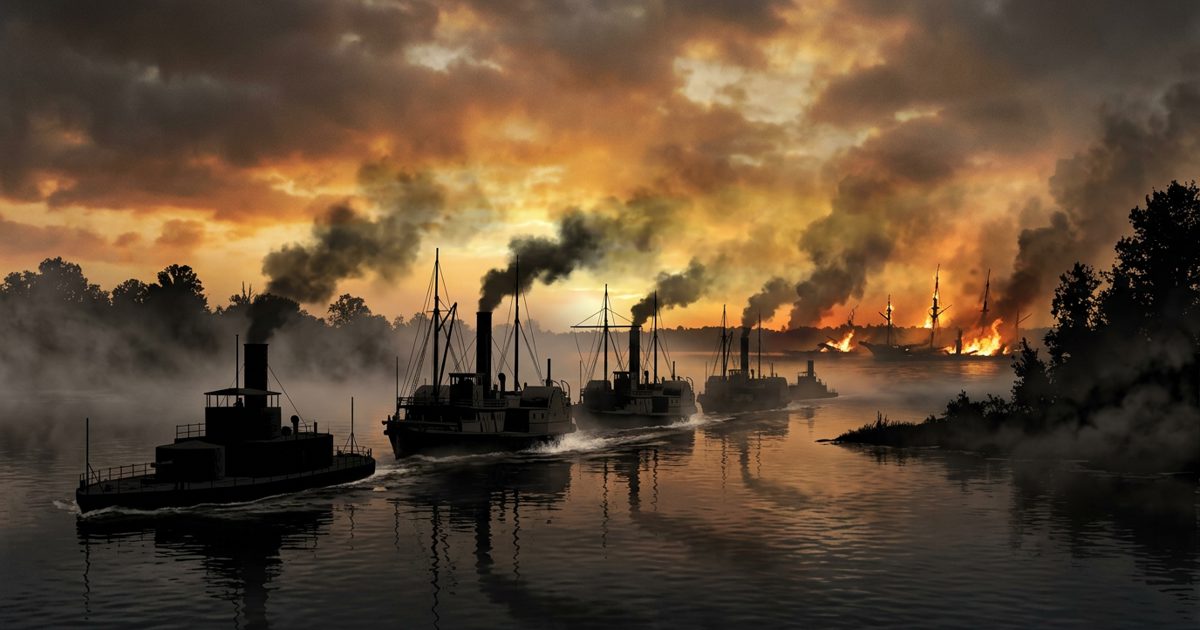
Commander Stephen C. Rowan steered fourteen federal gunboats up the Pasquotank River on the morning of February 10, 1862. His flotilla had just helped capture Roanoke Island, but his ships carried only twenty artillery rounds per cannon. Rowan knew that waiting to resupply would allow Confederate Flag Officer William F. Lynch time to strengthen his defenses. He assembled his captains aboard the flagship USS Delaware and ordered an aggressive charge. Federal gunboats would ignore shore batteries, ram the enemy vessels, and fight hand to hand.

Lookouts spotted the Confederate defensive line near Cobb Point, where a four-gun shore battery guarded six armed steamers and a schooner. Confederate artillerists fired as the federal flotilla approached, but their shells fell short. Rowan refused to waste powder at long range and ordered his steamers forward at full throttle. Federal gunboats surged past the fortification before the rebel gunners could adjust their aim. The paddle-wheeler USS Commodore Perry struck the flagship CSS Sea Bird amidships, crushing its wooden hull and sending it to the bottom.

Flames engulfed the remaining Confederate ships as their crews torched several vessels to prevent capture. Union sailors from USS Underwriter and USS Ceres boarded the armed tug CSS Ellis, subduing its defenders and taking thirty-four prisoners. Confederate sailors destroyed three other gunboats, leaving only two damaged craft to escape toward Norfolk. Federal landing parties dismantled the battery at Cobb Point and took possession of Elizabeth City. Rowan secured total naval control of Albemarle Sound, shutting down the Dismal Swamp Canal and cutting a major Confederate supply route to Virginia.

CHRONOLOGICAL RECORD

February 10 Across U.S. Military History

8 Verified Events
1899 U.S. Army Landmark Event • Philippine-American War

Eighth Army Corps Storms Caloocan Outside Manila

Major General Arthur MacArthur Jr. launched an assault against five thousand entrenched Filipino soldiers at Caloocan following naval bombardment from the protected cruiser USS Charleston and monitor USS Monadnock. Regiments from Kansas and Montana charged through burning perimeter trenches, seizing rail rolling stock. The victory extended American defensive lines north of Manila.

1940 U.S. Coast Guard • World War II Era

Coast Guard Cutters Establish Atlantic Ocean Weather Stations

Coast Guard cutters Bibb and Duane took up designated maritime coordinates in the North Atlantic to establish the Atlantic Weather Observation Service under presidential directive. Crews transmitted surface meteorological readings and launched instrumented weather balloons every six hours. Their data provided vital navigation and safety tracking for transatlantic military flights.

1944 U.S. Army • World War II

Allied Ground Forces Conclude Saidor Operation

Lieutenant General Walter Krueger declared the official conclusion of Operation Dexterity following the amphibious landing at Saidor in Papua New Guinea. Soldiers of the 32nd Infantry Division linked patrols with advancing Australian infantry along the coast. The linkup trapped thousands of retreating Japanese troops and secured vital ground for Allied airfields.

1945 U.S. Navy Landmark Event • World War II

Fast Carrier Task Force Fifty-Eight Departs Ulithi

Vice Admiral Marc A. Mitscher led sixteen aircraft carriers, eight battleships, and dozens of cruisers and destroyers out of Ulithi Atoll toward the Japanese home islands. Carrier air groups prepared to strike airfields around Tokyo before supporting the amphibious assault on Iwo Jima. The sortie launched the first carrier raids on mainland Japan since 1942.

1945 U.S. Navy • World War II

Submarine Batfish Destroys Imperial Japanese Submarine

Commander John K. Fyfe steered the submarine USS Batfish into Babuyan Channel off northern Luzon, detecting a surfaced Japanese submarine on radar. Batfish launched a spread of torpedoes, scoring a direct hit that blew the enemy vessel apart. This engagement marked the first of three Japanese submarines Batfish sank within seventy-six hours.

1951 U.S. Army Landmark Event • Korean War

Eighth Army Advance Reaches Han River South of Seoul

General Matthew B. Ridgway directed I Corps and IX Corps forward divisions to seize commanding heights along the southern bank of the Han River during Operation Punch. Reconnaissance patrols from the 25th Infantry Division eliminated enemy outposts, placing American artillery within bombardment range of Seoul. The advance stabilized the western front.

1962 U.S. Air Force Landmark Event • Cold War

Reconnaissance Pilot Gary Powers Exchanged on Glienicke Bridge

Negotiators completed the exchange of captured Air Force and Central Intelligence Agency U-2 pilot Francis Gary Powers at the Glienicke Bridge between West Berlin and Potsdam. American officials released convicted Soviet spy Rudolf Abel across the checkpoint line. The diplomatic swap ended twenty-one months of Soviet captivity for Powers.

1970 U.S. Army • Vietnam War

Specialist John Baca Shields Platoon from Grenade Blast

Specialist Fourth Class John Philip Baca moved forward with his recoilless rifle team from the 12th Cavalry Regiment to support an ambushed patrol near Quan Loi. Enemy fire pinned down the unit before a fragmentation grenade landed in their midst. Baca covered the explosive with his helmet and body, absorbing the blast and saving eight men.

MILITARY AVIATION 1945

Lieutenant Louis Curdes Downs Friendly Transport to Prevent Enemy Capture

Lieutenant Louis E. Curdes of the 4th Fighter Squadron patrolled over Japanese-occupied Batan Island on February 10, 1945. His flight spotted an American Douglas C-47 Skytrain descending toward the hostile enemy runway. Poor visibility had pushed the transport far off course on its flight from Leyte. Curdes attempted radio warnings, but the crew did not respond. He knew the passengers faced execution or harsh imprisonment if the plane touched down.

Curdes dived his P-51D Mustang behind the transport and fired his machine guns, knocking out both engines with precise bursts. The disabled C-47 ditched into the ocean three hundred yards offshore, where all twelve passengers and crew deployed life rafts. Curdes circled overhead to protect the survivors until nightfall, then guided a PBY Catalina rescue plane back to the site the next morning. Army Air Forces commanders awarded Curdes the Distinguished Flying Cross for saving the passengers and crew.