Chinese Fourth Phase Offensive Strikes Support Force 21 at Hoengsong
Chinese infantry divisions struck American artillery and armor units in central Korea during the winter counteroffensive of 1951.
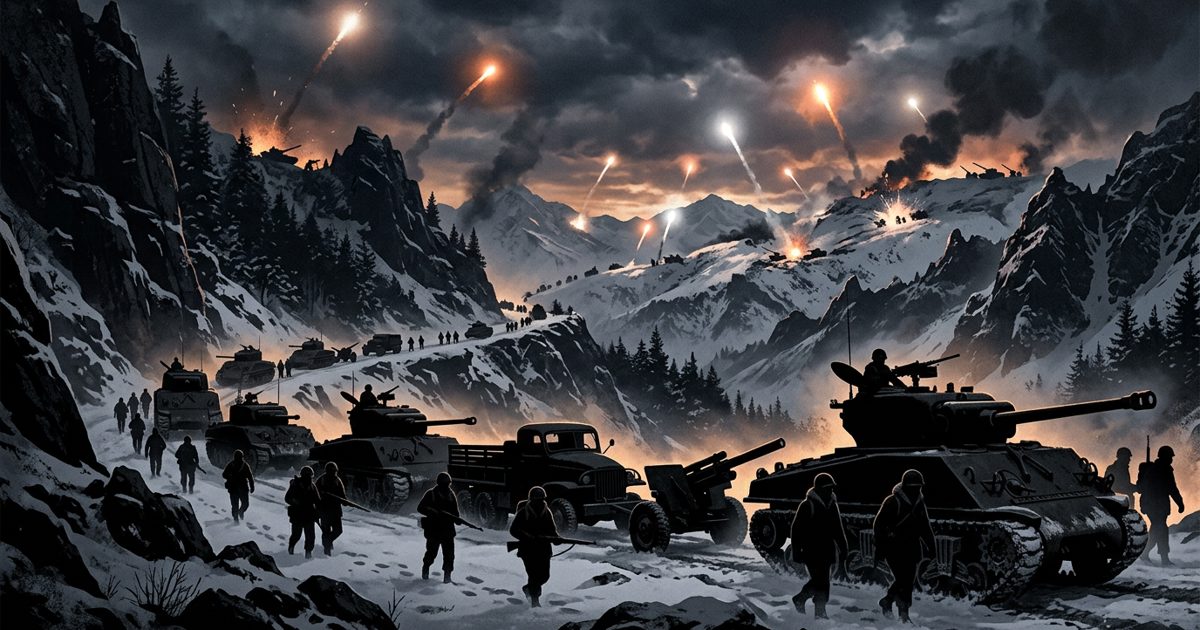
Bugles echoed across the frozen ridges north of Hoengsong as three Chinese infantry divisions launched a massive night assault against United Nations positions. Soldiers of the Chinese 39th, 40th, and 66th Armies struck the front lines of the Republic of Korea 8th Infantry Division, collapsing its defenses within hours. Behind the crumbling infantry screen sat Support Force 21, an American artillery and armor formation built around the 15th Field Artillery Battalion and the 38th Infantry Regiment of the 2nd Infantry Division. Gunners suddenly found themselves directly exposed to enemy assault forces infiltrating down the mountain ridges. Communist troops quickly established machine-gun roadblocks along the single narrow road winding south through the mountain valley.
Trucks and artillery tractors stalled in the darkness as enemy machine-gun fire raked the trapped withdrawal column. American artillerymen severed towing cables, fired their 105mm howitzers over open sights at charging infantry, and fought hand-to-hand with carbines and bayonets. Colonel John S. Coughlin ordered the remaining armor and infantry to clear the blocked road passes, but intense mortar fire destroyed the lead vehicles. Infantrymen from the Dutch Battalion held the road junction at Hoengsong itself, battling infiltrating enemy units to keep the escape corridor open for survivors. Hundreds of American soldiers fell or suffered capture along the route, which soldiers later named Massacre Valley.
Survivors reached friendly lines at Wonju the following morning, bringing news of the severe losses suffered by the field artillery battalions. General Matthew Ridgway immediately mobilized the 23rd Infantry Regiment and the French Battalion to fortify the critical road hub at Chipyong-ni to the west. American commanders regrouped the battered units of the 2nd Infantry Division into defensive lines, preventing the Chinese offensive from rupturing the entire Eighth Army front. Heavy fighting at Hoengsong cost the United Nations forces nearly two thousand American casualties and fifteen hundred South Korean losses, but the delay allowed United Nations command to halt the enemy offensive.