Full Calendar
THIS DAY IN U.S. MILITARY HISTORY • FEBRUARY 12 1988 U.S. Navy Cold War

Cold War Clash in the Black Sea

Two American warships endure deliberate ramming by Soviet frigates while defending freedom of navigation off Crimea in 1988.
Cold War Clash in the Black Sea

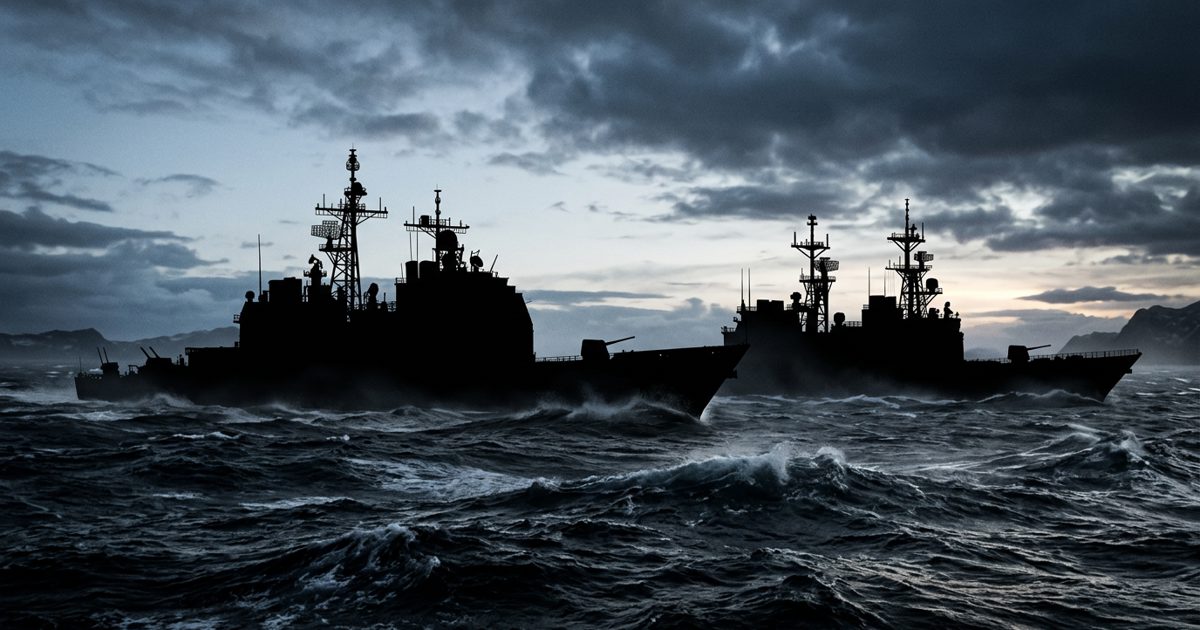
Cruiser USS Yorktown and destroyer USS Caron entered the Black Sea to exercise international rights of innocent passage off the Crimean coastline. American commanders directed the two vessels past the naval base at Sevastopol within the twelve-mile territorial boundary claimed by Moscow. Soviet regulations attempted to restrict innocent passage for foreign warships to narrow commercial sea lanes, whereas international law recognized the right of innocent passage throughout territorial waters without prior notification. Soviet naval headquarters responded by dispatching two warships to shadow and intercept the American detachment.

Captain Vladimir Bogdashin steered the Krivak-class frigate Bezzavetnyy alongside Yorktown while the smaller patrol frigate SKR-6 flanked Caron. Soviet radio operators broadcast warnings demanding that both American vessels vacate territorial waters immediately or face direct physical ramming. Neither American vessel changed course or answered the ultimatum, holding speed at ten knots along a preplanned navigational track. Both Soviet captains then turned their rudders sharply into the American hulls to shoulder the foreign warships out of the zone.

Bridge crews on Yorktown braced for impact as Bezzavetnyy struck the port quarter of the cruiser at frame four hundred fifty-six, shearing off its own starboard anchor and tearing open two American Harpoon missile canisters. Seconds later, SKR-6 scraped down the port side of Caron, peeling paint along sixty feet of the hull of the destroyer. Both American vessels maintained their defensive posture without uncapping weapons or returning fire, methodically clearing Soviet-claimed waters two hours later. The collision prompted bilateral diplomatic negotiations that resulted in the 1989 Uniform Interpretation of Rules of International Law Governing Innocent Passage.

CHRONOLOGICAL RECORD

February 12 Across U.S. Military History

8 Verified Events
1862 U.S. Army Landmark Event • Civil War

Union Forces Open the Siege of Fort Donelson

General Ulysses S. Grant marched his army overland from Fort Henry to surround Confederate fortifications at Fort Donelson on the Cumberland River. Ironclad gunboat USS Carondelet arrived along the waterway to support the encirclement, firing the opening naval bombardment against rebel earthworks. Grant positioned fifteen thousand Union troops along the defensive perimeter to begin the siege.

1935 U.S. Navy Landmark Event • Interwar Period

Rigid Airship USS Macon Lost off Point Sur

Airship USS Macon crashed into the Pacific Ocean off Point Sur, California, after severe turbulence sheared away its upper tail fin. Crew members abandoned ship as the damaged dirigible lost helium and settled into the water, with eighty-one of the eighty-three men on board rescued by nearby Navy ships. The disaster ended the United States Navy rigid airship program.

1942 U.S. Navy Landmark Event • World War II

Battleship USS Nevada Refloated at Pearl Harbor

Navy salvage crews successfully refloated the battleship USS Nevada, which had been intentionally beached at Waipio Point after sustaining heavy bomb and torpedo damage during the Pearl Harbor raid. Workers installed temporary wooden patches and pumped thousands of tons of seawater out of flooded compartments to restore buoyancy. The salvage operation allowed tugs to move the dreadnought into dry dock for extensive repairs that returned her to frontline combat service in World War II.

1944 Joint Service Landmark Event • World War II

Eisenhower Receives Directive for Operation Overlord

Commanders of the Combined Chiefs of Staff issued Directive 304/12 to General Dwight D. Eisenhower in London. The formal order appointed Eisenhower as Supreme Allied Commander of the Allied Expeditionary Force and directed him to invade Western Europe. Planners used this authorization to finalize operational command structures for the upcoming Normandy amphibious landings.

1945 U.S. Army • World War II

Sergeant Deleau Earns the Medal of Honor

Sergeant Emile Deleau Jr. led his infantry squad through fierce house-to-house fighting in Oberhoffen, France. He attacked four fortified positions, neutralizing two machine gun nests and capturing ten enemy soldiers before falling to hostile fire while defending his men. Deleau received the Medal of Honor posthumously for his single-handed actions against enemy strongpoints.

1951 U.S. Army • Korean War

Sergeant Long Stands Alone on Hill 300

Sergeant Charles Richard Long defended an exposed forward observation post on Hill 300 near Hoengseong, Korea. He called in accurate mortar strikes to cover his withdrawing company as hundreds of hostile infantry swarmed his perimeter. Long continued throwing grenades and firing his carbine until an overwhelming assault mortally wounded him, earning the Medal of Honor posthumously.

1968 U.S. Marine Corps • Vietnam War

Marines Land to Reinforce the Hue Citadel

Marines from the 1st Battalion, 5th Marines deployed into the imperial Citadel of Hue via landing craft along the Huong River. Battalion commander Major Robert Thompson positioned his rifle companies and M48 Patton tanks around the outer walls to reinforce South Vietnamese defenders. The arrival bolstered allied strength before renewed street fighting against entrenched North Vietnamese forces.

1973 U.S. Air Force Landmark Event • Vietnam War

Operation Homecoming Begins Repatriation of POWs

Transports from the Military Airlift Command landed at Gia Lam Airport in Hanoi to begin the repatriation of American prisoners of war. Forty returning service members boarded a C-141 Starlifter on the first flight to Clark Air Base in the Philippines. The flight initiated Operation Homecoming, which ultimately brought five hundred ninety-one American military and civilian personnel home.

WEAPONS AND TECHNOLOGY 1947

Pioneering the Submarine Guided Missile Launch

USS Cusk surfaced off Point Mugu, California, to conduct an unprecedented missile experiment. Crew members emerged onto the deck to prepare a Republic-Ford JB-2 Loon, an American adaptation of the German pulse-jet flying bomb mounted to an aft launch ramp. Engineers ignited the solid-fuel rocket boosters during the morning test. The pulse-jet roared to life, launching the missile into sustained flight over the Pacific test range.

Submarine officers tracked the Loon from the control room below deck, verifying that a naval vessel could deploy unmanned guided weapons at sea. This historic firing proved the concept of submarine-launched cruise missiles and led the Navy to redesignate Cusk as the first guided missile submarine in 1948. Navy planners incorporated the lessons learned from the Loon into subsequent weapon systems, including the nuclear-capable Regulus cruise missile. Testing continued through the early 1950s until vertical ballistic missile submarines superseded surface-launched cruise missiles.