Full Calendar
THIS DAY IN U.S. MILITARY HISTORY • FEBRUARY 15 1898 U.S. Navy Spanish-American War Era

The Catastrophic Destruction of USS Maine in Havana Harbor

The second-class battleship exploded at its mooring in Cuba, killing two hundred sixty-six American sailors and sparking the Spanish-American War.
The Catastrophic Destruction of USS Maine in Havana Harbor

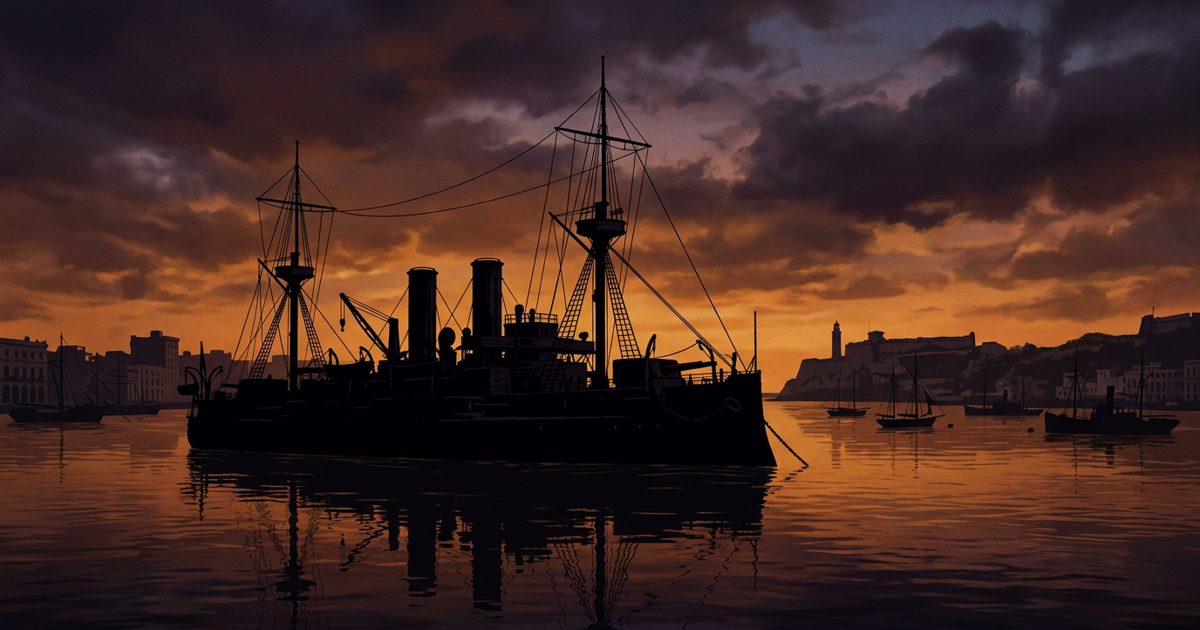
Captain Charles Sigsbee sat writing a letter at his cabin desk aboard USS Maine at twenty past nine at night. The armored second-class battleship swung gently at anchor at Buoy Number 4 in Havana Harbor, having deployed to protect American citizens during unrest against Spanish colonial rule. Terrific explosions shook the forward section of the warship with immense force twenty minutes later. Five tons of powder charges inside the forward magazines detonated almost simultaneously, tearing the bow into mangled steel fragments. Fireballs roared into the night sky while heavy debris rained over the surrounding waters.

Seawater rushed into the gaping rents along the shattered keel, pulling the twisted wreckage down into thirty feet of mud. Most of the crew of three hundred fifty-four officers and men were sleeping below decks in berths directly above the detonated ammunition stores. Surviving sailors crawled through suffocating smoke and twisted bulkheads to reach the open stern deck before the vessel settled. Lifeboats from the Spanish cruiser Alfonso XII and the civilian steamship City of Washington pushed through the burning debris to pull survivors from the harbor. Rescuers saved eighty-eight men, but two hundred sixty-six American sailors and Marines lost their lives.

Investigators led by Captain William T. Sampson convened a formal court of inquiry to determine the cause of the disaster. The Sampson board concluded the following month that an exterior mine had exploded beneath the keel and triggered the magazines. American newspapers published the findings widely, inflaming public sentiment against Spain and popularizing demands for military retribution. Congress voted for armed intervention, prompting President William McKinley to order a naval blockade and declare war in late April 1898. The conflict ended Spanish colonial rule in the Caribbean and Pacific, establishing the United States as a global naval power.

CHRONOLOGICAL RECORD

February 15 Across U.S. Military History

8 Verified Events
1862 U.S. Army Landmark Event • Civil War

Grant Repels Confederate Breakout Attempt at Fort Donelson

Confederate infantry under Brigadier General Gideon Pillow struck the Union right flank in a surprise dawn assault to open an escape route toward Nashville. Major General Ulysses S. Grant rallied disordered Union divisions, halted the Confederate breakout, and counterattacked to reclaim the lost perimeter. Grant maneuvers trapped twelve thousand Confederate troops inside the fort, forcing their unconditional surrender the next day.

1943 U.S. Army • World War II

Combat Command C Strikes German Panzers at Sidi Bou Zid

Colonel Robert Stack led Combat Command C of the 1st Armored Division in an armored counterattack against German forces near Sidi Bou Zid, Tunisia. German Panzer units and concealed anti-tank guns ambushed the American column, destroying dozens of Sherman tanks and repelling the relief thrust. The heavy tactical defeat forced American commanders to pull back their defensive lines toward Kasserine Pass.

1944 U.S. Army Air Forces Landmark Event • World War II

Heavy Allied Bombing Destroys Historic Monte Cassino Abbey

Bombers from the Twelfth and Fifteenth Air Forces dropped nearly six hundred tons of high-explosive bombs on the Abbey of Monte Cassino in central Italy. Formations of B-17 Flying Fortresses and B-25 Mitchells reduced the hilltop monastery to rubble in support of stalled ground forces. German paratroopers quickly occupied the ruins, converting the stone wreckage into a formidable defensive fortress.

1945 U.S. Army • World War II

Amphibious Forces Land at Mariveles on Bataan Peninsula

Soldiers of the 151st Infantry Regimental Combat Team went ashore at Mariveles Harbor on the southern tip of the Bataan Peninsula. Supported by naval gunfire from Seventh Fleet destroyers and continuous air strikes, the troops secured the port facilities against scattered Japanese resistance. The landing established a vital staging base and artillery position for the airborne assault on Corregidor the next morning.

1951 U.S. Army Landmark Event • Korean War

Task Force Crombez Breaks Chinese Encirclement at Chipyong-ni

Tanks of Task Force Crombez smashed through Chinese road blocks along Route 24 to reach the besieged 23rd Regimental Combat Team at Chipyong-ni. The combined American and French defenders had repelled relentless human-wave assaults across three nights of bitter close-quarters fighting. The armored breakthrough shattered the offensive strength of three Chinese divisions, securing a major tactical victory that blunted the communist winter offensive.

1954 Joint Landmark Event • Cold War

United States and Canada Approve Arctic Radar Network

Diplomats from Canada and the United States formally concluded an agreement to construct the Distant Early Warning Line across the Arctic frontier. The defensive network established dozens of radar stations spanning northern Alaska and Canada to detect incoming Soviet long-range bombers. Construction crews and military engineers quickly mobilized to deploy electronic surveillance equipment across thousands of miles of frozen terrain.

1968 U.S. Marine Corps • Vietnam War

Marines Storm the Dong Ba Tower Inside Hue Citadel

Leathernecks of 1st Battalion, 5th Marines assaulted entrenched North Vietnamese positions at the Dong Ba Gate tower inside the Citadel of Hue. Backed by M48 tanks and artillery, the riflemen cleared enemy strongpoints in house-to-house fighting under heavy rocket fire. Marine squads scaled the crumbling ramparts and secured the tower by late afternoon, breaking a major enemy redoubt.

1991 U.S. Air Force • Persian Gulf War

Captain Todd Sheehy Downs Iraqi Helicopter With Warthog Cannon

Captain Todd Sheehy piloted his Fairchild Republic A-10A Thunderbolt II on an armed reconnaissance mission over southern Iraq. Vectored by an airborne warning aircraft toward an unidentified low-flying target, Sheehy intercepted an Iraqi Mil Mi-8 transport helicopter moving near the desert floor. Sheehy rolled his aircraft into a steep dive and destroyed the helicopter with a burst from his 30mm Avenger cannon.

MEDAL OF HONOR ACTION 1944

Lieutenant Nathan Gordon Rescues Downed Airmen at Kavieng Harbor

Lieutenant Nathan Green Gordon flew his Consolidated PBY-5 Catalina flying boat on air-sea rescue alert over the Bismarck Sea. Japanese shore batteries at Kavieng Harbor had shot down several Army Air Forces bombers during an assault against enemy shipping. Gordon answered distress calls and piloted his amphibious patrol craft directly into the enemy harbor under heavy fire. High ocean swells battered the seaplane as the crew pulled three wet, injured aviators aboard.

Gordon made three additional water landings across the harbor to rescue twelve more stranded airmen from floating debris and rubber rafts. Japanese coastal artillery pounded the water around the overloaded aircraft, puncturing hull seams and soaking the interior. Mechanics manned machine guns while Gordon applied full throttle into crashing waves to lift twenty-four men safely airborne. Gordon received the Medal of Honor for executing four distinct water rescues in point-blank range of enemy guns.